Professional in residence Douglas Miller talks about Regent University’s cinematography and advanced directing courses and how students find their voices.
StudentFilmmakers Magazine drops in on Regent University to find out what’s new on campus. Professional in Residence Douglas Miller talks about Regent University’s Cinematography and Advanced Directing Courses, and shares his top three tips on filming in foreign countries.
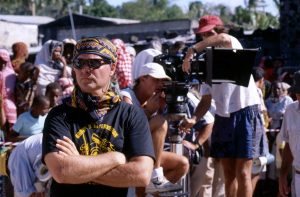
Douglas Miller has over 35 years experience in television and film production, including writing, directing, staging, lighting and photographing in studios and on location. Doug’s experience has taken him around the globe shooting in over a dozen foreign countries. He has lit large-scale multi-camera productions as well as single cam 2-man shoots. His film experience includes 35mm and 16mm, commercial and theatrical release as well as documentary. Whether hanging from an ultra light or bobbing in the ocean, Doug goes to whatever lengths necessary to get the shot.
What’s new at Regent University?
Douglas Miller: First thing that comes to mind is that we have added two new faculty, but that is only an obvious sign of some major reflection and evaluation. We have spent some time looking at what has been working, what hasn’t and where the industry and world is going. We recently concluded a review of our curriculum to find areas that need revising and areas that need strengthening. We are still story centered but as the tools change we are changing how we teach these tools and how we handle them. Our focus is the student and allowing them to have a foundation that provides the understanding and flexibility to adapt to the next generation of tools.
Francis Ford Coppola, Steven Soderbergh, David Lynch have all issued challenges to rethink the very stories we are telling in light of these new tools that we have at our finger tips. This generation of filmmakers that are currently coming through school have their own unique stories that need to be told and exciting new tools to tell them with. We are here to help them find their voices and develop the skills and abilities to bring their stories to their audience.
Could you tell us a little bit about Regent University’s Cinematography and Advanced Directing Courses?
Douglas Miller: On an undergraduate level the Cinematography class is designed to give the student a broad understanding of cameras and their use. But I take a problem solving approach; filmmaking is a problem solving activity and cameras and lights [Lighting is a separate course] are tools to help us solve those problems. They are our brushes or chisels if you look at it as painting or sculpture. On the graduate level we take this a step further and look at cinema as a language and the student is developing their individual voice. Through mastery of the tools and practice they become eloquent and able to express themselves in a subtle and effective way.
Could you tell us about some of the newer technologies that Regent University has incorporated into their Cinema-Television Department?
Douglas Miller: We have begun our migration to tapeless production. We have equipment broken into tiers; access to the tiers depends on classes taken and then the top tier is for large projects. Tier two is primarily tapeless and tier three is completely tapeless. Rather than investing in one top shelf camera such as the Red, we have chosen to put more cameras in more hands. But that is not to say that we won’t, if the funding is available, look at that option in the future. We spend a good deal of time looking at and talking about all the tools available including film.
We still have several 16mm film cameras and use them from time to time. I use the film cameras every semester I teach cinematography, because I believe that they are a great way to teach the mindset and discipline necessary to be a professional production person. If you approach HD or Ultra High Def with the same care you would approach film you will make much better projects.
There is no magic camera or tool; all are good in some circumstances and bad in others. Picking the right tool for the right project is essential. People get hung up on individual elements, shooting 24p, this or that lens, this or that camera, a particular filter. I constantly say it is not the tool but the hand the tool is in that matters. In the end is the audience moved? Did the technical get in the way of the story or support the story? Nothing separates bad films from great films more than indulgent filmmakers missing the point and thinking they are cool because of some gimmick.
What is your teaching philosophy?
Douglas Miller: I am a filmmaker. I have a disease it is called production and I am contagious. I am not sure I can teach anyone anything but I know that I learned and I can guide you in your journey. I feel like I am a back country guide, I know the forest and love it and can help you travel along the way. This causes me to have conversations rather than lecture. I make presentations and structure the semester to make sure we make it to our destinations, but each class and each semester is different because the students are different and have different needs and goals. I am as much a student as anyone and I am learning every day. My attention span is short, I get bored easily, that is why I love production, new problems to solve all the time.
I believe in asking questions. Questions directed at the student, at myself, about everything. Some of the questions have answers, some of those I know the answers before I ask, some questions the answers need to be worked out. But living in the questions is an essential part of how I work. www.regent.edu/acad/schcom/undergrad/cinema-tv.htm “Tip number one is relax. If you relax and try not to force your timetable you can see actually where you are and how you can work with those around you. They are people and you must treat them with dignity, you must listen to them, and not “use” them to achieve “your” goals.
“Tip number two. Prepare, do your homework, know what you have to do and anticipate possible issues and solutions. But be creative and flexible in the details in order to achieve the main goals. Remember what is in front of you might be far better than what you planned but you won’t be able to access it if you don’t see it. “Tip number three. Focus on the major points and let the minor things slip away. You went there for a reason keep that in mind and make sure it shows on screen! And relax.
Keep learning filmmaking
Want more lessons like this? Join StudentFilmmakers free for live webinars with working pros, and stream on-demand filmmaking classes in cinematography, directing, screenwriting, sound and post.