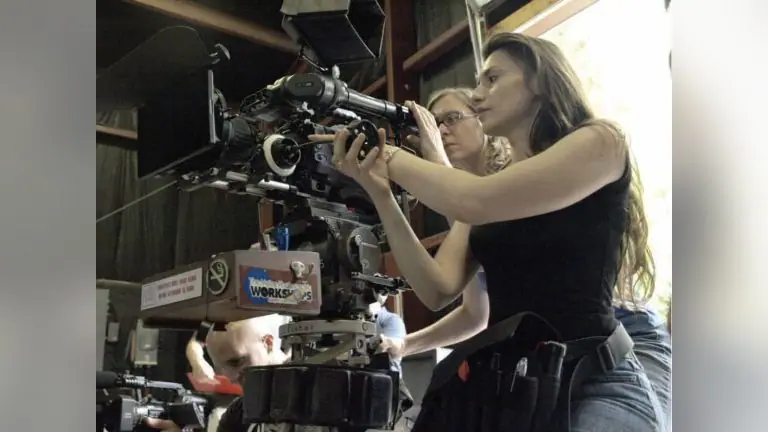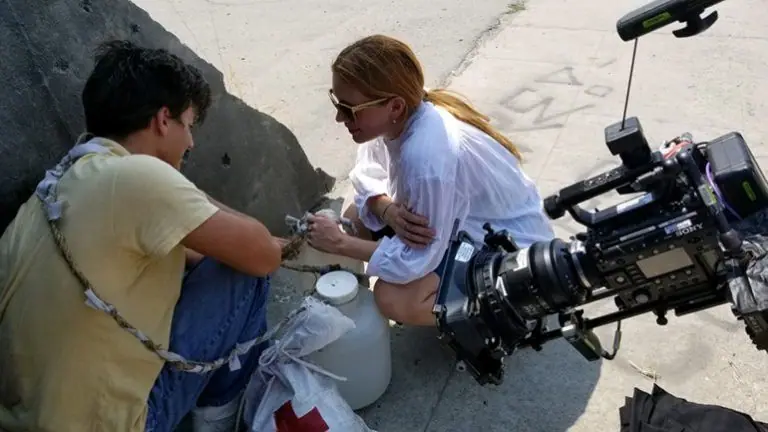
Action director Shane Stanley, an Emmy winner whose recent films include Night Train and Double Threat, spent the four or five years before this StudentFilmmakers class making mostly action movies, and he taught it with a stunt-driving day still ahead of him. His first rule for directing action scenes had nothing to do with style: plan every beat for safety, bring in people who have done it before, and keep the set lean.
He summed up the mindset in one line: “Hope for the best, prepare for the worst and expect the unexpected.” When a car, a horse, a boat or a fight goes wrong, he said, the cause is almost always the same: too little preparation, too little rehearsal, and nobody on the team who knows the genre.
How should you write an action scene?
Don’t overwrite it, especially if someone else will direct. Hit the beats the way you would in any scene: where it starts, where it turns, where it ends. Mention a few specific thrills you want, then trust the team. His example: two bank robbers slide over the hood “Bo and Luke Duke style,” peel out, dodge a garbage truck in an alley, scatter trash cans, dogs bark. That is enough.
The one-page-per-minute rule breaks down here, he said. Three or four pages of written action may end up as 20 to 45 seconds on screen, so long action passages only fatten a script. Use the space you save to find a fresh angle, since readers have seen every rooftop chase.
How do you find stunt people on a low budget?
Look up experienced stunt performers on IMDb Pro or through a stunt service such as Joni’s Stunt People, and choose someone with a long track record on big shows. Then make an offer that helps their career. Many performers want to move up to coordinator. On a non-DGA film, Stanley has also offered stunt performers a second unit director credit, and he says most jump at it. That is how he brought top-level motorcycle and driving doubles onto his early low-budget films.
Use certified precision drivers for any fast or blocked vehicle work, he said, not friends who used to race dirt bikes. On the water, a certified lifeguard must be there at all times.
Why keep visitors off an action set?
“I don’t recommend inviting people to come when you’re shooting action.”
Reason one: it is boring. Stanley learned that in the mid-1990s when, as a producer on a Charlie Sheen action film, he doubled for an actor and spent four days on car chases. An action film can have around 3,500 cuts against about 1,800 for a dialogue drama, and each beat is blocked for an hour and a half, run once with several cameras, then reset for 15 or 20 minutes.
Reason two is more serious. With an audience watching, people try to impress, and that is when cars go wild and cameras end up in the wrong place. Keep the crew down to the people the shot actually needs.
Which cameras work for chases?
Small and light, so nobody gets hurt if something hits them:
- Canon C70. His go-to cinema camera at about $5,000. Night Train was shot entirely on it, and Double Threat used it too. Small enough to mount on a hood or ride with a belted-in operator.
- GoPro. Nearly indestructible. Mount one on the rear bumper of the car being chased for a shot with nobody in danger. Match its settings to your main cameras, or the footage will stand out.
- DJI Osmo. His “secret weapon,” a palm-size stabilized camera around $200 on sale that shoots 4K at 23.98. On Double Threat, the cinematographer stood in a sunroof with one to follow a pickup, a gunman and a horse.
On lenses: long telephotos, even around 300mm, for open desert roads, as on Night Train, so everyone stays at a safe distance while the shot still feels close. Inside cars, 35, 50 or 85mm. Avoid very wide lenses, because empty space and below-speed driving give away the trick.
Should you speed up footage or slow it down?
Fight choreographer Kevin Inouye asked about frame rates. Stanley always gets everything at normal speed first, because that is the safe version. He does not speed footage up; in a recent test with car play, it reminded him of “old Batman and Robin leaving the Bat Cave.” Instead, overcrank. Shoot at a much higher frame rate, so you can play the moment slow, then snap it back to real time in the edit for a clean speed ramp. Footage manipulated after the fact without the extra frames tends to blur and stutter.
Can actors do their own stunts?
Not behind the wheel, with rare exceptions. Stanley is a licensed precision stunt driver himself.
“There is no way I would let an actor get behind the wheel of a car doing anything other than a speed limit.”
Insurance is one reason. Production policies ask up front about vehicles, gunfire, animals, boats and fights, and if you do not check the box, you are not covered. The other reason is what he has seen: an actor driving a van with a camera on a side mount went down an alley at 40 miles an hour and destroyed a Panavision 35mm camera. The footage looked amazing; the day was a disaster.
His two exceptions were both on Double Threat. Matthew Lawrence, who had raced the Baja 500 off-road, did driving well within his skills. Danielle C. Ryan, a licensed stunt performer as well as an actor, did every stunt herself: horseback archery, fights, guns, hanging out of a car.
For fights, ask each actor about their experience and comfort level. If they say they can do it, watch footage of their work or hold a rehearsal and see. If they cannot sell it, bring in doubles.
How much improvising belongs in a fight?
None during a take. Double Threat has a fight of about four and a half minutes, with 71 setups shot in roughly four and a half hours, blocked by the film’s stunt coordinator. “Everything was down to the breath,” Stanley said. Ideas are welcome before the take: if a performer wants to break a trash can over someone’s head, rehearse it first. He remembered his first fight scene, where someone improvised and an actor got hurt.
Plan wound continuity during blocking, too. The director and makeup decide when the bloody nose appears and when the bruised ribs show up. Stanley works without a script supervisor, but agreed with attendees that one experienced in action helps.
What about guns on set?
“I don’t think there is any reason for a gun that has the ability to fire a live round ever needs to be on a film set, period.”
His productions use airsoft and non-firing replicas, with muzzle flash, shell casings and smoke added in post. On Night Train an actor argued against the airsoft guns; three days later, he said, the shooting on the set of Rust happened. Revolvers can be tricky and need a qualified armorer, he added.
A few more techniques from the class
- Hidden cuts in an action one-er: place handheld cameras out of each other’s view, stay around 85mm, and let a body backing into the lens or a car smashing a cheap camera black out the frame for a natural cut.
- Bullet hits: a sponge of fake blood taped to an actor’s back leaves a smear on the wall as he slides down. On Break Even, every bullet hole in a pickup was added digitally.
- Car crashes: big franchises mix real wrecks and CGI. A camera operator in the audience who worked on two Fast & Furious films put it at about half and half.
His closing words were about care: everyone on the call sheet, down to the person servicing the restrooms, should know what the day involves. Cars, guns and badly thrown punches can all kill.
Further reading: safety on the set after Rust, making smart choices around prop firearms and 15 things to know about fight choreography.