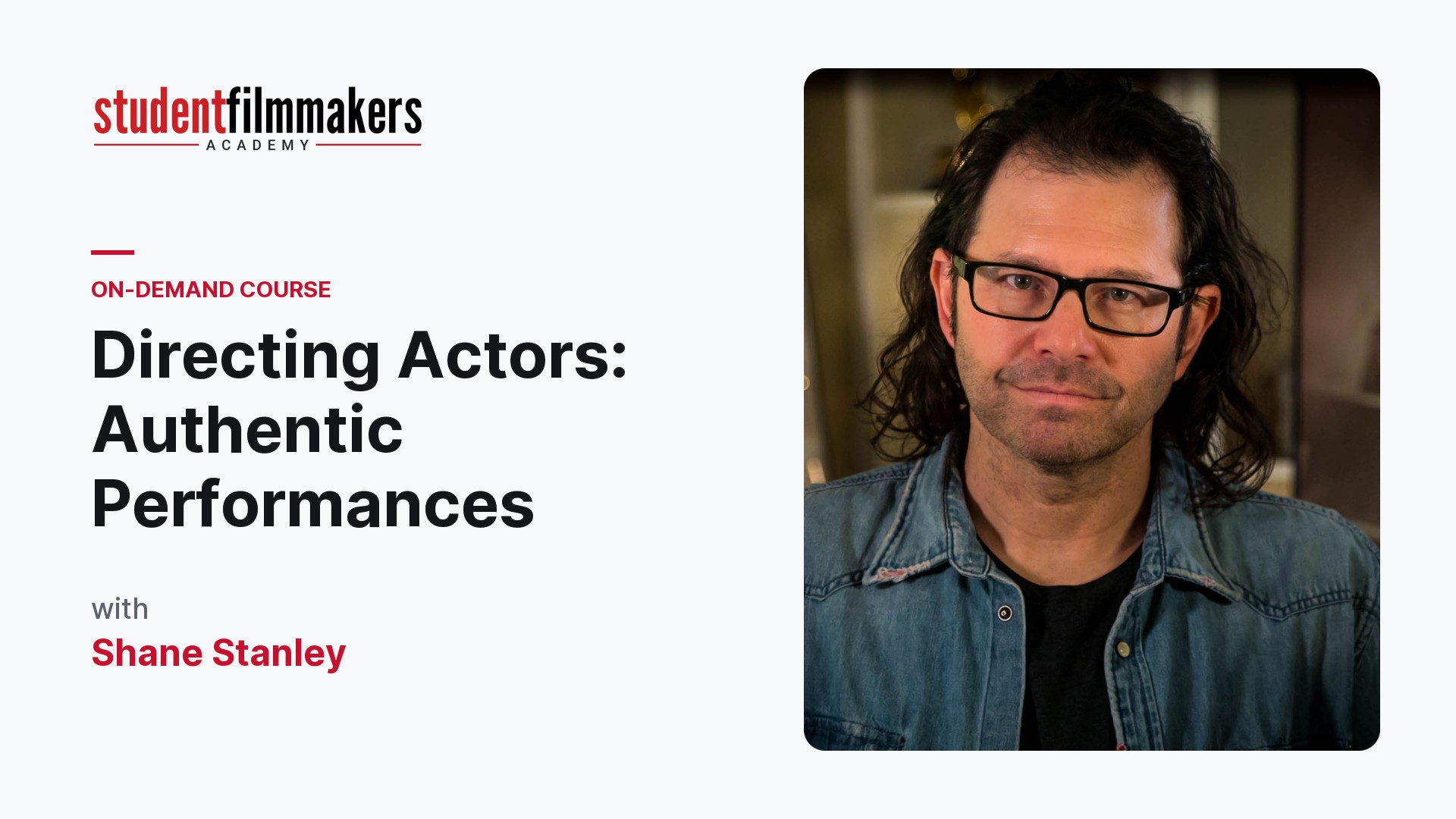
Shane Stanley started on Desperate Passage, the Emmy-winning docudrama series he produced with his father, and has since directed features including Double Threat and Night Train. His approach to directing actors comes down to trust: listen more than you talk, never promise a role you cannot deliver, and make the set a place where people feel safe enough to give you something unexpected. Here is what he told filmmakers in a live StudentFilmmakers class about first features, first meetings with actors, and the conflicts that come up on every set.
How small should your first feature be?
Smaller than you think. Stanley told the story of the first Desperate Passage film. His father spent about five years trying to raise $1 million. Finally a wealthy family friend called them to his house in Montecito, wrote a check and wished them luck. In the car, his father opened the envelope. It was for $25,000, and that was the whole gift.
They made the film anyway. It starred Michael Landon, went to number one in the ratings, earned four Emmy nominations and won two, and launched seven years of TV films and, later, Gridiron Gang. Asked what he would change with the full million, his father said only that he would have paid everyone better. Stanley was 15 and learned “low budget, high output thinking” early.
He also likes short “practice” versions of a bigger idea. He pointed to Sling Blade, Saw, Whiplash and Napoleon Dynamite, which all started as shorts. Work in a genre where you know your strengths, and hire trained actors from local classes and schools instead of relatives who do not act.
What should you say at the first meeting with an actor?
Not much, and promise nothing. Early in his career Stanley had a script that four Academy Award winners and three A-list actors wanted to do. But he had promised the lead to an unknown, and one by one the big names fell away. He kept his word and lost the deal. Today he warns filmmakers not to attach or promise parts to people who bring no money, distribution or name value.
“I think the best thing to do as a director is shut up, listen, and learn.”
Recently an actor who had just finished five weeks on another film read Stanley’s script and asked to meet for coffee. The coffee lasted seven and a half hours, and Stanley said he barely got five words in. He learned more about the actor, the script and himself than any pitch could have taught him.
When an actor asks to rewrite, listen for where it comes from. “Bill will take your words and personalize them without changing them,” he said of actors like Bill Murray. Others want a page-one rewrite for more screen time and never think about the domino effect on the rest of the film.
How do you build trust with an actor?
He offers actors a plain trade: they give him what the story needs, and he makes room for what they want. Describing that promise, he said:
“And when they hear that, the barrier instantly comes down. The trust factor goes through the roof.”
The director needs certain beats to make a scene and an arc work. Within that, the actor gets room to give the gift of their talent, which often brings things no writer could put on the page.
His other habit is patience at the end of a take. “Some of the best moments you’re ever going to get on your film or that extra three to five seconds, you don’t yell cut,” he said. When you hold, actors read it as trust and play on. With digital cameras, letting the card roll costs almost nothing.
Knowing the craft earns trust too. Stanley cuts his own films and has operated cameras since he was a boy. Good actors will ask what lens they are on, and a 50mm or an 85mm tells them exactly where the frame cuts off. One actor he had wanted to work with for seven years asked how he would cut a relationship like the one in the new script. Stanley sent four scenes he had edited that mirrored it, and the actor was in.
Should you cast against the script?
Sometimes. On Double Threat, Dawn Olivieri signed on to a part written for a man. They even sent her the script with the male description and lines, and Stanley calls her joining the film a gift. On his current film, which has 23 speaking roles, he cast every supporting part first and the two leads last, the reverse of his usual order. He was happy with the result.
Once you choose an actor, back them. He paraphrased Sidney Lumet: you go to bat for that actor and die on that sword, even if producers wanted someone with more Instagram followers.
One warning about preparing a role: “Don’t ever tell an actor to watch another actor do the role in a movie,” he said. He learned that one the hard way. Ask instead how they want to play it, and let them talk it through.
What causes conflict on set?
“I find the biggest conflicts happen on set are because people don’t feel safe.”
People who feel threatened, cornered or unheard are the ones who blow up. So in pre-production he tells his team he will always be a sounding board. On set he keeps his antennas up. Once, he noticed one actor struggling because of something his scene partner kept doing. Between setups he walked him away, made sure the mics were off and asked what was wrong. Then, after a word with the DP and sound mixer so it did not look aimed at her, he talked to the other actor and quietly steered her away from it. Five years later, he said, the two are dear friends.
He also shared a mistake from his book. Everyone, down to hair and makeup, knew what was going to happen in one scene except the male lead, and Stanley assumed he knew. The actor felt let down, and the trust never fully came back. His rule now is “no surprises.” Ask permission for everything, and do not count on forgiveness afterward.
Smaller notes from the Q&A
- Blocking: Movement keeps a scene alive. Early on, actor Joel Brooks saw he was green, asked “May I?” and staged a scene so it felt like real life.
- Two cameras: Even if the second one is a 4K iPhone, it speeds the day and helps actors with continuity.
- Acting methods: He respects Stanislavski and Meisner training but stays out of an actor’s process, as long as they deliver.
- Morale: “You can always see the toxic vibes on screen,” he said, so weigh every decision by its effect on cast and crew.
- Gear: His last three films were shot on the Canon C70, partly because a whole camera package fits in fewer cases.
For more on helping performers, read our pieces on helping actors past their fear of an audience and directing actors once the camera is ready to roll.