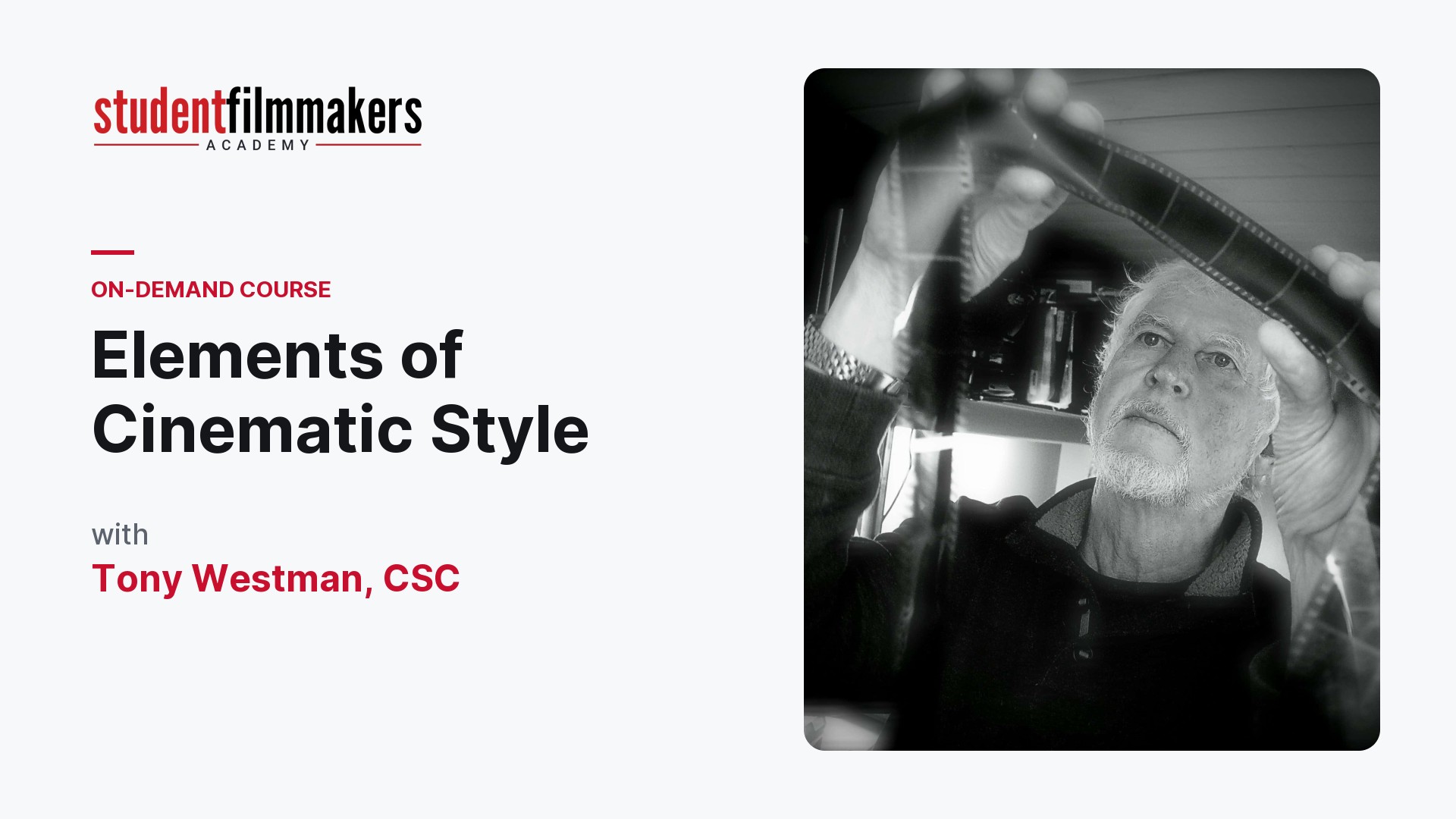
Tony Westman, CSC, has spent more than 50 years as a cinematographer and director, and he was the director of photography on the Stephen King adaptation Needful Things. His class for StudentFilmmakers breaks down the building blocks of cinematic style, from the frame and the lens to light, texture and camera movement, with one rule over all of them: the tools only matter when they serve the story.
What does cinematography actually mean?
Westman opened with the word itself. “Cinematography comes from the Greek root meaning writing with motion,” he told the class. In his view, the job is to take the words, actions, emotional tone and subtext of a script and turn them into images that add layers of meaning. It is never a solo task. The director of photography works in partnership with the director, and needs to understand editing well enough to know how the raw footage will be shaped into rhythm.
His first example was Blade Runner, directed by Ridley Scott and shot by Jordan Cronenweth. Flying cars, endless night, smoke, giant screens and squalid markets build a world that feels familiar and alien at once, and then a 1930s-style detective walks into it. The audience pieces the place together from visual clues, which is exactly what Westman wanted the class to notice.
The tools of cinematic style, and the films he used to show them
Most of the class moved through one tool at a time, each tied to a film:
| Tool | Film he showed | What to notice |
|---|---|---|
| The frame | Citizen Kane | A hole cut in the studio floor put the camera low enough to show Kane’s power and ego. |
| The lens | Raiders of the Lost Ark | Westman points to Spielberg’s regular use of a Panavision 27mm, which let actors move from distance to close-up without distortion. |
| Light and color | Traffic | Each storyline has its own color cast: cool Washington, dusty sepia Mexico, warm California. |
| Texture | McCabe & Mrs. Miller | The stock was pre-flashed before production to soften contrast and lift the grain for an antique look. |
| Movement | La La Land | A magic-hour dance played in one long take, with the camera moving in and out with the couple. |
| Point of view and eyelines | Blade Runner | Singles with eyelines slightly wide of the lens, so two strangers meet at an angle. |
On lenses, his practical point was that a set of primes anchors a film’s style. A Panavision kit runs from 18mm and 24mm up through 27, 35, 40 and 50mm, and using the same few focal lengths again and again gives a picture a consistent look. On eyelines, he noted that the closer an actor looks to the lens, the more the scene seems to look at the audience, pulling the viewer into the character’s world.
When should the camera move?
Early films were shot wide, as if the audience were watching a stage. Today, Westman said, the camera can go anywhere:
“Now the camera is a magic carpet that can go anywhere we can imagine.”
The catch is the reason behind the move. He wants the camera “motivated by the narrative and not just by the arbitrary action of the camera.” In the La La Land dance, the camera singles out one dancer, swings into a two shot and follows each change in the choreography, so it becomes part of the feeling between the two characters. Because the light was changing all through magic hour, the crew had to keep adjusting the balance between the actors and the sky behind them.
He told a story from Days of Heaven, shot in Alberta, about chasing magic hour with super speed lenses. A camera assistant couldn’t believe they were still rolling in near darkness. He hadn’t grasped that with those lenses you keep opening up as it gets darker, holding the balance of the light so the whole sequence plays together.
How did filmmakers create texture before computers?
Westman counts McCabe & Mrs. Miller, directed by Robert Altman and shot by Vilmos Zsigmond, as a brave example. To give the Gold Rush story an aged feel, the stock was run through a printer at about 10 to 12 percent light to fog it slightly, then re-spooled for the shoot. He remembers the worry it caused among filmmakers at the time, and says the results worked about 90 percent of the time, with the occasional reshoot.
Rain and fog on exterior sets and filters on the lens do similar work. The smoky world of Blade Runner came from a studio filled with smoke under Doug Trumbull.
Do actors care how they are lit?
Some care a great deal. Westman remembers Kirstie Alley staying on set while the lighting was built, even though a stand-in was there for that job:
“She would stay there holding a mirror to watch how lights were set and where shadows would fall, so that she would not hesitate to make comments when things were not correct.”
His takeaway: lighting has two jobs at once, moving the story forward and taking care of how each actor is presented.
How did he find the look of Needful Things?
An attendee asked about the 1993 film, directed by Fraser C. Heston, whom Westman had worked with on several shows. The Exorcist was a jumping-off point because the story has devils, magic, and good and evil, but Westman warned against copying. Each film is its own entity, he said, and the job is to absorb the essence of that one story and find its big frame.
The production took over Gibsons Landing on British Columbia’s Sunshine Coast and turned it into Castle Rock, with false storefronts, a big church, a Victorian house and towers of rain falling on the crew. A couple driving through, he said, saw what looked like a lovely New England town and bought property there. Then the crew blew it up.
Film or digital?
Westman has shot both and still keeps a darkroom. With film, he said, you have to fit inside a narrow technical box, where half a stop matters, and you don’t see your work until dailies:
“Boy, if you make a mistake, you’re going to sit there all night and say, oh, my God, what are we going to do?”
Digital moves much of that decision-making to post, where a knob can fix what film would never forgive. He finds that less satisfying as a craft, though he admits fiddling with images on his computer is fun too. On color in particular, his experience is that what you photograph is largely what you get, even on effects films built from many separate layers.
How do you show shifts in time without losing the audience?
Asked about a story that moves between past, present and future, Westman pointed to Memento, where Christopher Nolan uses black and white and color to mark time running forward and backward. Costume, aging and color can all serve as cues. Confusion can work for a while, he said, but sooner or later you have to settle it and let viewers catch up, or they will give up on the story. His short version: love your audience.
Technique, then story
Westman also showed the Lumière train, Georges Méliès’s camera tricks, the first close-up in The Great Train Robbery (1903), Hitchcock’s Rope, Kurosawa’s Rashomon and Kubrick’s candlelit Barry Lyndon. He ended in five words: “Technique means nothing without story.”
For more on these ideas, read Coverage: Telling the Story with the Camera, Jack Green, ASC Talks About The Look and Chiaroscuro Lighting.
The full class includes the film clips and stills Westman used for each tool, plus his answers on lighting in post versus on set.