By Michael Corbett
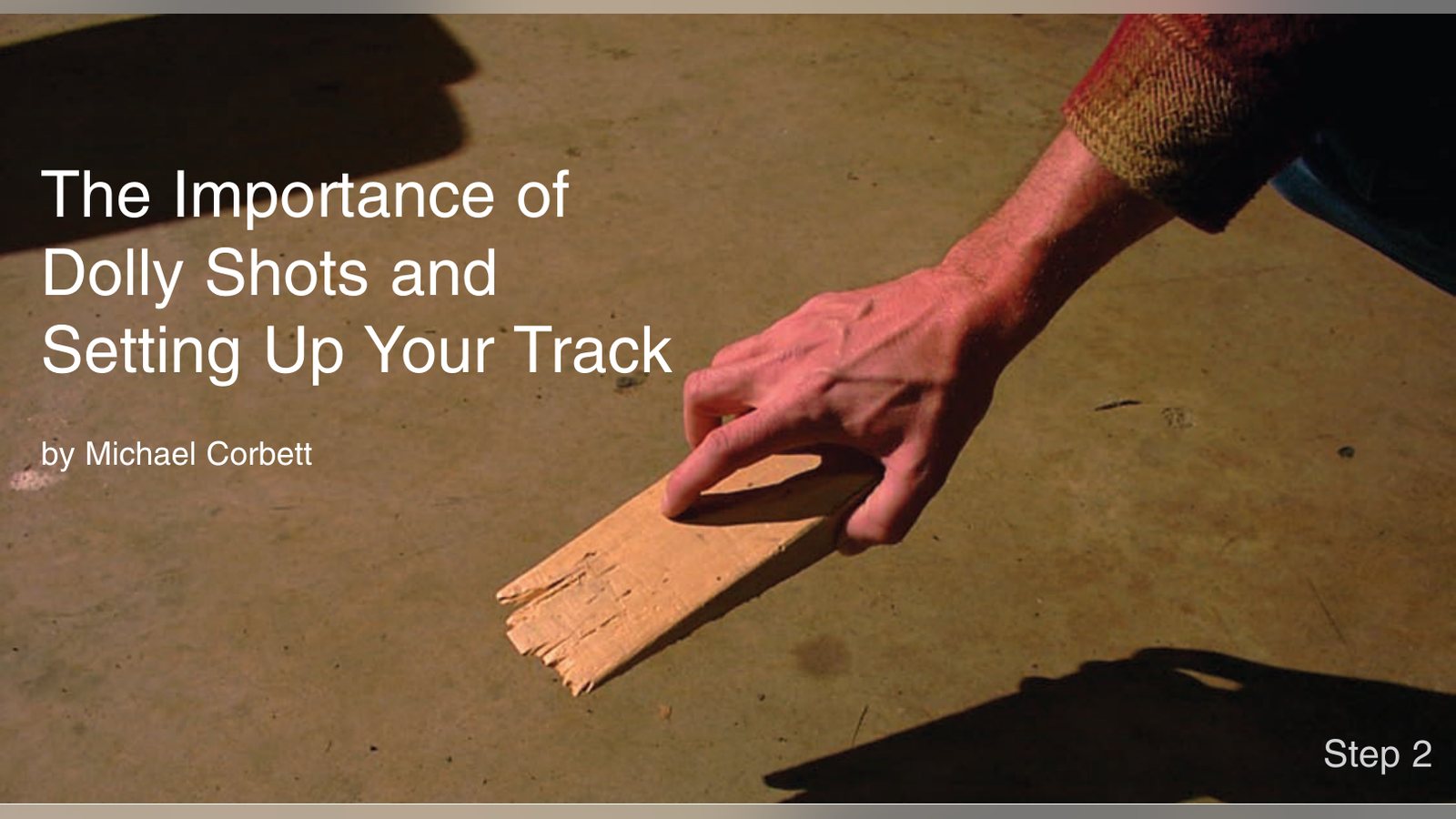
Dolly shots build tension and reveal story. Michael Corbett explains why moving camera shots matter and how to set up and level dolly track on set.
Moving camera shots, or dolly shots, are a fundamental visual element of today’s narrative films. They are used to emphasize elements in the story to increase and build tension in the scene or to reveal important parts of the set’s geography. To be good or useful, a dolly shot does not need to be long. Often a dolly move of only a few inches can add much to the storytelling in a film.
Almost anything with wheels can be used as a camera dolly – wheel chairs, shopping carts and hand trucks, just to name a few. But for a dolly shot to be really effective and not call attention to it, it must be smooth. The best way to get a smooth dolly shot is to use a dolly on professional dolly track rented from a production vendor. You can rent a Chapman or Fisher dolly or a Matthews doorway dolly with track wheels, or build your own dolly using skateboard wheels; (do an internet search on “how to build a skateboard dolly” for lots of examples). Below is a brief description of how to set up and level your dolly track for filming.
Steps to Lay Dolly Track
1. Determine where the camera will be.
2. Mark the start and finish positions of the camera. Determine which way the camera will face (what is in the shot).
Step 3 Step 4
3. Roughly place the track in position and snap it together. Align the tracks so that they are straight and in the proper position over the start finish markers.
4. Locate the highest point in the track run and place at least one wedge under the starting cross support at the highest point.
5. Place pancakes and other apple boxes (or use dolly boards or both) under the track supports to achieve a roughly level track run leaving enough space for at least one wedge at each support point.
6. Level the track lengthwise starting from the highest point.
7. Put at least one wedge under each connecting track support point (the two cross braces where tracks are joined)
8. Fill in the “air” in the other track support points
9. After leveling the “high side” along the whole track run then, starting at the highest point, level across bringing the low side up to match the high side. [see image on page 46]
10. Place a clamp on each end of the track to prevent the dolly from rolling off the track. [see image on page 46]
Step 8
11. Place the dolly on the track.
12. Test the track run on the dolly for smoothness and level.
13. Call for the camera.
Michael Corbett has a career as a filmmaker that spans more than thirty years. He began his career in 1969 at CBS affiliate KOTV Channel 6 in Tulsa, Oklahoma as a floor crew cameraman. He has worked on more than a thousand television commercials and a dozen feature films in roles as varied as grip-electric to producer/director. He was line producer of the feature film Captiva Island, which aired on HBO. Other feature film credits include, “Miami Hustle”; as first assistant director and “The Lay Of The Land;” as director of lighting. His documentary credits include “Zimbabwe, Miracle in Africa.” As cameraman and editor on this project, Corbett documented the peaceful transition of the minority Rhodesian government into the hands of black majority rule in the new country of Zimbabwe. Corbett presently serves as the Director of the Piedmont Community College Film and Video Production Technology Program in Yanceyville, North Carolina. His honors include a Cine Eagle, three Silver Reels, four Addy awards, and three festival silver plaques.
Keep learning filmmaking
Want more lessons like this? Join StudentFilmmakers free for live webinars with working pros, and stream on-demand filmmaking classes in cinematography, directing, screenwriting, sound and post.