
By Melissa Chan
From Tim Hetherington’s cameras in Afghanistan to student shoots, Melissa Chan shares practical documentary making tips learned in the trenches.
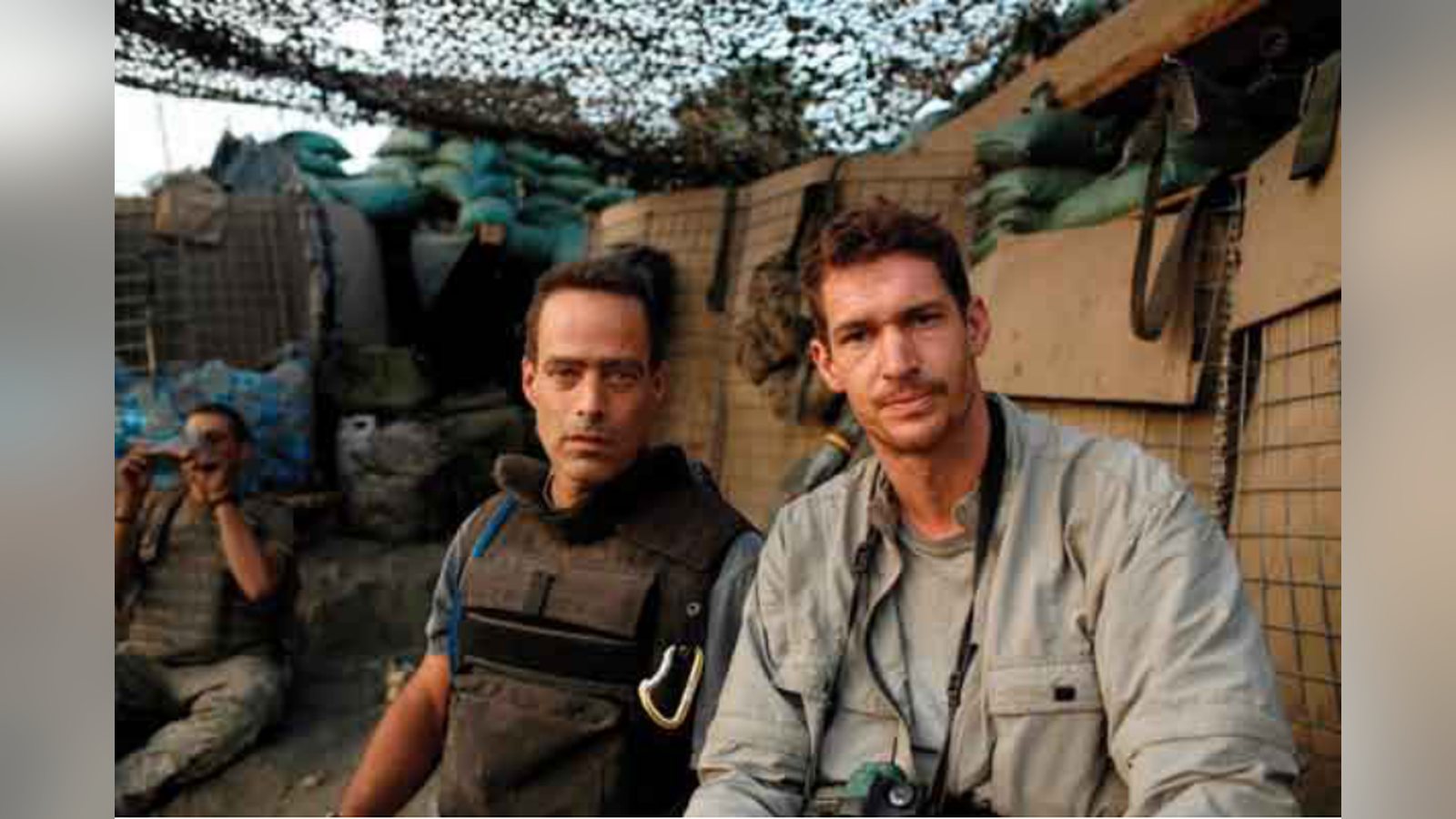
Notable British award winning photographer Tim Hetherington has taken filmmaking to a whole other level by bringing cameras into a war raged zone in Afghanistan. His assignment as a photographer for Vanity Fair expanded his career as a filmmaker by directing Restrepo, which is playing wide release in United States. His work with Sebastian Junger, American writer most famous for the best-selling book “The Perfect Storm: A True Story of Men Against the Sea,” has led the two to produce a powerful film.
Restrepo follows a platoon of soldiers stationed in Korengal Valley, Afghanistan, one of the most dangerous outposts. Hetherington candidly shares his experiences as he rose up to be a filmmaker and talks about filming Restrepo, which premiered on the opening night of the 2010 Sundance Film Festival. In this interview with StudentFilmmakers Magazine, Hetherington shares the reality and rawness of what it takes to film a war documentary. He also shares ideas about what aspiring filmmakers should focus on to become successful.
StudentFilmmakers: How did the project for Restrepo come about?
Tim Hetherington: The project for Restrepo came about as a very organic process from an assignment I was making with the author Sebastian Junger. Sebastian and I are good friends – we’re colleagues – we work together at the magazine Vanity Fair. He’s the writer and I’m the photographer, and so I was initially sent to Afghanistan with him by Vanity Fair. It was Sebastian’s idea to cover a platoon of soldiers in the Korengal Valley. He was interested in the experience of U.S. soldiers since the war since it began in 2001. He was interested in what that experience might be like. We went out there, and he had the idea that he wanted to write a book and do a number of articles for Vanity Fair. When we got out there, the focus was still very much on the war was in Iraq, but it was obvious to us that the war in Afghanistan had slipped out of control. We started to make the film because it was such an incredible story. When we went to the Korengal Valley in 2007, one fifth of all fighting in Afghanistan was taking place in that valley, 70 percent of American bombs were being dropped in the area of operation of that Valley, and Battle Company – the soldiers we were with, were taking a killed and wounded rate of 25%. So the story was incredible, and the film Restrepo came out of that.
We were with the “tip of the spear” – Second Platoon – at the end of the Korengal Valley. They were doing an awful lot of fighting, and we stayed with them at a very kind of Spartan outpost called Restrepo. That’s where the action in the film comes from. We wanted to make the most experiential and immersive war film we could. We wanted to take the viewer on a 90-minute deployment. We felt there was a disconnect between what the soldiers in Afghanistan were doing and what we the public understand about them, and we felt that rather than making a political commentary or a network mediated view of the war, we would just take you into it as closely as possible – and that’s what we did.
StudentFilmmakers: What was your intention for the film? What did you want to get out to the viewers?
Tim Hetherington: We wanted to connect the American public with the experience of the soldier. I didn’t want to put my personal opinion in the film because I don’t want that to cloud your experience of what is happening out there. I think that there are a lot of people in this country who are confused about the war, and that seeing, digesting, understanding, and in some ways honoring the soldier’s experience out there is a good starting point for a conversation about the war. We are paying for soldiers to go out to Afghanistan and it is our responsibility to understand their experience as closely as possible, because ultimately we have to make sure that we integrate them back into this country. So that’s the focus of the film.
StudentFilmmakers: How was it like working with Sebastian?
Tim Hetherington: Sebastian is just really a wonderful guy to work with – it’s a great privilege. We’re not only good friends, but obviously we work closely together, and we’re business partners in this. We really complement each other. Although he’s a writer and I’m an image maker, we both have a sense of narrative. We both filmed Restrepo and we have an equal partnership. He’s a very stimulating person and extremely generous, and I couldn’t have wanted a better partner to work with.
StudentFilmmakers: What formats did you work in?
Tim Hetherington: Well, when we first started shooting, we were filming in NTSC. We did that because the film was an organic process. We didn’t go out to Afghanistan necessarily with a film movie in mind – I think neither Sebastian nor I imagined that we would have this kind of film playing wide release across America. We are currently playing in 45 cities. It’s a small budget film but we never dreamed of we would be playing across America. So initially we were doing all bits of filming for ABC News – we filmed two Nightline pieces for them. But as time went on, we realized that actually the story was really compelling, and so when we decided to start making a documentary, we switched to filming everything in high definition.
StudentFilmmakers: What camera did you use for the bulk of the filming?
Tim Hetherington: We used a Sony Z1 and a Sony V1. We used pretty simple cameras because we were working in very extreme circumstances. Restrepo was a small 20-men outpost on the side of a mountain. There was no running water or electricity out there. We couldn’t have very complicated equipment. We also had to carry everything with us – even when we went on long of combat operations with the soldiers. We had to carry water, food, everything, and cameras on top of that. So we had to have light cameras. We didn’t have the luxury of having big cameras. We did everything the soldiers did: we slept where they slept, we ate their food, we went on every patrol, and we went onto every combat situation. So we needed a camera that could be versatile and that’s why we filmed on mini-DV tapes. That’s also why we filmed with the Z1 because frankly, if we broke the camera, it would not have broken the bank to buy a new one.
StudentFilmmakers: Tell us about the challenges of shooting in Korengal Valley.
Tim Hetherington: Well we were in war. I remember once filming Restrepo when the insurgents attacked it four times in one day – although the record was 13 times in a day. There was a lot of fighting going on and people were being killed, and people were being wounded. There was a possibility that every time you left the outpost – which was basically every day – you could get shot. Just that alone makes the logistics of filming very difficult. You’re on foot; it’s very treacherous on a mountain terrain, and it really pushed filmmaking to a limit. You couldn’t really set up tripods anywhere; it really wasn’t that kind of environment.
StudentFilmmakers: What kind of emotions were you feeling when you were filming this?
Tim Hetherington: When I’m filming, I’m very focused.
You need to be focused in this kind of situation, and I’m focused at the job at hand, which is filming. You don’t really have time to start examining your emotions when you’re in the middle of this kind of situation. You kind of push them to a deeper place in your mind and examine them later. But war is traumatic. I’ve seen a lot of traumatic things happen out here in the Korengal Valley when we were there. Both of us got injured, and I was with people who got killed and that was a very sad and upsetting thing to go through.
Tim Hetherington’s Top 3 Documentary Making Tips
(1) Always make work about something that interests you. If you’re not working on something that doesn’t really interest you, then other people aren’t going to find it interesting. It sounds very obvious, but often people make projects about things that they think other people would be interested in, and it’s not really a good idea. You should make something that you are definitely interested in.
(2) Make something that you can realistically do. Don’t have ideas about doing things that may not be realistic to achieve. Make sure that you can film everything, and make sure you have access. Documentaries are usually about access. If you had a great idea, you have to say to yourself, “How easily can I get access to that?” You have to be really realistic about that. (3) I would also say that a lot of people put emphasis on equipment, but it’s really not the most important thing. The most important thing in documentary is the story. If you have a really compelling story or a really compelling idea, then you could shoot it on a cell phone and it would still be interesting. It’s not really about having the best equipment or what format – the most important thing is the story.
Close-Up Exclusive Interview with Tim Hetherington, Director of Restrepo by Melissa Chan http://www.studentfilmmakers.com/nycproductions/2010/08/an-exclusive-interview-with-tim-hetherington-director-of-restrepo/
Related filmmaking guides
- Film directing: getting good performances
- Coverage and the master shot
- Camera angles in film: a beginner’s guide
Keep learning filmmaking
Want more lessons like this? Join StudentFilmmakers free for live webinars with working pros, and stream on-demand filmmaking classes in cinematography, directing, screenwriting, sound and post.






