By Scott Essman
Scott Essman describes a shoot at The Art Institute of California with professional actors and a student crew, and how they kept it a tight ship.
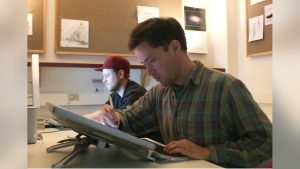
On Saturday April 28, 2012, at the Digital Filmmaking and Video Production school of The Art Institute of California in Orange County, a student crew of mine shot a mock presidential debate in an efficient four hours, covering five scenes over ten script pages.
The crew, largely current students, with a few graduates and members of another school in various positions, utilized six Canon XH-A1 cameras, all calibrated to shoot to tape in HDV 60i in the 1920×1080 format. Frank Garbutt, an Art Institute graduate, served as cinematographer while I wrote the script and directed the actors and studio, which we shot in a green cove area to allow for adding various backgrounds in post. We set up two existing podiums to serve as the main speakers’ areas of concentration and devised a master two shot and three isolated singles on the speakers. The fifth camera on the green cove set was roving, so it could pick up various different shots in each of the scenes, and a sixth camera captured the moderator who was offscreen throughout the dialogue portions with the two main actors playing the presidential candidates. This third actor, Sky McDougall, will be carefully and selectively added to the material with the two speakers (Wil Bowers playing incumbent candidate Tom Hinker and Dean Scofield playing challenger Bill Williams) during the editing process.
What made the whole shoot work so smoothly was the addition of support crew: one sound recordist plus two boom operators – one for each presidential speaker – with the two actors also being miked with lavaliers. The moderator was miked with just a lav and was shot against a black curtain that was separately lit from above and the floor by Garbutt and his gaffer and best boy. Additional support crew included six assistant cameramen and women who slated each separate shot carefully. While most of the five scenes were captured in one shot, at least two scenes were broken into separate shots for simplification.
I had rehearsed with the actors at my house a few days before filming, so we all knew the nuances of the script going in. This allowed us to shoot quite efficiently, doing a maximum of three takes for most of the shots we completed. I usually prefer to shoot a minimum amount of takes when on a tight schedule, so I am used to tweaking a scene on the spot so that the actors are comfortable and can proceed. Sometimes, we do pickups and adjust the scenes after specific takes so that we can move forward in a timely manner. Doing so, all five scenes, with an average of two pages each, were accomplished within an hour. Plus, shooting with so many cameras, even on the lesser takes, we will have surely picked up coverage that we can use nonetheless. As such, in just four hours, we achieved plenty of usable material. As soon as we wrapped, in under 30 minutes, working together, this student crew had all equipment and the entire studio broken down and ready for the next project. All in all, a very successful execution of a student-oriented film.
The crew: Chelton Perry (documentary), Ralph Williams (stills), Miguel Arce (assistant camera), Jessica Wautlet (camera operator), Nicole Miller (camera operator), Jackie Bastawroos (first assistant director), Frank Garbutt (cinematographer), Matt Toscano (boom operator), Paulina Kim (assistant camera), Alexander Clague (camera assistant/second assistant director), Bobby Richard (boom operator), Allison Williams (floor supervisor), Jonathan Switzer (camera operator/best boy), Sarah Deister (camera operator), Jordan Woollen (gaffer/camera six operator), Keisha Ranada (sound recordist), Troy Kallman (camera operator), Jair Millan (assistant camera), Scott Essman (writer/director).
Since the mid-1980s,
Scott Essman has been writing and producing projects about motion picture craftsmanship. He has published over 350 articles as a freelancer and has produced over twenty publicity projects for Universal Studios Home Entertainment where he made video documentaries and wrote publicity materials. He published his first book, “Freelance Writing for Hollywood,” for Michael Wiese in 2000, and has a new book about Tim Burton.
Related filmmaking guides
Keep learning filmmaking
Want more lessons like this? Join StudentFilmmakers free for live webinars with working pros, and stream on-demand filmmaking classes in cinematography, directing, screenwriting, sound and post.