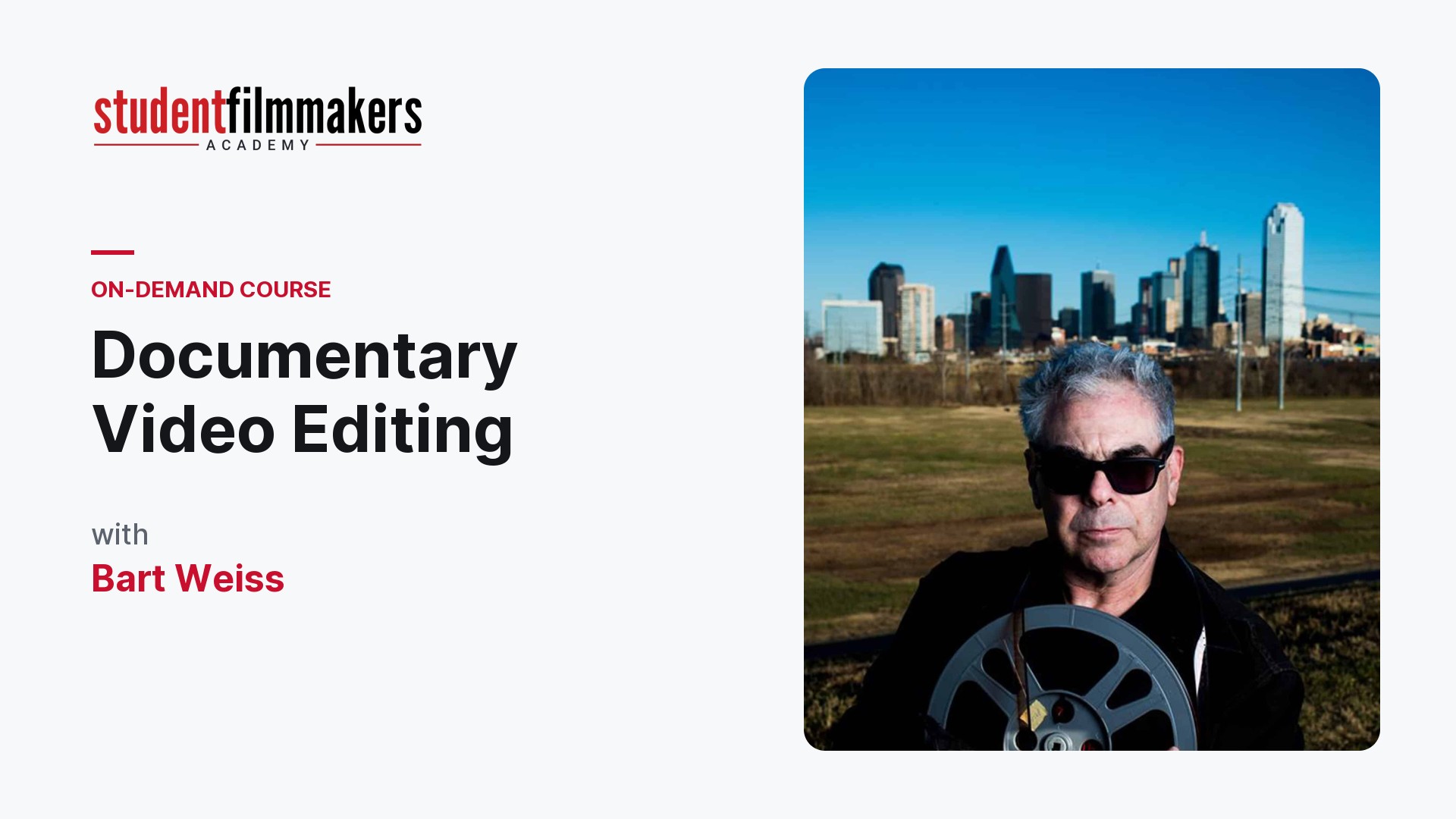
Documentary maker and longtime film teacher Bart Weiss, who started the Dallas VideoFest in 1987, cuts every documentary in five stages: dailies, assembly, rough cut, fine cut, picture lock. His key lesson is patience. Each stage has one job, and trying to polish too early leaves you with a beautiful 30 seconds and no film.
He taught this class live with DaVinci Resolve and Descript open, crediting part of his method to Karen Everett’s free documentary editing book.
What is your film really about?
Before any cutting, Weiss wants two answers. The first is what kind of documentary you are making: portrait, issue-based, essay, poetic, observational, participatory, archival, music. Each one is edited differently. The second is what the film is really about, which is rarely the one-liner you tell people at parties.
His example is his own film about the polka band Brave Combo. The pitch is simply a film about a band. The real subject is Carl’s struggle to find a wider audience for polka and how he kept the band alive for 30 years. Until you know that deeper subject, he says, you can’t really edit.
He also asks for a finish date. Deciding to finish in a year gives the project an ending, and that pushes every later decision.
Why do documentaries now borrow three-act structure?
Documentaries play in theaters now, and audiences expect a beginning, a turning point, a journey and an ending. Weiss traces the change to Pumping Iron, the 1977 film that made Arnold Schwarzenegger famous. When Arnold said something good, the crew asked him to say it again from another angle so the editor would have a match cut. Nobody had done that before, Weiss said, and the film plays like a drama.
As you watch footage, look for the inciting incident, act climaxes and backstory.
How should you watch your dailies?
“You are only a virgin audience member once.”
Two months in, you will have seen every shot many times and the moments that grabbed you won’t anymore. Take notes on the first viewing: what moves you, what is usable, what isn’t.
Then comes the part he calls the hardest work of all: marking every clip with keywords or subclips. It is busy work, and every instinct says skip it and start cutting. He asks you to fight that instinct.
“This is the organizational part of the editing process that allows you to be free and creative later.”
Logging also puts the footage into your head. Early on, Weiss played VHS copies of his dailies in his office all day to soak them in.
Two field habits feed this stage. On the drive home from every interview, think of the three best moments and write them down when you arrive. And make your last interview question, every time, a request for any old photos or footage that could help tell the story. Offer to scan their photos and return the scans.
How do you set up keywords in DaVinci Resolve?
In the class Weiss opened a Civil War reenactment project. His bins hold interviews, B-roll, stills, music and sound effects. He logs on the Media page, typing keywords such as cannons, Confederates and Union into the metadata panel. Smart Bins then gather every matching shot, so a cannon sequence starts with two shots already waiting.
A keyword covers a whole clip; a subclip marks an in and out around one moment you can name and find later.
What goes into an assembly edit?
The assembly answers one question: is there a film here? It should be chronological, quick to make (a few days) and chunky, with sequences built from two or three long, untouched shots.
| Stage | Length target | Allowed | Who sees it |
|---|---|---|---|
| Assembly | Not too long, not too short | Sync sound, jump cuts, title cards for missing shots, maybe soft music | Only the core team |
| Rough cut | Within about 10% of final running time | J and L cuts, scratch narration, temp music, text placeholders | Test audiences, possible funders |
| Fine cut | Within about 3% | Temp music, narration, low-res archival, effects | Advisors, funders, test audiences |
| Picture lock | Final | Paid archival, final graphics, music, narration, color and sound | The finishing team |
In the assembly there are no J cuts, L cuts, voiceover, intercutting, B-roll, dissolves or effects. The one exception is a little music under a long scene, and he picks something soft and without much beat, just enough to keep you watching. If footage doesn’t exist yet, a title card says so.
Students who trim here end up with 30 seconds cut after two hours. Watch the finished assembly straight through without stopping, then decide which characters, themes and scenes can go. Maybe two of your five interviewees aren’t needed.
If you catch yourself waiting for a better part coming up, the part you are watching is the problem. Note it. In Resolve, pressing M twice opens a marker note, so the timeline holds your to-do list.
How do you run a rough-cut screening?
The rough cut is the first version you show outsiders, so it should look decent without being polished. Match the mix of the final film: if it will be 30 percent interviews, so is this cut. Use temp music so funders feel a sequence lift. Invite friends, film people and a subject expert.
Hand out an anonymous questionnaire before any talk starts, with the first question about their overall impression. Then discuss what works and what doesn’t. Bring specific questions, like whether a character was believable.
“The audience is always worried about what isn’t working for them, but rarely about how to fix it.”
Listen to the problem, not their proposed fix. Don’t argue when viewers are confused. If two or three people mention the same thing, treat it as a real problem. And the fix often lives just before the scene that felt flat, in the setup that failed to prepare it. Weiss says he can physically feel a film working or failing, on the back of his neck, when he sits in a room with an audience.
What do festival programmers notice first?
As a longtime programmer, Weiss is blunt about openings. Music that oversells weak material is a warning sign. “If I don’t like your taste in music, I’m probably not going to like your film.”
He also watches a moment he says nobody else talks about. Many documentaries open with a music montage introducing the world and its people. Then the music fades, natural sound comes up, and someone speaks. That first line must deliver what the montage promised, because programmers and grant panels are judging right there.
What changes at the fine cut and picture lock?
Revisit the dailies once more; something you passed over may now fit. Fact-check while you finalize narration. Keep archival footage as low-res, time-coded copies from the archive house until picture lock, because you pay per frame and only then know exactly how many frames you need.
Answers to questions from the class
- Edit during production? Mostly no, but log as you go, so you catch problems like missing sound in time to reshoot.
- Shooting for the edit: on a film about the Second Vatican Council, every subject was asked to finish the sentence “If it wasn’t for Vatican II…” Their answers became the film’s sections.
- E&O insurance and fair use: distributors and TV outlets won’t take a film without errors and omissions insurance. For fair use, a specialist lawyer signs off on each clip, and you use only enough to make your point: the Richard Pryor remark you are discussing, not the joke after it.
- Overwhelmed by footage? To a filmmaker sitting on concert footage of the Cuban percussionist Pedro Martinez, his advice was to take one piece and do something with it. Even a rough assembly gets you moving.
Can Descript clean up interviews?
Weiss uses Descript for his podcast, The Fog of Truth, and for cleaning interviews. He transcribed a clip, chose “remove filler words,” cut text to tighten the answer, then exported a Resolve XML. The catch: every text cut is a jump cut that needs B-roll. In his example about the 1965 Watts uprising, the speaker appears on screen only for his five most important lines, and archival images cover the rest.
His last words to the class: “In the real world, you can’t control everything, but in the editing world, you can make the magic happen.”
For more on the shooting side, read The Art of the Documentary Interview and Story First: Narrative in Documentary. When your cut is done, How to Begin Preparing for Submitting Your Films to Film Festivals covers the next step.