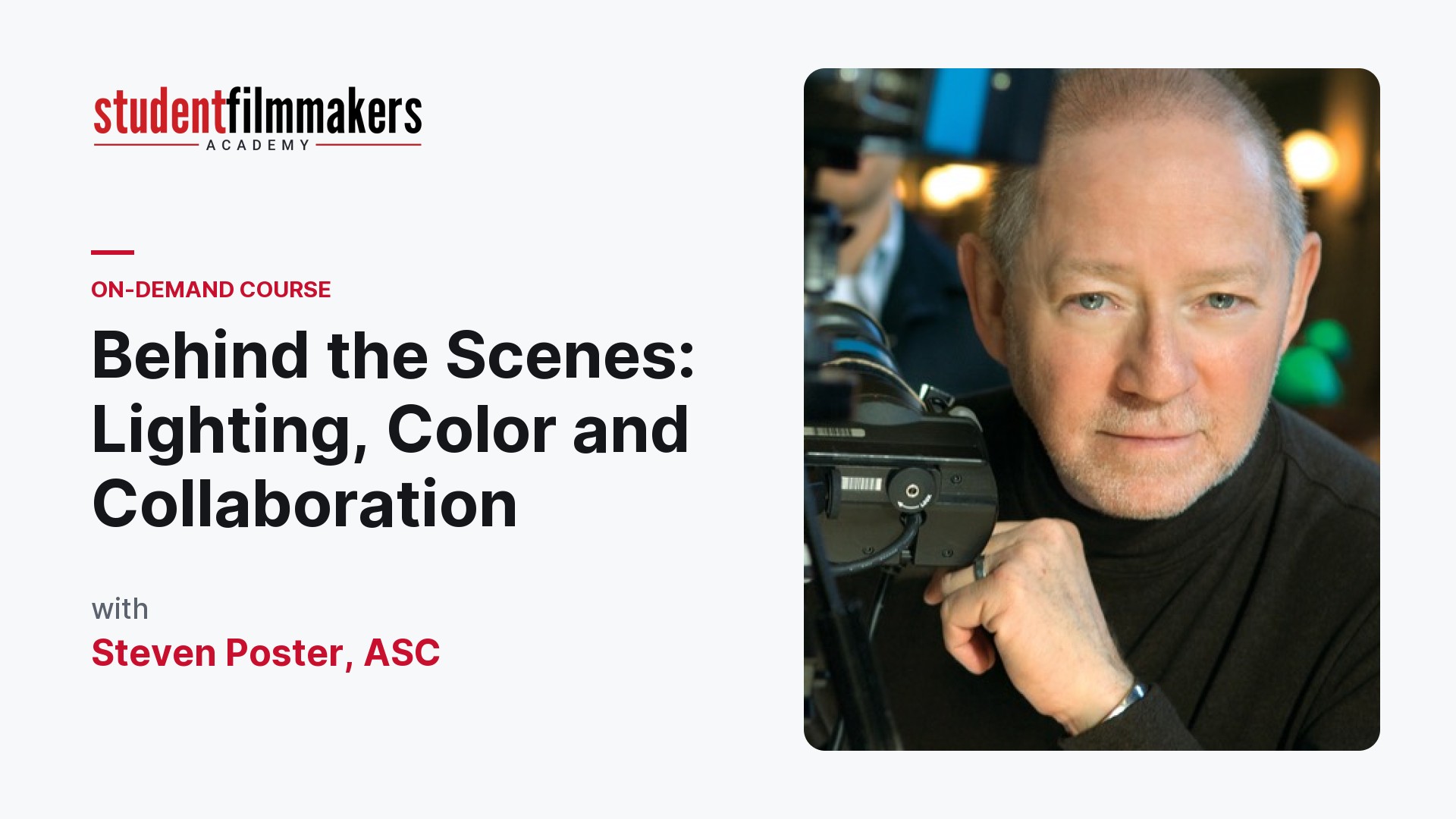
Steven Poster, ASC is the cinematographer of Donnie Darko and Stuart Little 2, and he shot Someone to Watch Over Me for Ridley Scott. In this StudentFilmmakers class he took filmmakers inside his latest low-budget horror comedy, shot in 20 days in one old house, and his lesson was that a small budget today still buys a beautiful image if you choose sensitive cameras, battery lights and a clear look. Then he answered questions about live grading, digital intermediates and how to handle a young director with a big idea.
Why would a cinematographer shoot at 3200 ISO on purpose?
The film is Scared to Death, a horror comedy about a séance, starring Lin Shaye and directed by Paul Boyd. Almost all of it was shot in an 1890 mansion in Altadena, northeast of Pasadena, now used only for filming. Three floors, a basement, and an attic so full of beams the crew wore hard hats.
Poster shot it on a Canon C500 Mark II with Canon’s Flex zooms and primes, and he made an unusual choice:
“I shot this entire movie at 3200 ASA, very sensitive, very little light. And the reason I do that is because I want to build a little bit of noise into the image.”
His reason is Canon’s sensor design. He said the photosites fire randomly, so what noise there is looks like film grain, and raising sensitivity also raises voltage to the chip, keeping the black level consistent. “I happen to think that Canon cameras are probably the best kept secret in Hollywood,” he said. Most of the film sat between T2.8 and T4.
What lights does a tiny-budget horror film need?
At that speed, very few. Over the séance table hung four LiteMats, with two larger ones at either end of the room, all on DMX and run from an iPad. Everything else was battery powered: Aputure units that mount magnetically and charge in their own case, and one favorite. His gaffer, an old friend who had worked with him on Someone to Watch Over Me, brought in an 18-inch round Flapjack from Edge Lighting, about $300. Poster liked it so much he bought his own.
“Every time I needed a very quick fill light, out came the flapjack. And I’ll tell you, I used it on almost every shot in the movie.”
For circling shots around the séance table, they carried the Flapjack right behind the camera on its Ronin gimbal. The director worried the moving light would show. It never did, because it moved with the lens and simply added a touch of fill. With no cables, it was easy.
How did they move the camera without a dolly?
In prep, Poster asked for a dolly. Producer Eric Barrett said no, for two reasons: there was no money, and no way to carry it between floors. He was right, Poster admitted. The Ronin became the dolly, and in tight spots it worked as a remote head. It was his first time using one.
The crew had two camera operators and mixed veterans with newcomers, which Poster called a great learning experience for the younger crew. It was a union shoot, and the company never went past 12 hours a day, lunch included, except one night of exteriors.
For the look, he always uses lens diffusion. Here his base was a Tiffen Black Fog No. 2, sometimes up to a 3 or down to a 1, switching to Tiffen’s heavier Night Fog when the ghosts arrive. He helped develop those filters to bring back the feel of the double fogs popular in the 1960s through the ’80s, which are too heavy for digital on their own. For background on what diffusion actually does, see What Are Filters Good for Anyway?
Why does Poster grade live in video village?
Nancy Schreiber, ASC asked how he monitored on set. He always works with a DIT and grades live, and he explained why with a bit of history. In the film days, the cinematographer was like a grand stage magician: nobody knew what the image would look like until dailies came back. Then came low-quality video dailies, which took that away, and everyone started asking whether a shot was too dark.
“Now, when we can sit there with a calibrated monitor and a digital imaging technician that we can then color on the spot, it’s like doing close-up magic. Everybody can see it.”
He does it in video village, not a tent, so the questions end. When Gary Baum, ASC asked how close the final grade lands to the on-set look, Poster said his ASC CDLs carry the grade through post within a tight range. The director told him the editing room had never seen dailies that looked so finished.
What happened on Stuart Little 2?
He knew the only way to finish the film was a digital intermediate, which Sony had never done. He visited the post team on Amélie in Paris and Roger Deakins during his DI for O Brother, Where Art Thou?, two of the very first, then did what he believes was the third. Matching live action to a CG white mouse made it essential: on film, changing the background color would have changed the mouse too.
His friend Brian Frankish, who produced the first Stuart Little, told the class Poster once came in for two days of second unit and, with light alone, brought a group of cats’ eyes to life after weeks of struggle.
How do you say no to a director?
You don’t, says Poster. On Donnie Darko, Richard Kelly was 23 or 24 and wanted the opening at the school as one continuous shot, from the bus through the hallways. The producer called Poster and told him to refuse. Instead, Poster set up a Saturday rehearsal at the school with his camera operator and the gaffer, sent Kelly in, and handed him a stopwatch, knowing the scene had to fit a piece of music. Twenty minutes later Kelly came out and said, “Okay, five shots.”
“I didn’t tell him no. I just gave him the parameters of what it was gonna take to do it.”
That sequence became one of the film’s best known. His other advice for new DPs: “Shoot anything you can get your hands on. Just keep working.” Every job, even the bad ones early in his career, made him better. Poster is also a longtime champion of camera operators, and our magazine has weighed whether a DP should also operate.
The class closes with Poster’s work at 6P Color on displays with more primary colors than red, green and blue. He said RGB screens show about 45 percent of the colors the eye can see, and adding a deep cyan brings that to about 70 percent.