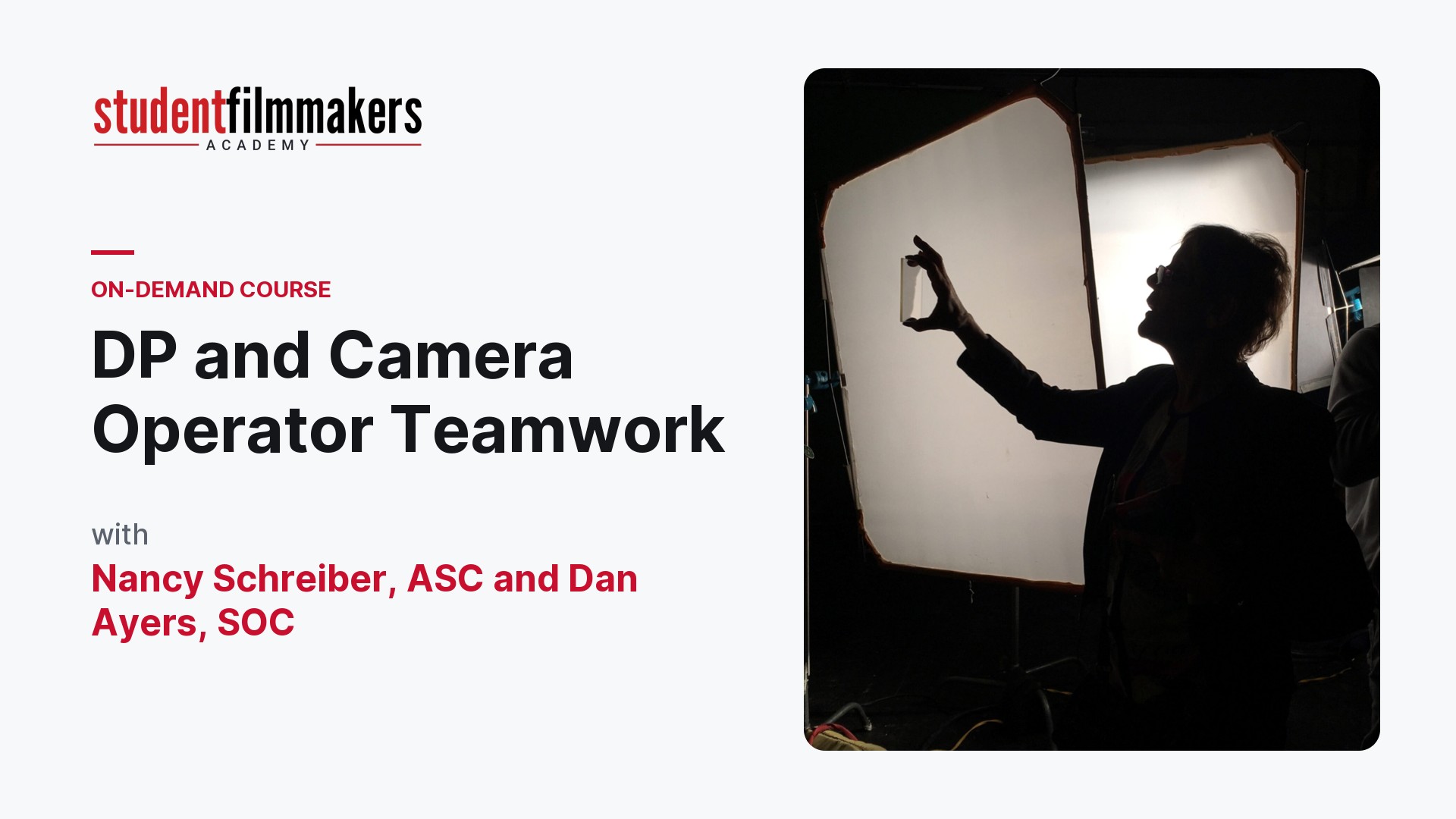
Nancy Schreiber, ASC won the Sundance cinematography award for November and has shot P-Valley and The Comeback. Dan Ayers, SOC was a camera operator on Avatar: The Way of Water. The two worked side by side on ABC’s The Rookie: Feds, and their class makes a clear case: a DP leads the whole set, so a trusted operator who shares her eye for framing is what keeps every shot on track. Schreiber hosted the conversation, and filmmakers on the StudentFilmmakers call filled the chat with questions for both of them.
Why does a DP need a camera operator?
Schreiber came up through electric in New York and worked her way to gaffer. On her early indie films she could not afford an operator, so she framed every shot herself. On a TV series today her attention is pulled in every direction: lighting, the director, showrunners and writers, the schedule, art department, hair and makeup, the DIT.
“The operator can focus entirely on what the shot is.”
She brings her operators into the private rehearsals with the actors. After that, Ayers takes over figuring out how to cover what the actors did. These days, he said, a crew cannot force actors into a set window the way they had to with slow film stocks. They let actors move where they want, then work out the coverage.
Shared taste matters. Schreiber once had a B operator on a movie who left too much headroom and centered everything, and she ended up on the walkie calling “pan right, tilt down” all day. Her advice for anyone hiring an operator: look at their website and their actual work, not only their Instagram.
What does the operator watch that others miss?
For Ayers, it is the background. Even on the Zoom call he caught himself checking what sat behind each person’s head. On The Rookie: Feds the sets were full of glass, so before a take he and the crew would walk the dolly or Steadicam move looking for reflections of the boom, the lights or themselves, and grips would tilt the glass panels to kill them.
That show ran three cameras. Ayers was the A camera and Steadicam operator, Robert operated B on a Movi-style gimbal, and Paige handled C. With three cameras, Ayers said, staying out of each other’s shots becomes a dance.
Who else is part of the camera department?
Ayers gave an answer some students did not expect:
“Stand ins are part of the camera department. The stand ins and the dolly grip. A good dolly grip is a camera operator.”
With little or no rehearsal with the actors, good stand-ins save the day. They remember that the actor bent down in one take and not in another, and they can tell the actor about a mark that moved for lighting. Schreiber helps the AD department choose them, looking for matching height and hair color. One stand-in she loved kept wigs in different colors, and short stand-ins sometimes carry a half apple box. She hopes wardrobe dresses them in similar colors to the actor, so the light is set for the real thing.
Ayers does not like the no-rehearsal habit. When an actor walks into light that was never meant for them on take one, the DP looks like the bad guy. Schreiber mentioned a sticker going around set: “if you shoot the rehearsal it’s not a rehearsal.”
Why choose primes on a fast TV schedule?
Ayers said they “took a lot of heat” for using prime lenses on The Rookie: Feds, where zooms would have been faster. His reason is about directors as much as glass. With a zoom, a director can walk away after a vague request and come back unhappy with the frame. With primes, the director has to pick a lens, say a 65mm on A camera from a certain spot, and everyone knows what the shot is.
To help directors choose, they carry a director’s viewfinder with a short zoom, and they use the Artemis app on phones and iPads. Paige would sometimes come over with a frame she had found in Artemis that kept her C camera out of A and B. For a deeper comparison of the two lens types, see Zoom Lenses vs. Prime Lenses.
Why do TV shows run two or three cameras?
Ayers said he has not worked on a series with fewer than two cameras in years. The math is simple for producers: if a third camera saves about two setups a day, it has paid for itself. Schreiber added the reason behind the pressure:
“When I started, it was five pages a day. Now it’s eight.”
She admitted she was worried about three cameras, but was happy with the look in the end: moody, not flat like TV. Ayers also shared a trick from his years on Monk. Directors there always wanted the close-up, but when they set up the wider shot first, the B camera got pushed off the eyeline. So he put the B camera in first for a clean close-up and worked the A camera around it.
Steadicam, gimbal or dolly?
Mostly it is terrain, Ayers said. If a dolly would have to go through a doorway, or the track or dance floor would show when the camera pulls back, it goes to Steadicam or the gimbal. He can turn corners backward a little more easily on Steadicam, while the gimbal can go lower. On The Rookie: Feds, he thought about 60 percent of the show was handheld, and on long moves he and Robert would split a shot or its coverage in halves so neither burned out. Once all three operators went handheld on one dolly, pulling back with an actor, because the director wanted it.
What happens when the DP and director disagree?
The crew has a name for it, Ayers said: “mom and dad aren’t getting along.” The DP warns him not to pan toward a sunbaked white wall, then the director asks him to pan there. He does not pick a side. He gets them together to talk it out. It is one reason he likes shows with two alternating DPs, so one is free to prep with the incoming director instead of discovering a hedge blocking the doorway on the day.
Notes from the chat box
- Mixed skin tones: Schreiber softens light on faces, avoids over-powdering actors, and a viewer pointed out a polarizer for reflective skin, which she uses often. A grip may net a very pale actor.
- Aspect ratio: On Neil LaBute’s Your Friends & Neighbors the studio would not allow anamorphic, so they shot 2.35 without it. Anamorphics were T4 back then, she said, and far faster now.
- Aging actors: Test filters and settings before production, and keep a special light ready. On The Comeback, Lisa Kudrow asked for standard-definition video.
- Every day on the walkie: Schreiber spins through the channels and thanks grip, electric and camera, every day.
Schreiber also taught a full session on choosing lenses for us.