By Dana Weidman Dorrity
Robert McKee says we lose interest when point of view isn’t set. Dana Weidman Dorrity explains how to use the camera as a character to build POV.
The screenwriting guru, Robert McKee, explains that if we lose interest in a movie in the first ten minutes, it’s because the point of view hasn’t been established. If we lose interest in the last ten minutes, it’s because the climax was not in the hands of the protagonist. These two points are the cranium and sacrum of the story spine.
At the risk of turning a metaphor on its head, in the first act, or roughly the first ten minutes of a movie, the audience wants to leave their seats and begin experiencing the action of the film through the point-of-view character. In other words, we get into that character’s cranium. Whether it’s The Blair Witch Project or Doctor Zhivago, movie-viewers pay eight dollars to have a vicarious experience; to get chased by a witch, or to fall in love. We don’t want to watch a movie; we want to leave our life for two hours and be in the movie.
This magical process happens both through the screenplay and through cinematography. The point of view character doesn’t need to be in every scene, some scenes may shift to the POV of the antagonist, but the point of view character will be in a majority of the scenes in a film. In Spiderman, for example, there is a great scene where Norman Osborne, brilliantly played by Willem Defoe, talks to his Green Goblin mask. The scene not only depicts action that the hero isn’t aware of, but it also reflects Osborne’s deteriorating mental state and his point of view. It’s a complete point-of-view shift to the antagonist character.
To establish a point of view character, the cinematographer uses subjective and objective shots. An objective shot might reveal a location, a character, or a group of characters. A subjective shot will show us specifically what one character sees. A great example of this technique is the opening of Vertical Limit. The movie begins with an eagle swooping through a canyon. The eagle is almost like the consciousness of the audience member searching for their character, and it’s a completely objective shot. In the next shot, the eagle is seen through the viewfinder of a camera. The photographer is Chris O’Donnell’s character, Peter. First the world is established, then there is a subjective shot, the viewer see what the main character sees, and the next shot is an objective shot of Peter, which establishes him as the point-of-view character.
In the sacrum part of the spine, the climax, the protagonist overcomes the adversary and faces the final ordeal. Since, by this time, the audience is inside that character, they win too, and they walk out of the theatre feeling like a hero. This is why people flex their muscles after seeing a documentary like Pumping Iron, or karate kick their date after Drunken Master II.
Digital cameras are lighter, smaller and can shoot in low-light, so there’s an opportunity to move the camera into locations that would have to be recreated for traditional cinematography. This enables directors to blend elements of documentary or news style into their films. This can be a tremendously effective storytelling tool, offering a feeling of immediacy, but if a point-of-view isn’t established, it can also leave viewers feeling dissatisfied.
Michael Mann’s Miami Vice adopted an edgy documentary shooting style which brought viewers directly into the action sequences, but in the more character oriented dialogue scenes, the movie lost momentum. Miami Vice was a significantly less satisfying movie than Mann’s HD masterpiece, Collateral, because a point of view character was never established. The story seemed balanced somewhere between Colin Farrell’s character, Sonny, and Jamie Foxx’s character, Rico. Both characters had shower scenes and sex scenes, but what was most disorienting was the lack of subjective shots. The camera always seemed outside the characters, shooting them, as though they were being featured on an episode of Cops. Rather than setting up the camera in the place of the actors then shooting each from the other’s point of view, a DV cinematographer can get into the scene and pan back and forth. In the limo scene, when Sonny is meeting with the crime boss, the camera is in the car with him shooting the entire scene objectively. In traditional cinematography, the camera would have been set up in Sonny’s seat to film the dialogue and reactions of the other characters. Then the camera would have been set up to shoot Sonny as he delivers his lines. By alternating between these subjective and objective shots, the viewer would experience the scene through Sonny’s point of view. Instead, because of the cinematography style, the viewer feels like an unidentified character along for the ride.
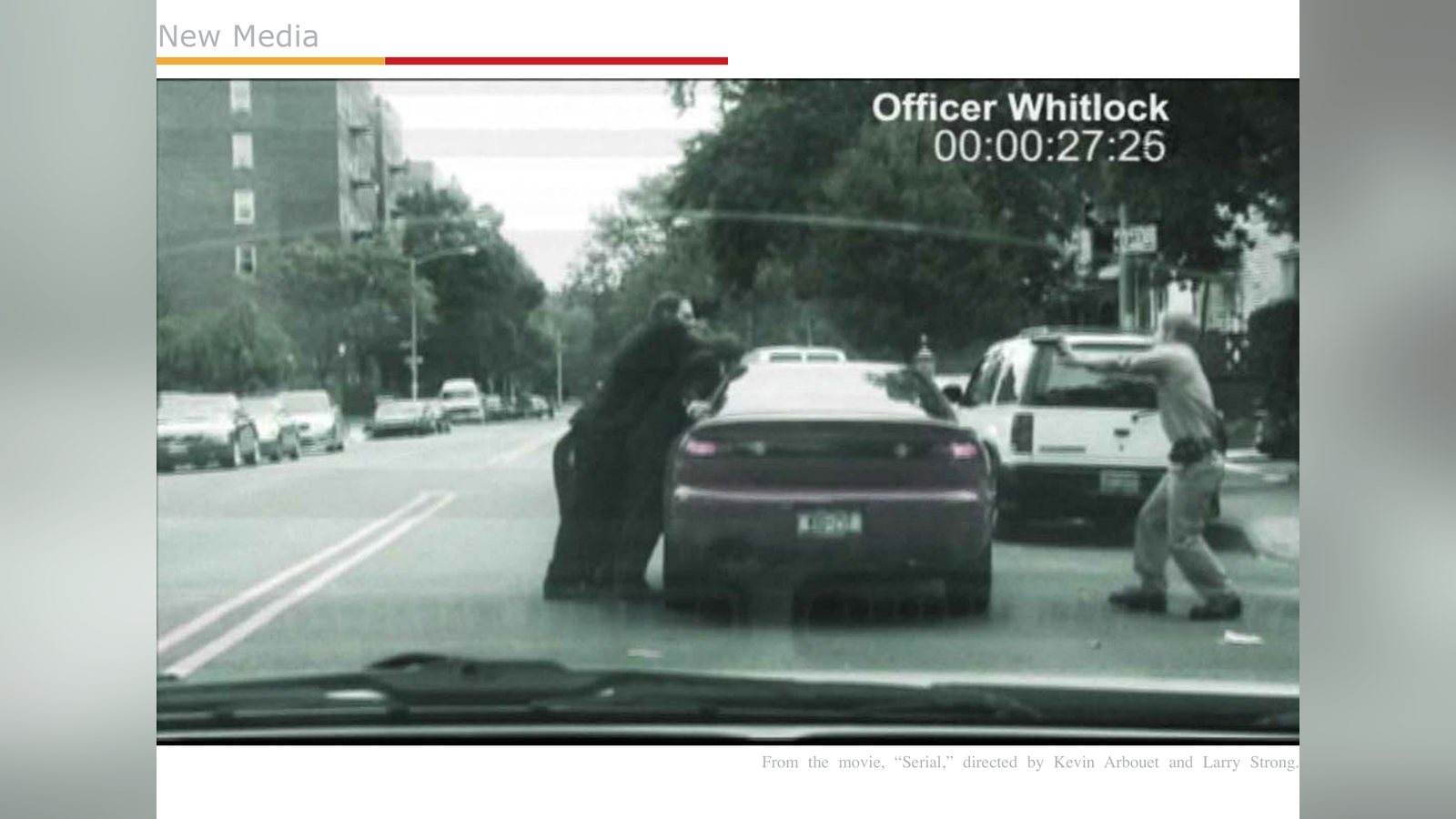
In Serial, a satirical, digital feature about a television news team, directors Larry Strong and Kevin Arbouet use the camera itself as the point of view character. Early in the film, as the news team gears up to cover a breaking story, the cameraman turns the camera around and looks into the lens. With this simple move, they set up the news camera as the primary camera shooting the movie. Four additional cameras: a consumer camcorder that the reporter uses for her video journal, a security camera, the camera in the police interrogation room, and the camera on a police car, also play into the story. Rather than using an invisible cinematographer who exists outside the movie, the movie becomes a recording of the experiences of this crew and justifies the use of news style cinematography.
Most viewers have looked into the viewfinder of a video camera, so it’s a familiar point of view for the audience. Rather than entering the story through a character, in some digital features, the familiarity of the video camera can provide a way into the story for the audience.
In Gus Van Sant’s digital feature, Elephant, the camera follows students through the halls of a high school as they casually say hello to their friends and go through what seems like a normal day. Rather than shooting in the point of view of the students, these long tracking shots follow the students from behind. This technique intentionally distances the viewer from the characters. The viewer barely gets to see the characters’ faces and almost never sees what they see, so the point-of-view remains external, an objective witness to the lives, and, for some characters, their deaths in a Columbine-like high school massacre. The placement of the camera also mirrors the style of the video game that the two students play before they decide to turn real guns on their fellow students.
The only subjective shot in Elephant, is the shot of the map of the school, as the two killers plot their route. Van Sant intentionally remains outside the characters as if to indicate that although we can watch them and study them, we cannot know them. The point-of-view remains in the cold, mechanical eye of the camera.
Like a camcorder toting tourist who steps backward into the Grand Canyon, in the camera’s point of view, there’s always the fear of what’s behind or outside of the video frame. The viewer is pulled into the action through the camera, then they are disoriented with only enough information to remain in suspense.
The Blair Witch Project was the first digital feature to incorporate the video camera into the story. Initially the film was marketed as the found artifact of a documentary crew’s run-in with a witch. Only the camera survived the attack. In previous films, like Ridley Scott’s Alien, there was a sense of security in the audience that one character, our point-of-view character, would survive to “tell the tale.” By establishing the video camera as an external point-of-view character, there is no longer a need for a human survivor. The video camera makes us expendable.
At the end of America’s greatest novel, Moby Dick, Ishmael, or at least the young deck hand who has asked to be called Ishmael, survives the attack of the White Whale by holding onto his friend Queequeg’s floating coffin. It is from this vantage that he surveys what has happened and one can assume begins the story that is Moby Dick. He’s the point-of-view character who recounts what he has seen. The video camcorder is today’s Ishmael, it sees though it doesn’t understand, and it leaves the tape, and the movie, as a record of events.
Dana Weidman Dorrity is an assistant professor of Communications and Media Arts at Dutchess Community College. She has an MFA in screenwriting from the American Film Institute and teaches media writing, screenwriting and video production classes.
from the Divider Kit System or Removable Interior Soft Carrying Case.
View the full line of Portabrace cases and accessories available at the StudentFilmmakers.com Bookstore Online at prices up to 26% OFF MSRP. Additional discounts for schools and universities; call (212) 600-4646. Visit the website for the latest free gift offers! Order Direct for immediate delivery from: studentfilmmakers.com/store Traveler Camera Cases Cool Shoulder Cases DV Organizers – Black w/Red Hiker Pro Camera Cases Backpacks – Modular/ Extremes Traveler Camera Cases – Camouflage
Keep learning filmmaking
Want more lessons like this? Join StudentFilmmakers free for live webinars with working pros, and stream on-demand filmmaking classes in cinematography, directing, screenwriting, sound and post.