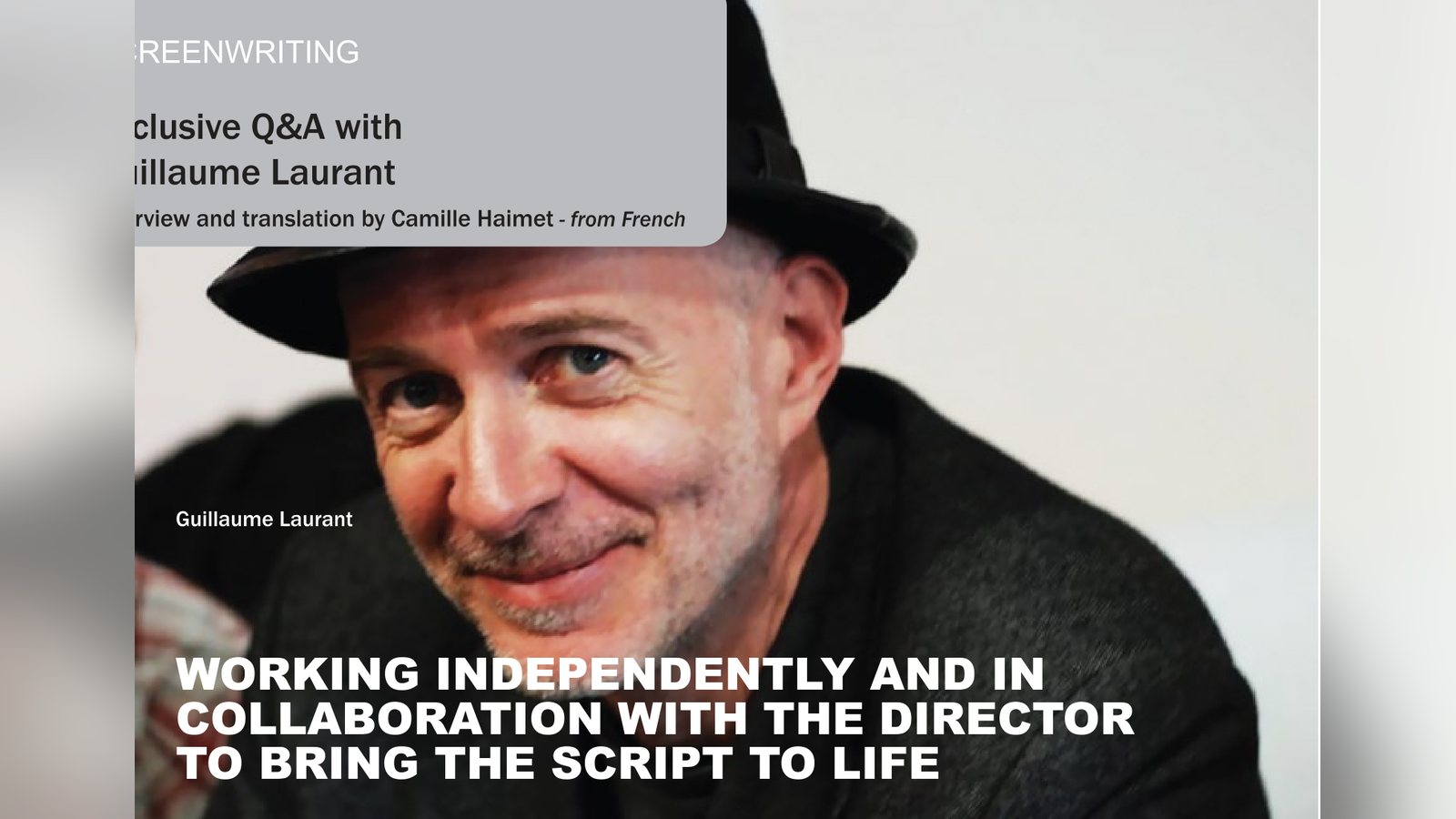
Screenwriter Guillaume Laurant, co-writer of Amélie, talks about his partnership with Jean-Pierre Jeunet and balancing your voice with creative freedom.
SF: Many of your scripts have been collaborations with Jean-Pierre Jeunet. How did this partnership start and how has it evolved over the years?
Guillaume Laurant: I am currently working on my sixth script in collaboration with Jean-Pierre Jeunet. At a time where I was doing amateur theater and working little jobs to sustain myself, the members of my troop gifted me with the book, “How to Write a Script”. I followed the model all alone in my small room and sent the product of this to Jeunet by mail. I had looked up his address in the yellow pages. He contacted me to write dialogues for “The City of Lost Children”, then consulted with me about “Alien IV”. Since then, we have collaborated on “Amélie”, “A Very Long Engagement”, “Micmacs”, and “The Young and Prodigious Spivet”, which is in production and due for release in October.
SF: What is the standard process? Does Jeunet come to you with an idea and trust you to translate his vision? Or do you come to him with an outline for a script?
Guillaume Laurant: The original stories that we work on Screenwriting Insights
Three Tips from Guillaume Laurant
- If you want to gain time, or at least not lose any, it is always a good idea to have a firm, though not immutable, idea of what the finished product will look like.
- It is also good to focus on who the main character is, because that point of view will give direction to the narrative.
- At one point, it may be beneficial to reread your work and try to see if there are any points where you could add something unexpected, surprising, or even illogical.
Guillaume Laurant: With Jean-Pierre Ameris, we discussed the story at length, but I developed the script independently. The rhythm of the narrative in the finished product moved a lot faster than my initial vision for it in the script. As for the dialogues, I felt a real challenge in balancing Victor Hugo’s emphasis with a more modern language.
“Le Fabuleux Destin d’Amélie Poulain”, (“Amélie”, 2001), written five Oscars, including Best Screenplay, and went on to win 51 international awards (Césars, European Film Awards and BAFTAs among them), as well as 46 other nominations. Guillanume followed this by co-writing “Effroyables Jardins” (“Strange Gardens”, 2003). He returned to co-writing with Jean-Pierre Jeunet for “Un Long Dimanche de Fiançailles” (“A Very Long Engagement”, 2004), which was an adaptation of a novel by Sébastien Japrisot. The film was nominated for two Oscars, won 16 film awards, and was nominated for 21 more.
are often ideas that he has been developing for a long time. We discuss them together and take notes. As for the books, Jeunet has people who prospect for him. When something holds his attention, he shows it to me and we discuss it. Then he often runs the story through a pre-deconstruction, and we write the script together. I write the dialogues independently.
SF: Do you find that you will often have similar visions of how the story should develop?
Guillaume Laurant: Yes, we know each other well. And I am quite familiar with his film style.
SF: “Amélie” and “Micmacs” have a very recognizable and playful tone. What goes into the making of this tone that seems to be a trademark of your collaborations?
Guillaume Laurant: These two scripts are based on original stories, the others are adaptations. For both, our method relied mostly on letting fantasy and imagination run wild and utilizing a more playful narration.
SF: What are examples of some challenges of collaborating on a script as opposed to having full creative freedom?
Guillaume Laurant: I never work on a script without knowing who the director will be. Even if the director is not a co-writer, I do the best that I can to mold my writing so that it melts into his vision of things; or at least to propose a vision that I believe will be adequate. I also write novels, which, I guess are my outlet for that full and refreshing creative freedom.
SF: What would you say is your strong suit in the collaborative process of putting together the script? Dialogue, story development, character development…
Guillaume Laurant: I love to create dialogues. This is something that comes easily to me and that I always take pleasure in doing. I am also very interested in character development, which leaves a lot of room for creativity. Whereas there aren’t 50 ways to structure a narrative, so this aspect is a lot less gratifying, in my opinion.
SF: Which was the favorite of your collaborations with Jeunet?
Guillaume Laurant: “Amélie”, which was only the second script I worked on that became a movie, which changed my life, and into which I put a lot of personal things.
SF: How has the collaboration with Jean-Pierre Ameris on your film “L’Homme Qui Rit” [“The Man Who Laughs”] been different from what you were used to?
Related filmmaking guides
- 7 advanced screenwriting tips
- 40 basic plot points for a feature film
- How to write a short film script
Keep learning filmmaking
Want more lessons like this? Join StudentFilmmakers free for live webinars with working pros, and stream on-demand filmmaking classes in cinematography, directing, screenwriting, sound and post.