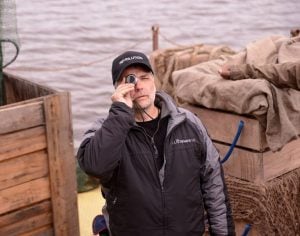
Meet Alex Fuerst, a director of photography based in Texas, United States and a member of the StudentFilmmakers Filmmakers Network. See Alex’s Network profile to connect.
Alex Fuerst is in post-production on his most recent project, TV pilot, Soulicitation, which was shot with a Canon 7D. He shoots mostly HD, especially with HDSLRs, but has experience working on several 35mm and super-16mm film productions. His most recent film project, Knife, is a short film executive produced
Charles Baker. His next project, which is a short, will be shot with a 5D Mark II and 7D.
Why did you choose to shoot the TV pilot on DSLR versus another kind of camera?
Alex Fuerst: Time and Budget. The project has been volunteer-based so far and on a shoe-string budget. Originally this was going to be shot with one of the Panasonic P2 cameras but a camera test comparison easily convinced the director to embrace the more cinematic 7D. Also, footage could be played back on the spot to make sure we got the shot. In post the HD workflow is a lot smoother than that of film, being that the final format would be HD anyway, so there was no nail biting while bank. I currently own a G-170s shoulder support rig by Gini, Zacuto Z-finder, Zoom H4n, Manfrotto tripod 503 head with 745XB legs, and a Manfrotto 577 quick release adapter.
Are you using different lenses and filters?
Alex Fuerst: I own a Canon 28-135mm f/3.5-5.6 USM IS (kit)
and a Canon 50mm f/1.4 USM prime. I will borrow or rent lenses if necessary for certain projects. On my personal lenses I put on HOYA Super Quality HMC (Multi-Coated) UV (0) filters right out of the box. This not only filters unwanted UV light but protects the glass on the lens. It’s very easy to clean or replace a filter compared to the glass on the lens itself. One of my favorite filters is an H&Y variable ND filter that allows me to control my depth of field in very bright shots.
In reference to working with these HDSLR cameras for making movies, what are you doing for audio and sound?
Alex Fuerst: Where these HDSLRs really fall short is on their ability to capture good audio. I’ve tried inputting mics directly into the Canon’s 1/8” jack and the results are still terrible. I strongly recommend a digital field recorder like my ZOOM H4n. It has built in compressor/limiter, phantom power, and a plethora of other great tools that can be useful in post and for those who are musicians as well. I have also used the Marantz PMD-671 that the film department of the University of Texas at Arlington makes available for students to check out. I prefer the H4n.
Could you give an example of a scene from Soulicitation and the camera/equipment setup?
Alex Fuerst: My favorite scene we shot required a very moody and intimate feel. To accomplish the shot I used a very fast lens between f/1.4-2 and a 85mm focal length to get plenty depth of field that creates that creamy bokeh we all love. What we did for the lighting made the scene though. We back lit with a 1K gelled to a rich amber hue and had a few diffused fills coming from just left or right of camera. I got chills on several shots in this scene and I knew this was going to be a stunning project to see finished.
What would you say are some challenges of shooting/ editing with HDSLRs that you’ve found and applied solutions or alternative solutions for?
Alex Fuerst: Capturing good audio is the biggest hurdle.
Once you get past that the next challenge is being able to pull focus accurately. Especially without a follow focus. The lenses that are made for these HDSLRs are designed for and excel at fast autofocus photography. A cinematographer must recognize this and find methods of overcoming the short range and sometimes the ‘play’ of the focus ring. Best solution for this: know your glass and practice with it! Only buy or use the lenses that focus well. Even with a mediocre lens a good follow focus will help tremendously. Zeiss, so far, is the only lens manufacturer to give the HDSLR users lenses with features that have been used on film industry standard cinematic lenses for decades.
What do you edit with?
Alex Fuerst: I have used everything from iMovie to AVID to Final Cut Pro that I use now. I have a MacBook Pro with Final Cut Studio 3 and Adobe CS5 Production Premium. Being a student, a laptop is the most practical for me but I do miss the power of my old 8 core Mac Pro I had at my last job.
For Soulicitation we imported and converted footage to Apple Pro-Res using Canon’s free EOS Movie Plugin-E1 for Final Cut Pro. This is a great tool I use for every project since I got it. Editing with Pro-Res footage has been very smooth at full 1080p HD footage and I highly recommend it.
What are your favorite cameras and film/video making tools?
Alex Fuerst: I can’t stop praising the Canon HDSLRs. They have changed the game and left other makers behind. The Panasonic AG-HVX500 is a favorite of mine to shoot video with when not on a film project. I really miss the CamMate 2000 series jib that I had been operating for the last 3 years before returning to school. The now available camera sliders/dollies are really cost effective tools for cinematic movement but there is nothing quite like using a J.L. Fisher dolly. Steadicam systems are another favorite tool I have used.
If you could share one piece of advice for new and aspiring filmmakers and video makers around the world, what would it be?
Alex Fuerst: Story! Without good story, we have nothing.
With the technologies that are available at more and more affordable prices nearly anyone can produce something that “looks” great. However, the tools do not make a good film or filmmaker. You can have all the gear and gadgets and still have a film that does not connect with the audience. Purposefully make decisions that progress and develop the story for the end audience. This applies to everything from films to commercials to bar mitzvah slide shows. Now, go share your vision and change the world.
www.alexfuerst.com
Related filmmaking guides
Keep learning filmmaking
Want more lessons like this? Join StudentFilmmakers free for live webinars with working pros, and stream on-demand filmmaking classes in cinematography, directing, screenwriting, sound and post.