By Paige Cram
Writer-director Sasha Knezev talks about her award-winning short Fragments of Daniela, about sex trafficking, and how her background shapes her writing.
I tend to incorporate a lot of my own background into my writing. My parents are Eastern European. I’m Serbian by decent. I’m a first-generation American. I tend to stick to issues of cultural amalgamation, cultural specificity, cultural identity, and the Americanization or Westernization of various cultures that are specific to Los Angeles. My newest film comes from my experiences in Eastern Europe. I have family there, so I visit quite frequently, and I have an apartment in Northern Yugoslavia, Serbia. I travel extensively when I go down there, and that’s where I get my writing…
What inspired you to write “Fragments of Daniela,” and why did you choose to do this film as a narrative instead of a documentary?
The reasons I wanted to make this film – I came back from Europe and in Europe this is a well-known issue. Everybody has an opinion on it. Then you come back to the States, you bring it up, and people are just so unaware. It’s shameful really.
It’s something that’s so horrific that I felt I needed to express it in some way, through the craft of writing and directing. I’ve seen endless documentaries on the subject of human trafficking, but there’s never been a narrative… I always stick to narrative because if you do it right you can bring the element of pathos, the human touch, something more evocative. I’m just such a fan of the collaborative process of filmmaking. We’re using all those various components: the music, the acting, the composition, the score, the framing, the writing… If you’re human you’re going to be touched by this [film]. Human trafficking, in and of itself, is repulsive; it’s shocking. With a documentary… you get that window on reality, but through a narrative you have the ability to convey a story that is able to touch the audience on several different levels.
The film screened in New York and won Best Dramatic Feature in NYIIFVF. How will the LA screening be different?
It’s going to be good in LA. The cast is from LA. My family is from LA. In New York, there were only a couple of us. It was really well received, but this is more important to me because my family will be there, my entire crew, everyone involved in the production – so it’ll be the first time we all watch it together. It’s going to be exciting to share that experience with all the people who worked so hard.
This is your second feature film. What do you feel you learned from your first feature, “Welcome to San Pedro,” that helped make “Fragments of Daniela” more successful?
My first film was really personal, and because it was personal I think it took a lot out of me. I focused more as a writer on the writing, the authenticity of the characters and of the situations, and I was just concentrating on protecting the story. You worry so much about telling the story that you forget about all the other forms of the medium that are so important in its reinforcement. You forget about the score, lighting, etc. On Fragments of Daniela, I was really able to use various forms of the medium very well. We have a fantastic score in this film; the cinematography is much better… We knew our locations and pre-visualized the shots, whereas with the other one, we just kind of went as we went along. Also, we were a lot more liberal with the editing style; I didn’t feel it had to be as linear as the first one. Financing came a lot easier this time because I already made my first film. Then you have that backbone to support your new project.
How was Fragments of Daniela shot? How long did it take to shoot?
We shot on the Digital Canon XP2 24 P. One year to write, shoot, and edit.
Did any problems coming up filming?
Not having permits always creates problems, but for the most part, it was smooth.
How was the score in the film developed?
Eric Froeberg of USC has composed all my films and continues to do so. This is his third composition. He composed it on stage live with a five man set. I wanted a Balkan melody, so he studied its style as such.
What was the biggest challenge of this film, and how did you overcome it?
The biggest challenge, from a director’s standpoint, was not to exploit the exploited. I’m making a film about the exploitation of women and girls, these sexually abused human beings, and the trick is to be really subtle. You have to convey that to all your actors, your crew. You have to be very careful. I think that’s why people do documentaries on things like this because it’s safe. When you start getting to the narrative part of it, it’s tricky. We don’t want to objectify these girls, but then again, these are beautiful girls, and you do have to show that these girls are dolled up, but there’s a delicate balance. We tried to avoid being explicit in showing sexual acts. Also giving a thorough, three-dimensional background to the characters was the most important part.
You’ve said that Daniela is based on a real girl. Tell us a little about how you met her, and what it was like.
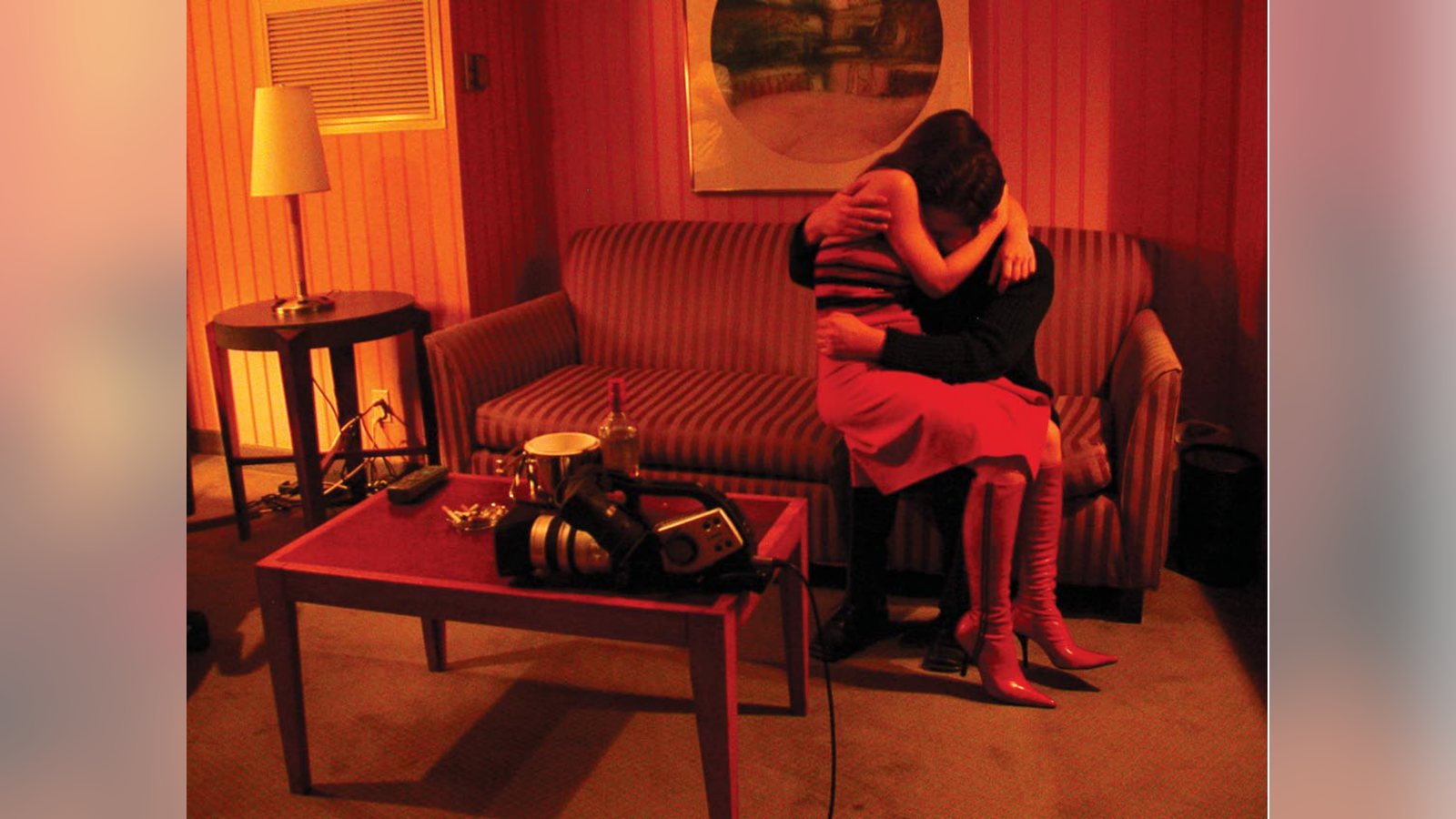
In Europe, it’s so open that it’s ridiculous. When I was in Greece, I was walking in the street at two in the morning, and people stop you and say, “Hey we’ve got girls. Right here. From here, from anywhere. Come here.” And it’s weird because most of us have heard these stories, but unfortunately, we’re so consumed by every day life that we never stop to ponder the significance. Then I started to ask questions, and people are very open. It’s not a hush-hush thing. And at one of these bars, these strip bars, I sat down and spoke to this girl. The girls drink a lot, and that’s in the film because they choose to remain in this fog. So we’re sitting, having drinks, and I questioned this girl for about 20 or 30 minutes. Everything that Daniela says in the second scene in Sam’s hotel room comes directly from this girl. For example, Daniela says, “I have a mother and a brother.” This girl told me she had a mother and a brother. So the things that Daniela says and her background come directly from that girl.
What are some of the differences between your real life experience and what you put into your script?
In my film, she’s sent to the hotel room of the reporter, but normally the girls are not allowed to leave the room. The girl that I talked to was from the Ukraine. I switched her background [in the film] to be Romanian because my actress was Romanian.
What led you to start your own production company?
I knew I wanted to be a filmmaker, and I knew I was going to do it on my own. I wanted to go outside the studio system because I want to make the films that I want to make. No one’s going to edit or tell me what I can or cannot make. I made the film, Welcome to San Pedro about the Serbian and Croatian community in Los Angeles, and who’s going to finance that? But at the same time, that’s my story, my life, and I’m going to make it.
What does it take to start a company to produce your own films?
You have to be self-sufficient. You have to be very ambitious, and you have to prepare yourself for failure because you’re going to fail along the way. Do what you gotta do. Cut corners, pay when you gotta pay, but don’t go the other route.
Can you talk a little about your experience at USC?
It was a fantastic experience. I have some professors that left a profound influence on me. My focus was in critical studies. That’s where I learned the most, really learning intensely about my favorite filmmakers, [the ones] who came from a time when the filmmakers were also film theorists. Unfortunately, we don’t have too much of that these days, but to me that’s the greatest education you can have: where you’re not only watching someone’s film but reading his theories, reading his essays, his works. Studying the work, writing about the work, theorizing and really dissecting the medium. That’s really what I learned from USC, and that’s really what helped me become the writer and director that I am.
Who were these filmmaker/theorists that you studied?
Todd Boyd, Priya Jaikumar, and David James. Those three have had an amazing influence on me. I can’t even begin to put words to it.
Would you say that film school helped you get where you are today?
That’s difficult. I would say it’s twofold. It has in my education and learning the specifics of the medium. So from an educational stand point, yes, but as far as being a writer goes, that’s something I really learned on my own.
What advice would you give to aspiring filmmakers who hope to achieve your kind of success?
Prepare to get your hands and feet dirty and never give up. If you have a story to tell, tell it. And keep going. Tell another one, and another one and another one. Because you’re going to put a lot of energy into that first film, and it’ll open doors for you, but it’s not going to set you financially. If you’re doing it for the money, be a stockbroker. But if you love cinema, eventually your passion will transcend into something. The energy that you create will carry you places.
Paige Cram is a recent graduate of the University of Massachusetts where she studied journalism and creative writing. Among other honors, she was awarded The Robert Crowley Memorial Prize for Excellence in Column Writing for her published articles in The Massachusetts Daily Collegian. She hopes to attain her MFA in creative writing beginning next fall.
Keep learning filmmaking
Want more lessons like this? Join StudentFilmmakers free for live webinars with working pros, and stream on-demand filmmaking classes in cinematography, directing, screenwriting, sound and post.