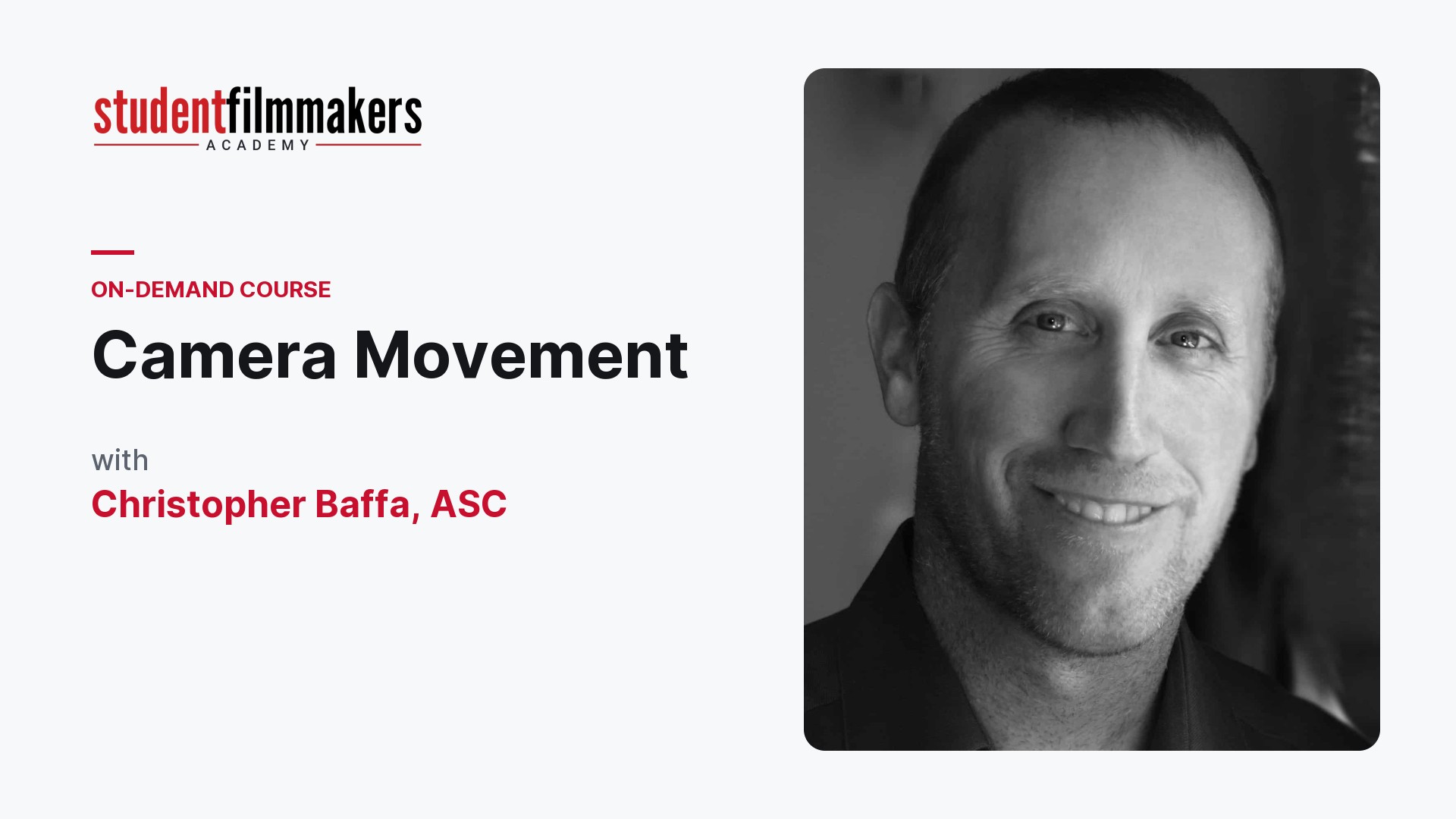
Christopher Baffa, ASC was director of photography on the Glee pilot and the show’s first three seasons, and he also photographed most of Nip/Tuck, Ryan Murphy’s Running with Scissors and episodes of Krypton. He says every camera move starts with a single word: why. In a live class for StudentFilmmakers, he played scenes from his own shows, broke down tracking shots, handheld, push-ins and pull-backs, and answered filmmakers’ questions on Steadicam, cranes, drones and shot lists.
Why move the camera at all?
Young directors often tell Baffa they want a certain move. His answer is always a question:
“I will always ask as a director of photography, why? What are we trying to say with that? It’s not to be difficult. It’s not because I’m mean.”
Sometimes the reason is simple, like keeping two people in frame as they walk and talk. Sometimes it is emotional: building dread, or pulling the audience into a character’s head. What he wants to avoid is the gratuitous move, the one made “just because.” He is happy to break rules, he says, but only after knowing them.
What does a tracking shot give you?
More than geography. On American Horror Story, he showed a young man walking a hallway with the camera holding a close-up the whole way, so we stay in his head as he moves. Then the camera swings behind him. Baffa loves the behind shot because you are still with the character but you now see what he sees: a woman in a green dress, people giving him strange looks, where he is headed.
His favorite example is from Krypton. The camera starts in front of the actor, lets him spiral past and overtake it, and ends up behind him as he enters a place he has never been. Shots that stayed in front were also filmed, but the editors did not use them because they were less interesting. The director’s only note to the actor was to throw a few looks back over his shoulder so the audience could catch his face.
That shot, filmed in Northern Ireland, moved through a crowd. A filmmaker asked how the Steadicam avoided hitting extras. Baffa explained the setup: a stripped-down Steadicam on a wider lens close to the actor, a first AD who chose the extras he trusted to walk toward camera, and several rehearsals. On the first take, background actors stepped aside too early, and it looked like people dodging a camera. The fix was to tell them to wait until the rig was about a foot from their chest, then slip away.
When is handheld the right choice?
Baffa thinks handheld is often overused, but he showed a scene where it was perfect: a child’s terror, with the operator making a small push-in just by stepping forward. Because it is just a person with a camera on a shoulder, the move can be spontaneous. “They don’t have to cue a dolly grip, they don’t have to wait to be told, they can react emotionally.”
He also used it for combat, where it brings confusion and chaos, and for a dreamy, loose feeling after an injury, the sense that things are “not quite right.” Its documentary roots make the audience feel present, as if they were one of the firefighters at the scene.
Can push-ins be overused?
Yes, and he has seen it happen. He once worked with a director who wanted to push in on everything. Baffa told him:
“We’ve done so many push-ins that the audience is going to feel like that’s the normal thing, so that the push-ins all have weakened each other.”
The director agreed, and they learned to pick their battles. The push-ins Baffa showed instead were chosen with care: a slow move on Annette Bening in a bathtub, a tight close-up pushing even tighter as intensity builds, and a reverse idea, a pull-back on a boy hearing terrible news on the phone, so he seems to shrink.
How did one dolly move link two characters?
In Running with Scissors, the camera pushes in on a boy, then drifts over and keeps traveling on the same track to land on Jill Clayburgh. It began when Ryan Murphy asked whether they could pan to her after the push-in. Baffa suggested finding her during the move instead. He had already lit for it: as soon as he sensed both actors might end up in one shot, he made her key light the boy’s backlight. His point to the class was that the more the camera moves, the more it sees, and the more you have to light.
A cut to her would have been easier. The single move, he said, told the audience there was a link between the boy and her, and that she was having a deep reaction to the moment.
When should the camera stay still?
Sometimes the strongest choice is no move at all. Baffa recalled a pilot that never aired, where a well-known actor playing a straitlaced businessman made a grand entrance down a staircase, dressed as a nurse for a costume party. The director asked whether they should push in to accent the moment. Baffa’s reply: “You mean other than him coming down dressed as a nurse?” The director laughed and agreed.
He also shared a lesson from early in his career. Martin Landau told him that on films with lots of camera movement or dramatic lighting, he pulled his performance in a little. When Woody Allen told him he would sit on a 24mm lens in the corner for a whole scene of Crimes and Misdemeanors, with no coverage, Landau had to bring his performance up. Baffa says that talk still colors his choices: if an actor is on point, get out of the way.
Does TV camera work differ from features?
Not to him. “I try and shoot a television show like I would shoot a feature,” he said. The difference is the schedule, which means more planning. He gave a Glee example. The show kept a Technocrane on the auditorium set for musical numbers, and a producer asked if it could go once they moved to a dialogue scene in the seats. Baffa asked to keep it. When the producer came by to ask why, Baffa had the crane grip retract the arm, swing it over and extend it to the reverse over-the-shoulder. No seats had to be unbolted by the art department. The pricey crane saved time, and “time is money in Hollywood.”
On a smaller film, he told the producers he would not bring big-budget expectations: “I don’t wear beach wear to a formal wedding.”
Which tools does he reach for?
| Situation | What Baffa did or suggests |
|---|---|
| Walk-and-talk straight in front of actors | Steadicam, or dolly track with planks laid over it so actors are not stepping over the rungs |
| No dolly or Steadicam | A handheld operator in a wheelchair |
| Tight spaces | An ARRI Alexa Mini stripped to its bare components; small high-quality mirrors with a long lens for brief moments |
| Close-up to huge overhead | A drone held by a helmeted handler, released once up to speed, rising from a crying boy to a full view of a church |
| Fixing a move in post | Digital punch-ins are possible, especially from 8K, but he dislikes them; he would rather zoom on set |
The drone shot took planning with safety staff, stunt people and child services, with five or six people deciding when it could be released. He also learned from a park ranger that drones cannot be flown in U.S. national parks. On a small project with no time for all that, he suggests the biggest crane you can get and a cut or dissolve.
How do shot lists and storyboards fit in?
Storyboards help everyone see problems early. If a green screen sits outside a window and the boards show it 19 times when the budget covers three, the team knows before the shoot. Shot lists are a guide, not a contract. One director he works with hands his over saying it was made in the middle of the night without any actors or cinematographers present, and he expects them to improve it. The best list Baffa remembers came from a director who arrived with the essentials and clear reasons for each shot. With two handheld cameras and everyone assigned, they made about 77 setups in one day.
He also shoots with the editor in mind. Going from a big wide straight into a single can feel abrupt, so he will ask for a quick medium. He would rather the editor have it and not use it than wish it existed.
More on moving the camera: M. David Mullen, ASC’s Notes on Camera Movement, The Importance of Dolly Shots and Setting Up Your Track and Important Keys to Successful Handheld Camerawork.