By Jody Michelle Solis
Phillip Van, Eastman Scholarship winner, talks about directing and shooting his short film High Maintenance: visual effects, budget and winning festivals.
Director and cinematographer Phillip Van is named the 1st Place winner of the 2006 Eastman Scholarship for film students at the 60th Annual UFVA conference in Orange, California. Van receives a $12,000 scholarship for his film, “High Maintenance.”
What is “High Maintenance” about?
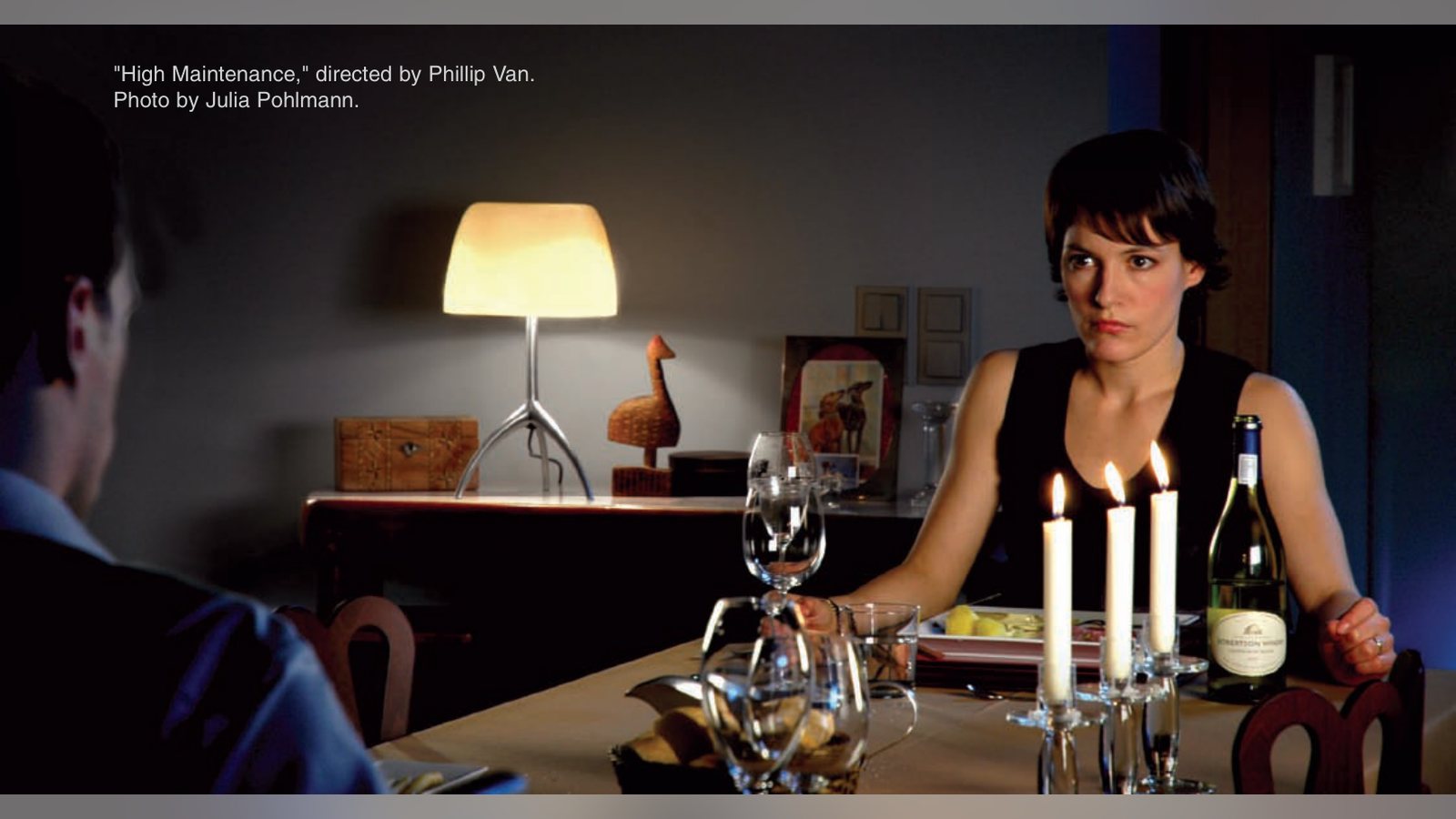
It is about a woman who is dissatisfied with her monotonous marriage and decides to exchange her husband for an upgrade. In the near-future, husbands are modified and can be bought on the consumer market. The film uses hi-concept ideas to really focus on a small inner-personal story about a woman on her search for fulfillment through a man. Of course, it doesn’t turn out as she expected it to, and she has to deal with the consequences.
Could you talk a little bit about the origins of the production?
I made this film through the Berlin International Film Festival. Every year a student-oriented part of the festival called the Berlin Talent Campus admits around 500 filmmakers from approximately 3000 applicants based on their work. From the 500 filmmakers, three are selected to make short films during the week of the festival. The films are fully funded by a production company in Germany, and are made in a single week. The three films go into competition at the end of the festival and the 500 filmmakers in addition to industry guests vote on a winner. It’s the largest jury vote in the Berlin film festival and this year my film, “High Maintenance,” won the competition.
Could you talk about one or two interesting things that happened during pre-production?
I was asked to direct one of the talent movies based on the work I submitted. They called me a few weeks ahead of time and I accepted the opportunity immediately. I was pre-producing in New York for a few weeks – working on storyboards, breaking down the script and casting from New York by communication with the production company in Germany. They would send me DP and editing reels and headshots as well as video reels from the actors. All the actors we were looking at had extensive T.V. or film backgrounds in the German film industry, so they were very accessible through their work. My actress, Nicolette Krebitz, starred in some great films in Germany and Europe. I watched her in an epic sized production called The Tunnel, about tunnels that Germans dug to help their loved ones escape from East Germany under the Berlin Wall. She had some extremely powerful scenes and it was clear to me she was a serious ingénue. It was just wonderful to be able to base my decision to work with her on these kinds of films.
The last week of pre-production was in Germany. I was staying there and dealing with the initial culture shock, and at the same time, trying to get the film off the ground in the dead of winter. And that was an amazing experience, going every day to the production company and to the little office they had set up, and speaking to an entire team of Germans. They were all incredible. English is a heavily spoken language in Germany, so it was easy to communicate and get around, but there were still so many cultural differences. It was great to be thrown into the fire, so to speak, with a crew from a completely different culture. I storyboarded every shot ahead of time, and the images helped a lot, especially in the few cases that crew members didn’t speak English. I was able to communicate with them in a very exacting way, irrespective of the language barrier, through pictures, and that was awesome.
How many days did it take to shoot?
The film was shot completely in two days. The entire film was made, with breaks, in about eight days. We shot in two days, edited in about two-and-a-half to three days, and then we did final sound design and mixing in two days. The movies that the Berlin Talent Campus commissions are all made in the limited span of a week. It wasn’t like a 24-hour competition, where the time span is necessarily taken into consideration by those who view the final film. We had to make what would essentially take a thesis grad film student three to six months. We had to make that quality and standard of a film in a week. That was the energy in the air and it was absolutely my goal and expectation. It was the shortest time I’ve ever made a full short, and it was difficult but compelling. I didn’t sleep very much. Maybe about twenty hours the entire time. It was an intense situation.
Could you share one or two lighting tips or tricks that you used in “High Maintenance”?
Our location was on the 12th floor of an apartment building, and we had to shoot day for night. The whole story takes place at night. We were dealing with a full wall of windows in the living room, with no porch or access from the exterior. We put ND 1.2 gel on all these windows, but alone, it felt bland visually. We decided that if it was night and we were in a metropolis-based environment we should see building and city lights outside. We couldn’t get a crane to suspend a light outside the window, because we were too high and on a budget, and of course, none of the buildings were lit because it was the day.
I work as a DP in the city in addition to the work I direct, and my great DP, Felix Novo De Oliveira and I collaborated pretty intensively on our lenses, f-stop, light units, all facets of photography before the shoot. We basically just used the simplest New York trick in the book – we strung up a set of Christmas lights behind the window sheers and in front of the ND, and then taped some of the bulbs to create different shapes with the light. By throwing the windows slightly out of focus in the background with longer lenses and an open f-stop, it looked convincingly like a city lit at night outside of the windows. It was a true no-cost solution and it was very effective.
In researching the look of the film, I decided that I wanted it to be softly lit but to have a high contrast ratio, with graphic lines and sharp, bold blacks. This dynamic aesthetic felt fundamentally related to the story, which I visually equate to an off-kilter mix between a romantic dinner, the film noir genre and a horror or scifi tale in a graphic novel. Soft light felt romantic, while dynamic contrast ratios came from the world of sci-fi and film noir and worked well with the uncanny and sometimes eerie tone of the film. The intermingling of the two was the way we married the visual world of the film with its narrative influences.
Was there a particular scene that was most challenging to light?
Yes, definitely. There’s a reveal that a character is not human, and it involves a very small and peculiar implant built into a part of his body. We shot it with macro lenses. We had to underexpose it a bit, and we had to hide some of the flaws, in make-up and prosthetics, with the light, which can be tricky.
Did any challenges come up during post production?
The first cuts of most films are generally not so great, even when the films themselves are. There are always pacing issues and a lot of rough edges. Stopping at a first cut of a film is like deciding to go into production with the rough draft of a script. We knew that we had to get past a first cut in a very short amount of time in order to get the film tight enough to do justice to the great material and performances we shot. The challenge was essentially that we had to get to a legitimate third or fourth cut of the film in roughly twenty hours, with no time to step away, gain perspective and re-approach the material.
We had to streamline the whole process, and my wonderful editor, Dorothee Brockelmann and I used a technique that I just call “over-cutting.” I came up with it while editing directing exercises at NYU overnight. In a typical editing process, you can shape and refine a film over time, whittling down a longer version of it until you get to an acceptable length and pace. Instead of lavishing my film with pauses, beats and ‘precious’ between characters, I make a note of them on paper, then basically just cut them out. It sounds destructive, and it is, but only at first. After you “over-cut” the film it ends up being too short, lacking a definable pace, and somewhat difficult to understand. When you hit this point, you start to re-insert the pauses. The act of adding time decisively, rather than taking it away slowly, makes you extremely conscious of what a pause or a breath is doing in your film.
Do you think it’s important for filmmakers to enter film contests and festivals?
Yes, definitely. Competitions and festivals get your work out there to an audience or a committee that can evaluate it. Filmmaking doesn’t end with a final cut. Audience reception is a part of the experience. You want to see how your material plays among those that are not you, not your friends, and not a hermetically sealed group of people.
Watching my films in different regions of the country or in entirely different cultures is always an eye-opening experience. Often, moments that you just know work actually work universally, across cultural divides. Others don’t. Screening a film you made in a different part of the world is one of the most fascinating possible types of communication with other cultures.
So yeah, get your stuff out there, and get the feedback of creative communities in your country or from around the world because you’ll come to know yourself more as a result of it. As a filmmaker and as a person, you’ll get a better understanding of your own tastes, inclinations and motives and how they resist and define different parts of your own culture.
How important is it for students to gain industry experience while pursuing their undergraduate and graduate degrees?
It can sometimes be difficult to time-manage, but for me, it was critical. As a graduate student at NYU it has been fairly easy to interact and work within the industry in New York and attend the program because of proximity. But as an undergrad initially getting into film at Cornell, in upstate New York, the isolated, self-enclosed environment made things difficult. I needed a way out. I needed to experience what the industry was, or at least, what New York City was, if nothing else.
How has film school helped you?
It has done a lot of good. The main thing I took from film school is probably simpler than I would have thought going in. The program really taught me how to work with other people, not that I didn’t know how to beforehand, but I mean every type of person imaginable.
I got into a few graduate film schools that I had always admired and was overjoyed but a little overwhelmed trying to make a decision between them. I was picking between NYU, Columbia, USC and UCLA. One of the incredible things that separated NYU from the other schools was that they chose a widely diverse, extremely intelligent group of people per class. Don’t get me wrong, the other schools have an amazing and diverse student body, but NYU’s range of diversity was something I had never before experienced. And I come from a very multi-cultural background. I’m Greek American and Vietnamese. My father is a refugee from Vietnam and a taxi driver and my mother was raised in a Greek community in Chicago and is now a supervisor at Keiser. I was raised in Honolulu and Portland, Oregon.
Even in coming from this background, NYU was on another level. And that may sound isolating, but it wasn’t. It was eye opening and definitional. And I firmly believe it has made me a stronger filmmaker and as cheesy as it sounds, a better person. There is not a culture, type, ethos or work ethic that you don’t encounter in NYU’s film program. What really teaches you about these people, is that you are thrown into highly technical, often stressful situations with them. You grow with them through a struggle against money and time in the name of your passion and art. And that’s something that transfers right into the industry.
Do you feel that film school has hindered you in any way?
I don’t, because I have been able to do everything that I would have wanted to do outside of film school within film school. In other words, I got to work while I was in film school. My professors and the faculty were in complete understanding when I had jobs come up, whether it was shooting a narrative film or for a company like Kenneth Cole or Macy’s. They would give me time off class and understood that it was a part of my education as much as coming to school.
I got to use all of the school’s facilities, so I could edit, I could take out grip and electric gear, use the sound stage. You can get better deals at rental houses because you’re a student. NYU believed in my work and I was on significant scholarships and finally a full ride dean’s fellowship. And the students in my class are some of my greatest collaborators. So no, I can’t think of any disadvantage. I wouldn’t take back the experience at all.
What are you working on next?
I’m writing a feature version of “High Maintenance” with Simon Biggs, the writer of the short, from Scotland. I’m also working on another feature script and a pilot. And I’m always shooting.
What advice would you give to beginner filmmakers?
Know yourself. This isn’t a Zen theory. It’s practical. Find meaning in what you do, and make sure that it’s meaningful to you first. Don’t do things just to satisfy other people. It sounds contradictory, but this is the best way to understand and expand your audience. If you were the one sitting in the theatre, and this thing came up, and you didn’t know who made it or where it came from, but it happened to be your film, the way that you watch that film is the most telling thing of all. Take into consideration the advice of others, especially those with experience and taste, but don’t forget that perspective. And if you can satisfy that audience member, that spectator who happens to be yourself, you will be making a film that many other people will want to watch, it’s almost guaranteed.
Learn how to work with all types of people. The more that you’re comfortable with every type of person that you could imagine, the more you can get in sync with them creatively and professionally, the better you’re going to be on set, and the better you’re going to be in every stage of filmmaking.
The amount of creative insight, advice and opinions that a team of people can give you is not to be underestimated. It could make or break the film. One of the biggest parts of directing and making films is having a strong personal vision, but also learning to accept, appreciate and to use anything that comes at you that is truly good. Don’t let your ego get in the way. It’s critical that you’re open all the time to new ideas and inspiration.
Jody Michelle Solis can be reached at [email protected] .
Related filmmaking guides
- Film directing: getting good performances
- Coverage and the master shot
- Camera angles in film: a beginner’s guide
Keep learning filmmaking
Want more lessons like this? Join StudentFilmmakers free for live webinars with working pros, and stream on-demand filmmaking classes in cinematography, directing, screenwriting, sound and post.