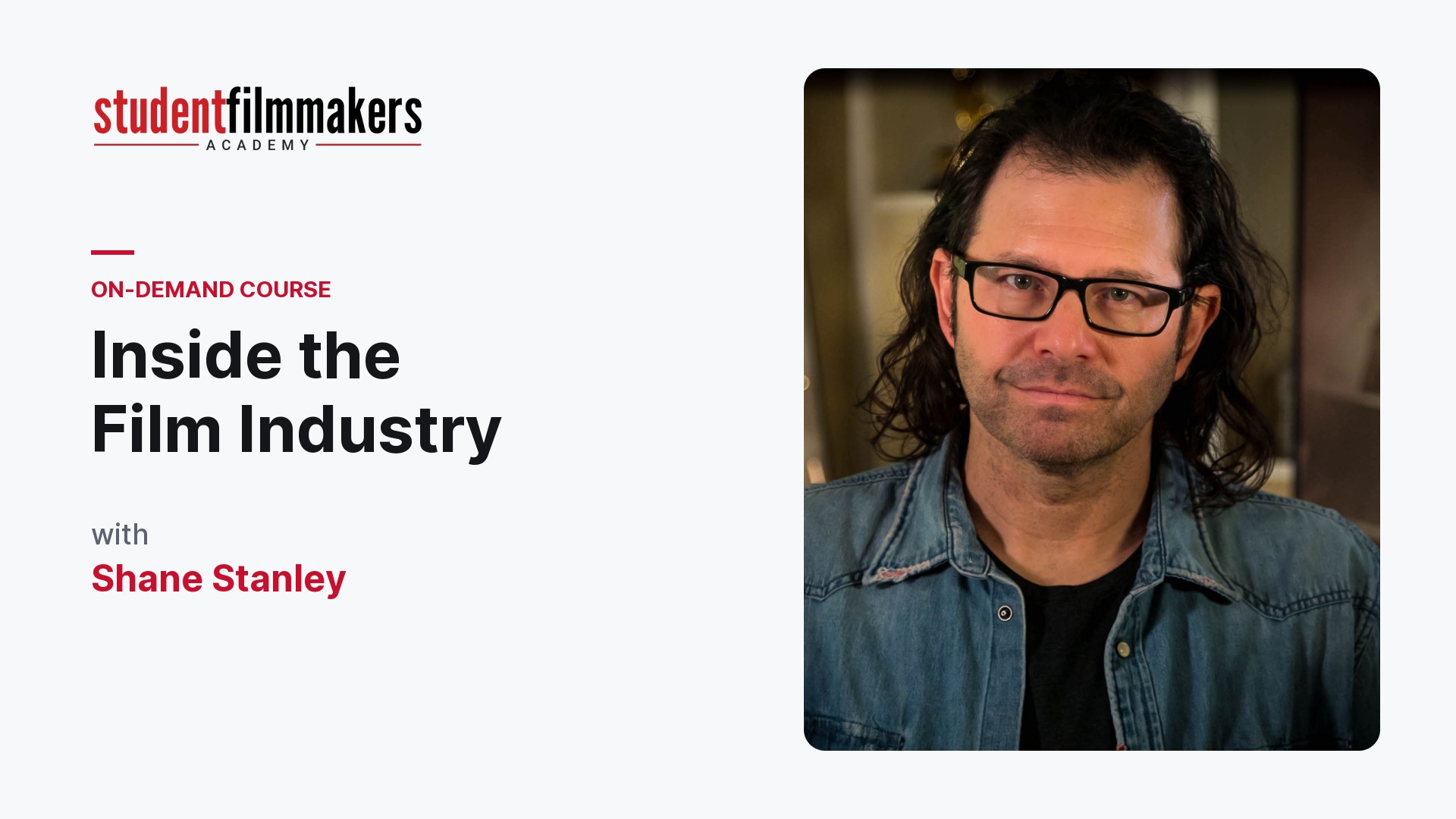
Emmys came early for Shane Stanley as a producer; later he executive produced Gridiron Gang and went on to direct his own action features, first Double Threat, then Night Train. He opened his first StudentFilmmakers class of 2024 with a challenge: the strikes are over, so stop waiting and finish your work. Over the next hour and a half he took questions on AI, streaming money, casting, festivals and day jobs, and kept returning to that one habit.
What is holding filmmakers back right now?
Not the market, he argued. He talks to writers and filmmakers who used to produce steadily and who admit they spent two and a half to three years telling themselves their work would never get made anyway, because of COVID, then the strikes, then the economy. Meanwhile, he knows people thriving in production. The excuse hardens into a way of life.
The answer is the theme of his book, What You Don’t Learn in Film School:
“The most important thing that you can do is complete a task that you set your hand to.”
When nobody is paying you to deliver a first draft in 30 days, he said, there is no outside push. He counts himself among the guilty, with dozens of unfinished scripts in his files. Parking an idea on purpose is normal. Starting a project to finish it, then losing steam and drifting to the next shiny idea after watching a new show, is the trap.
Will AI take filmmaking jobs?
Stanley did not pretend to have a crystal ball. His guess was that within 10 to 15 years, AI could change the work a great deal. He described sitting with a colorist who had built an entire 10-minute short, actors and sets included, in a side room on his computer, and it looked better than much of what is on screen. He compared the risk to auto plants that automated their assembly lines.
His worry is less that audiences will reject synthetic work and more that a generation raised on it will not know the difference. His advice was not to fight blindly but to learn the tools and know “the enemy,” while holding on to the human side of filmmaking: two strong actors, a good script and a camera discovering something nobody planned. He said that happened again and again on his latest film, Six Days in Evergreen.
Asked how a writer can avoid being replaced, he said:
“The minute you become regular or become generic as an artist, you’re replaceable.”
Find what is specific to you and get very good at it. Learn other jobs too: if you write, learn editing and directing; if you produce, learn lighting. On indie sets, the people who wear many hats are the ones working.
One question flipped the fear around. A screenwriter in Africa asked whether AI could help someone with no track record make a trailer or proof of concept to show investors. Stanley loved it: a writer nobody will fund could still show people what their work looks and sounds like.
What does a streaming hit really pay?
A filmmaker in the audience asked how successful an indie release can be. Stanley asked back what success means: money, or chart position? Then he gave a hard number:
“Amazon pays you a penny an hour. A penny an hour? That’s a fact. We can look that up. I’ve had a film that lived on the Amazon top 10 for eight weeks.”
If a streamer buys a film outright, it puts money behind it. If the film is one of many loaded onto a platform through an aggregator, a high ranking does not change the check. But charts can still pay off. Night Train went to number one on Hulu for about four weeks after a deal with Saban, and while that run did not change his finances directly, it changed the film’s value around the world. North America sets the tone, he said, and with dozens of territories buying films, a title that charts at home can sell for far more abroad.
How should a $4 million indie budget be split?
He called three to five million dollars a dangerous range right now, because minimum guarantees from sales companies keep shrinking. His rough math for a $4 million action or thriller:
| Line | Amount | Why |
|---|---|---|
| Cast (five or six names) | About $2.5 million | Names lower the risk for buyers and investors |
| Everything else | About $1.5 million | Crew, sets, wardrobe, post; period pieces eat this fast |
“Cast is king,” he said. “Content is king, but cast is going to get your content looked at.” He expects AI likeness rights to become a negotiating tool, letting a small production license a star’s digital likeness for a fraction of their usual fee. He told the class that music licensing contracts already claim rights in every medium, known or not yet invented, because nobody knows what comes next.
Is a female-led script harder to sell?
Not anymore, he said. His last eight or ten films have been female-driven. He remembers meetings where heads of sales at major studios refused to hear a female-led pitch because only two or three actresses could carry a movie. That has opened up. Will it sell? That depends on the writing; a strong enough story could star almost anyone, or anything.
How do you make a smaller festival count?
A filmmaker whose film had just been accepted at a mid-size festival asked how to make it worth the trip. Stanley warned that some festivals exist mainly to cash in on hope. At a real one, the mistake is spending all your time and money with filmmakers in the same boat as you. His advice: spend your time with the people who can take you to the next level, and work to get seen by those who can do something for your film.
What about the day job?
A corporate video producer asked for advice on side work. None of us is above any job that feeds our families, Stanley said. He has sold vacuum cleaners door to door. Some of his most successful writing grew from jobs he did not want, because those jobs put him next to unusual people and worlds. Keep your eyes and ears open and use it.
He also urged the class to follow the industry closely, including possible future union fights, rather than treating another strike as one more reason to slow down. His closing line was the same as his opening one: get to work, and send him your success stories. “It’s not how you start, it’s how you finish.”
Related reading: working the festival circuit like a pro, how to get foreign distribution for your film and why impatience stalls careers. The full class includes every question from the audience, from VR viewing to the budget range for low-cost features.