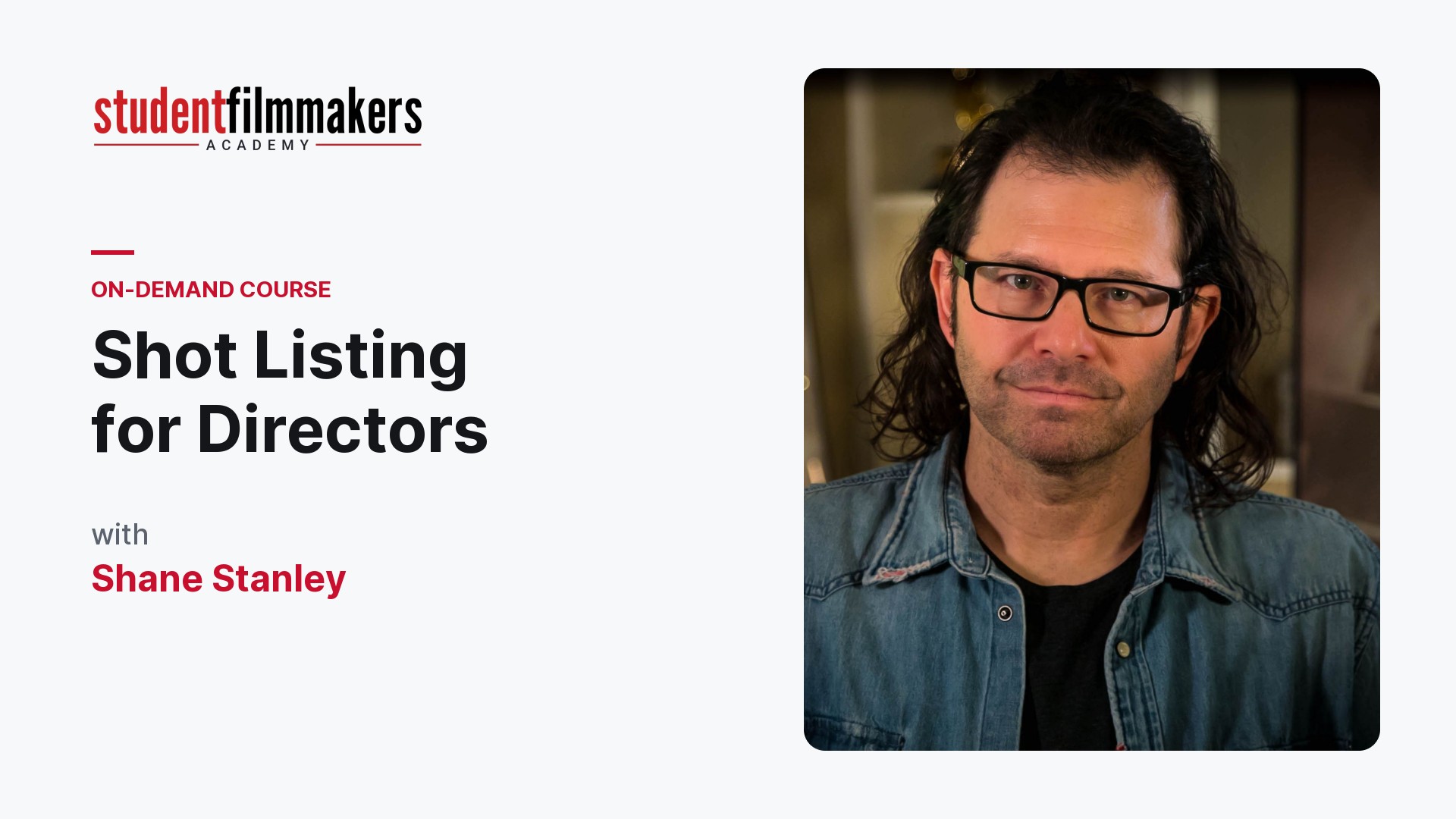
Long before he directed Mistrust or Night Train, Emmy winner Shane Stanley (an executive producer on Gridiron Gang) spent about 20 years in the edit bay repairing other people’s films. That is why his shot lists start from one question: what will the editor need to cut this scene? His answer is simple to say and hard to do: cover every person in the room, plan your specialty shots ahead, and never walk onto a set wondering what to shoot.
His first crash course in shot lists came while he was producing a big-budget film for a mini-major studio, decades ago. Two days before cameras rolled, the director got a call from the studio, walked back to the table in the house where the team was staying in Arizona, and asked Stanley what a shot list was. The movie cost about $18 million and had around 110 scenes. Stanley sat down with him and they wrote shot lists for the first 10 or 15 scenes so they could fax them over that day.
Why does an editor think about shot lists differently?
Because the editor is the one who finds out what is missing. Stanley was often called in, sometimes as a ghost, to recut films that weren’t working, at budgets from a $50,000 short to a $30 million feature. The problem, he said, was nearly always the same: the coverage simply wasn’t there.
His usual horror story is a room with five or six people in it. The editor gets a wide shot from an early, rough take, a close-up of one actor, maybe a two-shot, and nothing else. “I don’t have the material,” he said of those cuts. His rule since then:
“Everybody in a scene needs coverage. I don’t care if they’re a fly on the wall and they have nothing to say other than they’re listening to other people talking.”
That is also why he tells anyone who wants to direct to learn editing first. Cutting other people’s mistakes teaches you not to make them yourself, and not on your own budget.
What goes on a basic shot list for a dialogue scene?
Stanley walked through two people talking in a living room, the scene he uses to explain the basics. The order runs from wide to tight, what some people call macro to micro:
- The master. Give the actors one or two good takes in the wide so blocking, lights, camera and sound can settle. With a second camera, put it on a slider or dolly for a slow, moving wide.
- Move in. If someone enters, decide whether to catch them in a cowboy (thighs up) or push in on a dolly.
- Actor A’s coverage. A loose shot, then a medium, then a medium close, and a close-up only if the moment calls for it.
- Turn around. Repeat the same sizes on actor B so the two sides match.
- Then the interesting part. A profile shot with depth between the two actors, maybe a rack focus from one to the other, and specialty or insert shots.
His example of an insert is one actor lighting a cigarette while the other drinks coffee: the pack, the flame, the exhale, the cigarette going out in the ashtray. You may never use them, but they give you ways into and out of the scene. You could even open on the cigarette pack and let the audience wonder where they are before you reveal the room.
On a restaurant scene from one of his films, the list had 11 shots. Because they shot with two cameras, it came down to five setups.
Should you shoot a scene as a oner?
Stanley loves them. On Mistrust he shot a city street walk-and-talk with Jane Seymour and Parker Stevenson as a single take of about a minute and a half, starting small in the frame and ending in a two-shot profile. On a script he wrote, one oner ran six minutes. But a oner can turn on you: a focus problem nobody saw on the day, or a studio note to cut eight minutes from the film, and suddenly you can’t trim inside the shot.
“I say go with God. Roll the dice. They’re fun. They could be really cool, but get your coverage anyway.”
That means the overs, the close-ups, the matching shots on the other actor, all of it, even if the oner is the plan.
How do you plan for a location you haven’t seen?
Get eyes on it somehow. For Break Even, the team was shooting in executive offices Stanley had never visited, and his DP Joel was away on another shoot. Stanley found the building online: the architect and interior designer had posted photos of every room. The two of them went through the pictures on a video call and planned dolly tracks behind a pair of red couches and Steadicam moves past the artwork.
If a tech scout is possible, Stanley wants at least the director, DP and gaffer there, with an early shot list in hand. Even a rough sketch helps: a 20-foot hallway, double doors, a window that the gaffer can either use or black out.
A script supervisor in the class added a related point. When a “location” is really built from a stage and a second place shot weeks later, the shot list, stills and measurements are what make the reverse angles match.
What happens when the day doesn’t follow the list?
It often doesn’t. A house scouted at 9 a.m. may have sun blasting through the window at 4 p.m. A lighting rig can take an hour and a half to two hours for one side of a room, and once an actor sits, the B camera may be “dead” because it would see the C-stands. Then you and your DP rebuild the order on the spot and track what you still owe each actor. Stanley also tells the cast why, so nobody feels a medium was forgotten.
On Break Even, a planned stunt on a 100-yard dock ran into 20 knots of wind and low tide, which left only three and a half feet of water for the actor going in. Stanley asked for five or ten minutes, invited ideas, and his B camera operator suggested flipping the whole action to the other side. The scene was re-blocked in about a minute and a half, in six feet of water.
Being prepared is what buys these moments. When the list is done early, there is time to try a Steadicam entrance, a gimbal shot or a rig the DP dreams up.
Is it okay to punch in on 4K or 8K footage?
A little, sometimes. He explained that quality control reviewers notice when you push past about a 25% punch-in. In color on a recent feature, his team found a boom mic in the top of a dolly shot that had sat unnoticed through months of proxy files, and they fixed it with a punch-in of about 6 or 7% and a keyframed tilt. He is fine with that kind of rescue, but he warned against punching in to beat the clock. DPs light and pick lenses for a frame, and they will notice.
Shot list or storyboard?
Stanley has used a storyboard only once in his own films. In commercials the boards are the bible, but in his narrative work a shot list does more. It holds all the coverage and the special moments, and you can paste it from your phone to an actor’s or a sound mixer’s phone the night before. He also reminded the class of the five things a no-budget film needs, besides story: “Good DP, good actors, good sound, good locations, good editing.” Weak coverage hurts two of them at once.
His closing advice
Overdo it when you are starting out. He would rather see a new director arrive with 25 shots for a scene, sit with the DP, and sort the musts from the wishes:
“Don’t be afraid to put all your ideas on the paper. You can always take them away.”
And in every scene, keep asking the question he asks himself: “How do I paint myself out of this corner?”
For a step-by-step starting point, see How to Make a Shot List and How to Make a Shot List and Shoot Your First Short Film on a Budget. For the editor’s side of performance, see this piece on cutting performances.
The full class also covers camera personality and style, car coverage with French overs, and building a montage shot by shot.