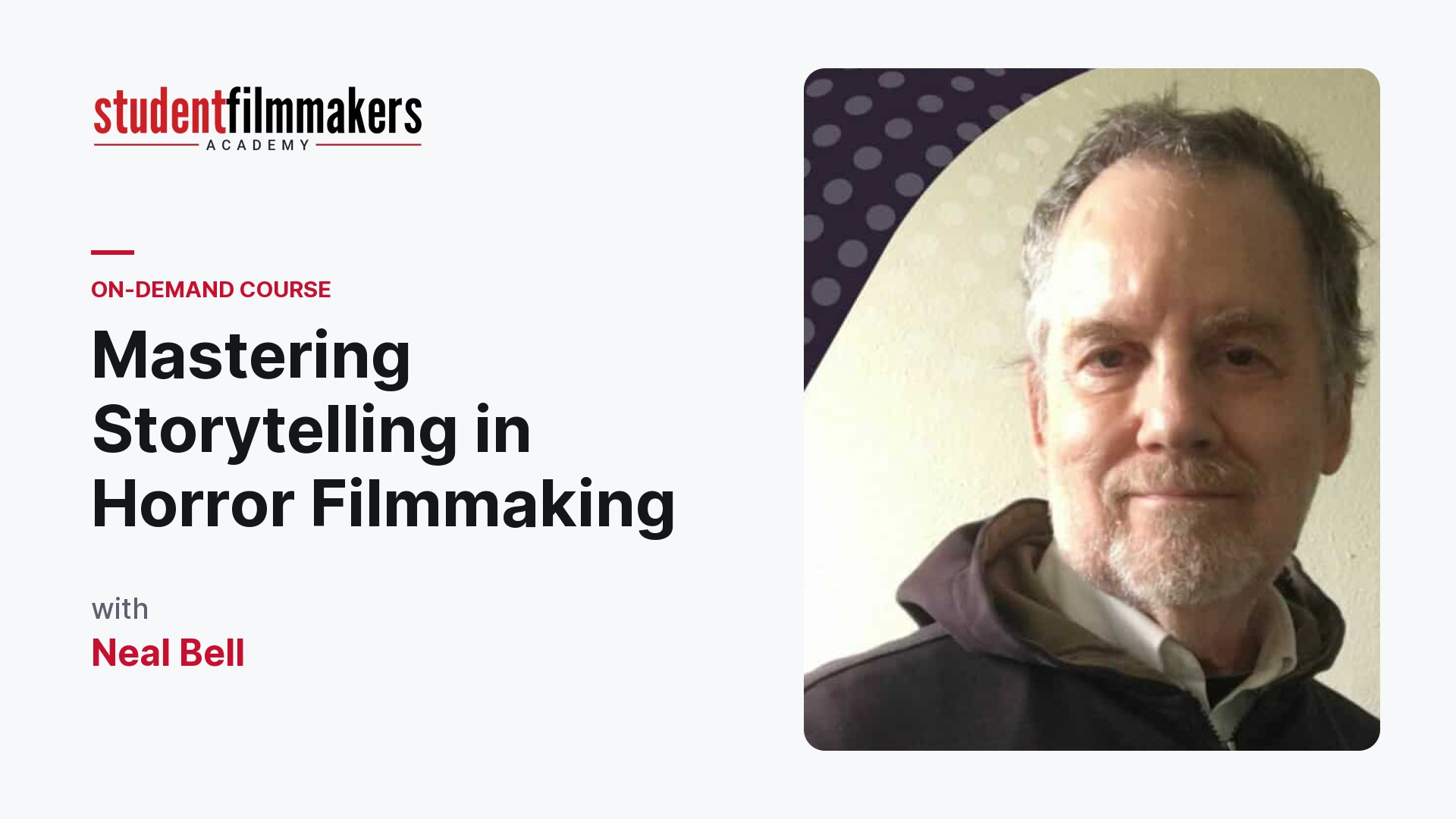
Neal Bell, the Duke University playwriting and screenwriting teacher whose play Spatter Pattern won the 2005 Edgar Award, wrote the book How to Write a Horror Movie. He says the scariest scripts let us see a little of ourselves in the monster. In a live class with StudentFilmmakers, he took apart Psycho, Barbarian, It Follows, Pulse and more to show how story structure, not gore, does the work.
He opened with a confession. After a screening of the Spanish film [REC] in his horror class, he asked students what scared them most. Their answer: him. He had been jumping and twitching so much they first thought he was joking. So this is a writer who loves the genre both ways, as a pure scare and as a mirror held up to society.
What makes a horror movie a horror movie?
Bell uses the definition from the critic Robin Wood: normality is threatened by the monster. Each of the three parts can change. What counts as normal? Who is the monster? What is the threat? Wood also split the genre in two:
- Conservative horror: normality wins, and the world goes back to how it was.
- Radical horror: the world has changed for good, and there’s no way back.
Bell’s sharpest example is a pair of sequels. In Aliens, Ripley beats the queen in a wearable forklift and heads home to an Earth, and a corporation, that hasn’t changed. In the original Alien, she also wins, but her crew is dead, the ship is gone, and she drifts in a pod with her cat Jonesy, hoping to reach a shipping lane. Same hero, same victory, very different genre. Bell calls the first a suspense movie and the second true horror.
Then there’s the mix. In Let the Right One In, a bullied 12-year-old named Oskar befriends Eli, a vampire who only looks 12. When she enters his apartment without being invited and starts to bleed, he takes her in his arms and she tells him she’s like him. He says he doesn’t kill people; she says he’d like to, for revenge. The ending, Oskar on a train with Eli hidden in a trunk, is neither happy nor hopeless. That is the point Bell draws out: what we fear in the other is often how much it resembles us.
How do you get an audience on the killer’s side?
Bell calls this an uncertainty of structure, and Psycho is the classic case. Marion Crane, played by the film’s star Janet Leigh, steals money, decides to return it after talking with Norman Bates, and is killed in the shower about 40 minutes in. Now the audience is adrift. Who do we follow? Hitchcock answers when Norman pushes her car into the swamp and it stops sinking halfway.
“Norman breathes a sigh of relief. And we in the audience breathe a sigh of relief also because we wanted the car to sink. We wanted Norman to get away with it.”
In one beat, the viewer feels for someone they know helped hide a murder. Bell calls it an amazing psychological trick.
Barbarian takes the same move further. For its first half hour, a woman named Tess and a stranger named Keith find their Airbnb double-booked, and almost nothing horror-like happens. Every polite thing Keith does, like opening a wine bottle in front of her so she knows it isn’t drugged, makes him seem more suspect. Bell nearly turned the movie off. Then the story cuts away to a new character entirely, a fired TV actor who owns the house, and starts over, the way Psycho did. A later jump back to the Reagan years explains how the monster was made. Fear of sexual violence runs under all three sections.
Why does the slow burn work?
Bell’s other main tool is the uncertainty of character: people are not what they seem. The count who wants property in England is a vampire. The computer won’t open the pod bay doors. The neighbors in Rosemary’s Baby really are plotting, and Rosemary’s paranoia is the truth she is talked out of.
His favorite slow burn of the past decade is Ti West’s The House of the Devil. A student takes a babysitting job in a creepy house. Her friend, played by Greta Gerwig in an early role, is killed soon after dropping her off. Now we know what the babysitter doesn’t, and the film can simply watch her order pizza and dance to her Walkman while the dread builds. Bell ties this to a wider idea: “Lack of recognition of what’s happening gives horror movies their implicit political edge.”
Can you write fear with no gore at all?
Yes, and his proof is Kiyoshi Kurosawa’s Pulse from 2001, which opens with the sound of a dial-up modem. A character named Yabe enters a forbidden room sealed with red tape. A woman in black walks toward him, stumbling once like a breaking video image. He hides behind a black sofa, looks up, and she is staring at him over the top.
“It’s not a jump scare. There’s no gore or blood. There’s just a sense of dread without release, which continues to mount throughout the movie.”
For writers on a small budget, that is the lesson. The scene is a room, a sofa, a woman walking, and a held look.
Five ways horror carries a political idea
| Strategy | Films Bell used |
|---|---|
| A powerful metaphor | Invasion of the Body Snatchers (1956), It Follows, Candyman (1992 and the remake) |
| Horror hidden in plain sight | The Platform, Train to Busan |
| A new normal worse than the old | 28 Days Later |
| A fear of the moment | Host, We’re All Going to the World’s Fair |
| A real historical terror | The Devil’s Backbone, La Llorona, Under the Shadow |
A few details stood out. The studio forced Body Snatchers to add a framing story and narration because the original ending, a man screaming “You’re next” at passing cars, was too bleak, which flipped the film from radical to conservative. The Cabinet of Dr. Caligari got the same treatment more than a century ago. Host, about an hour long, never cuts away from the boxes of a Zoom call. And in Under the Shadow, a mother flees a supernatural presence into the street and is arrested for appearing without a head covering, so the real terror matches the ghostly one. In that film, Bell said, normality is the monster.
Does a horror script need a message?
Kim Welch, the publisher of StudentFilmmakers, asked whether a scary movie can just be scary. Bell said yes: in the best ones, “the interpretation is completely open,” and the 1956 Body Snatchers works perfectly as a thriller. He was honest about his own first viewing of Barbarian:
“I promise you I was not thinking about sexual trauma or anything. I was just scared out of my mind.”
The layers only showed when he went back through it sequence by sequence. As for his own writing, he works from true stories. Spatter Pattern crossed two of them: a professor fired over a student’s murder despite no evidence against him, and a celebrated historian who told students about Vietnam service he never had.
Why is horror a good place to start?
It can be made cheaply and earn its costs back through streaming and worldwide sales, so producers can take risks. Bell pointed to Jason Blum backing Get Out after the script had floated around for a while, and to James Cameron and Steven Spielberg, who both started in horror. For series writers, he warned that shows like The Walking Dead can run past their natural life, and praised Breaking Bad: “they knew exactly how many seasons they wanted it to last.”
For more from Bell, read his horror screenwriting tips and writing pandemic horror. For the craft behind the fear, see the psychology behind powerful film narratives.
The full class covers each of these films in more depth, including Candyman, The Devil’s Backbone and Train to Busan, plus questions from filmmakers on which horror films Bell still hasn’t seen and the ones he never will.