With heavy hearts, we pay tribute to the late John Bailey ASC, a visionary cinematographer whose artistry illuminated the world of filmmaking. In celebration of his remarkable life and enduring contributions, we revisit a poignant interview conducted many, many years ago, shedding light on his profound insights, creative brilliance, and the indelible mark he left on the cinematic landscape. Beyond his mastery of the lens, Bailey’s impact extends far beyond the film industry, touching hearts and inspiring minds with his dedication to storytelling and the craft of visual storytelling. As we remember him with deep admiration, we honor a legacy that resonates beyond the frames, leaving an everlasting imprint on the art and soul of cinema. ~Student Filmmakers Magazine Team (Kim, Lien, Jody, Maura, Mariluz, Angie, John, and Juliet)
Exclusive Q&A with John Bailey, ASC –
Director of Photography for
“Brief Interviews with Hideous Men”
Insights into Lighting and Anamorphic 35mm Shooting
Interview conducted by Jody Michelle Solis, Editor-in-Chief, Student Filmmakers Magazine
Renowned cinematographer John Bailey, ASC has compiled over 70 credits including Ordinary People, American Gigolo, The Big Chill, Brighton Beach Memoirs, The Accidental Tourist, In the Line of Fire, Forever Mine, As Good As It Gets, The Producers, Brief Interviews with Hideous Men, and the films When In Rome and Ramona and Beezus.
In this exclusive interview, Mr. Bailey talks about his work on Brief Interviews with Hideous Men, John Krasinski’s directorial debut, which garnered a nomination for the Sundance Film Festival 2009 Grand Jury Prize, and recently secured U.S. distribution in a deal with IFC Films.
Could you tell us about Brief Interviews with Hideous Men, and how this project came to you?
John Bailey, ASC: I met John [Krasinski] when we were in preproduction doing screen tests for License to Wed, [which is] directed by Ken Kwapis, who I’ve known, he’s a very good friend, and we had worked on Traveling Pants, and did a film a long, long time ago in the 80s. And he told me, ‘you know, John [Krasinski] found this interesting part that he wants to do after License to Wed and when they go on hiatus from “The Office” in November…’ And so, when I met John, we talked about it, and he gave me the script. And then I went out and I bought the novel.
It’s based on a David Foster Wallace novel. He wrote a really similar novel ten years ago called “Infinite Jest” (1996). He’s a very major writer for the generation of writers in their 30’s and 40’s. A few years after that [“Infinite Jest”], he wrote this book called “Brief Interviews with Hideous Men,” which is really a compilation of interviews of men talking about their relationships with women. And it’s unplotted. It’s non-narrated in the sense that it’s just a series of monologues. It’s different men with numbers basically.
Purportedly, they are the results of interviews that some unnamed interviewer has compiled. And they’re done in different kinds of voices, different styles of writing. It’s a kind of an experimental work in a way. But the interesting thing is that there’s no central, driving dramatic or narrative line to it. And John found the book when he was a student at Brown University. He became very taken with it, and eventually was able to option the novel from David Foster Wallace who at the time never optioned any of his work.
And John got a friend of his from Brown to independently put up the $2 million dollars to make this movie, and he asked me to do it. And John is very, very well-connected with a lot of really extraordinary actors in his group, you know, in his age group, in their 20’s and 30’s. He basically has gone to a number of them and has cast them to play different men.
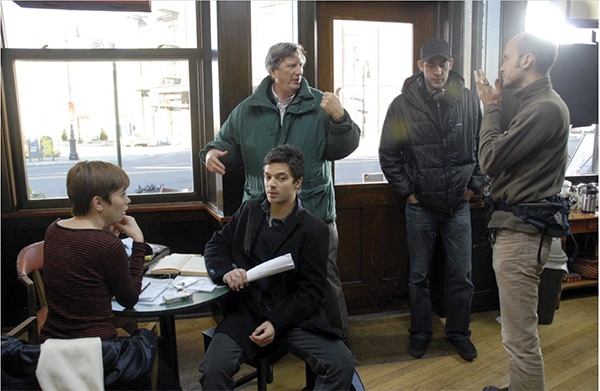
They’re extraordinary roles because, with the exception of like one character, none of them have a real through line all the way through the movie. They’re episodic; and they’re either literal kind of monologues of these interviews that they have, which can be quite lengthy, or the monologues are actually dramatized. John is open about the dramatizing and he gets creative for the sake of an entertainment movie, you know, a narrative line movie. He has created the character of the interviewer who is a graduate student, a woman, who has simply taken on this idea of interviewing a wide variety of men about their relationships with women as her doctoral dissertation. And John simply took sections from the interviews from the novel, and then, created additional material himself and has created a screenplay that is partly very literally taken from the novel and part completely created.
We just finished this second week of a four-week schedule. And so the budget is $2 million, and it’s a 20-day schedule, which is, you know, pretty ambitious. And because so much of it revolves around episodes of people sitting in a room talking, or different environments, essentially being interviewed, and a good amount of it is talking heads, we knew we had to kind of find a way of doing that to not seem like a documentary kind of talking head. And so very early on, I suggested to John, I said, I know we have very limited budget, but I think I can get some of my equipment vendors, especially Panavision, and basically I’ve worked with them for decades, to help us out because I’d like to shoot this film on 35mm film in the anamorphic aspect ratio which is the aspect ratio I’ve used on all the films I’ve done in the last 15 years. And even though this is a very small, intimate film, I think that the anamorphic aspect ratio will kind of give it a kind of scale and a theatrical quality that will keep it from being claustrophobic. And John just got very excited about that and signed on to that right away.
So, we had this little film that by most contemporary definitions on what you should do on that kind of schedule and that kind of budget are usually being shot nowadays all in video or digital video, high def. And, I did not really want to do that. I knew it would be a challenge for us to actually shoot it, say, the way we would a $40 million movie. That’s where the skill interest in terms of, I wouldn’t say technical level, but in terms of the technical-artistic level is with this film because it’s really cutting against the grain of how very low budget films are being made now.
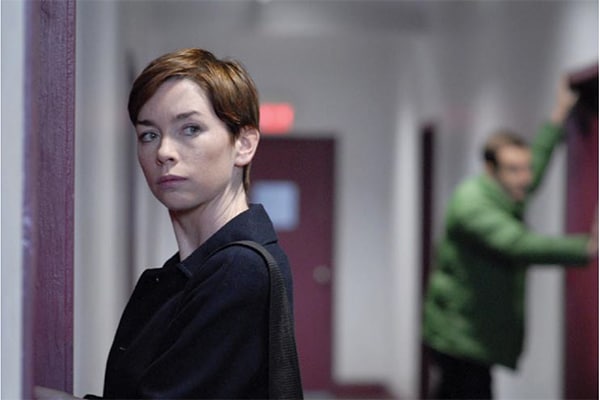
I did a documentary with Errol Morris ten years ago [A Brief History of Time (1991)]. Stephen Hawking’s book is “A Brief History of Time.” And that’s almost all interviews with people and talking heads, with friends and family and fellow cosmologists and scientists of Hawkings, and we’ve constructed these very simple tools instead of shooting on practical locations, which gave me the opportunity to light each of these situations, each of these interviews, with these different people in a very different way. It’s not like going in with a camera, and someone goes, ‘oh, this is horrible,’ and bringing up a couple lights and shooting it. I was able to create a very interesting, dramatic environment. And this film, Brief Interviews with Hideous Men has a component of that with regards to lighting. And, A Brief History of Time is kind of a lighting antecedent to this in a good part of the film of people just sitting and talking to someone off camera. And, I’m trying to create an environment that achieves settings through the lighting.
Brief Interviews with Hideous Men is independently financed and produced?
John Bailey, ASC: A college friend of John’s, Kevin Connors, he was a fellow student and long-time friend of John’s. John has wanted to make this film for over 5 years, from the time he was a student at Brown. I don’t know at what point Kevin came on board with this, but essentially, he became impassioned by John’s enthusiasm for the project and wanted to become involved in some capacity in making the film. So he essentially privately financed it. So there was no studio oversight. Kevin is actually the Executive Producer.
You said that you’re shooting the film on 35mm in anamorphic aspect ratio. Could you elaborate on this?
John Bailey, ASC: The aspect ratio is the ratio between the height of the film, in other words, the vertical dimension and the horizontal dimension. So 1.85 means that if the vertical is, say, 1 meter, the horizontal dimension would be 1.85, a little under 2 meters, almost twice as wide. That’s a normal widescreen. The new video high def to widescreen TV’s that are in are slightly less wide than that. They’re actually 1.78, which is odd because when this whole thing, the consideration of widescreen high def television came up a number of years ago, Sony unilaterally decided for whatever reasons that they were going to do what they call 16:9, which is essentially 1.78. They didn’t really consult with the film industry which already had its widescreen standard of 1.85, but unilaterally did this, and they were hearing for the FCC, which completely copped out on it and essentially said they did not want to set the standard, they would let the industry decide. So the creative community kind of lost that balance, but we now have films that are being shot for theatres at 1.85 and essentially then are being shown on television at 1.78. It’s a very small difference. It’s certainly not the difference in, say, between the normal in what we think of as a square TV. And a square TV is essentially the same aspect ratio as what movies were in the black-and-white era and the early color era, which is 1.33. It looks like a square screen, but it’s really not, it’s 1.33. So, that’s kind of for a background.
In the early 50’s, TV was starting to be a threat to theatrical distribution.
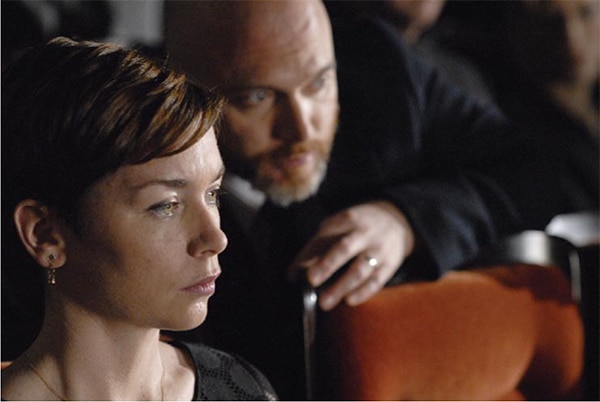
Twentieth Century Fox decided to develop a very widescreen format, which they called CinemaScope. And that was the first commercial anamorphic process. And anamorphic means you take on your regular picture your photographing lens which is what’s called a spherical lens, which means that the image you capture is like normal video camera and like normal still camera. It’s accurately represented. That’s called a spherical lens system. They came up with what they called CinemaScope which essentially squeezed the image almost 2:1. And so, maybe you’ve seen on television or something at the beginning or end of the film on television where they have all the credits and they run them and you see for a few minutes of a film everything looks kind of skinny? Well, that’s what is actually on the film. And they do that so you can read the credits. That’s an anamorphic squeeze.
So, you add to the spherical lens, you add an extra element which squeezes the picture together and allows you essentially to get an image that is twice as wide as it would be normally. And that’s an anamorphic process, and the first commercial one was called CinemaScope.
In the late 50’s, several other squeezed or anamorphic systems came out. Todd-AO developed one. But the most successful one became Panavision. And Panavision initially was strictly an anamorphic lens system. And then in the 60’s, they developed a normal spherical system.
So, when you talk about anamorphic, you’re usually talking about a Panavision squeezed lens system. And the aspect ratio is 2.40:1. So you see, it’s a lot wider than 1.85.
Then there’s now a way to essentially get an anamorphic release print image by actually shooting the film with a spherical lens system and extracting it at post production. And a lot of people are doing that.
But I love the anamorphic lens system. One of the things that’s wonderful about anamorphic – let’s see, 1.85 was developed as a reaction to the 20th Century Fox CinemaScope system, and it came from a poor man’s widescreen. And all they did was they took the normal 35mm frame and they just cut more off the top and the bottom. So you have maybe 40 percent of the frame that’s just black. And that’s how they developed 1.85. So if you compare 1.85 to anamorphic which uses the entire vertical frame, like 16mm, you know, with a frame line that’s very, very fine, the anamorphic frame, 4- perforation frame, has almost 50 percent more information picture area. So it has higher resolution. And I like it because of that, and because of other sort of aesthetic reasons.
But it’s a system that has been in place since 1953. The first Hollywood studio film that was filmed in the CinemaScope process was The Robe.
And I’ve been using it ever since 1989. The first film I did in anamorphic was called The Accidental Tourist. The film with Bill Hurt and Geena Davis.
And I love the anamorphic aspect ratio. I’ve become a real exponent of it, and it’s usually used for larger budget films. One of the things I wanted to do with this film [Brief Interviews with Hideous Men], which had a very small budget, was to demonstrate that not only did you not have to shoot a low budget film in high def video, that you could shoot it on 35mm film; but even more, you could shoot it in the anamorphic aspect ratio.
So it was an artistic, technical decision. I wanted to demonstrate to other filmmakers, and maybe young, emerging filmmakers that might only have 2 or 3 million dollars to make a movie, which is a lot of money still but, you know, by studio standards, of course, it’s nothing. And even by indie standards today it’s not very much money. Even a lot of low budget indie films are in the 5 to 7 million-dollar range.
So I just kind of wanted to show, yes, you can make a widescreen film in 35mm anamorphic in 20 days for $2 million. So that’s kind of the challenge I took on, and I presented it to John Krasinski, and he was very excited about it. The producers were a little bit uncertain because it was not the normal way these things are done. Now, a lot of these low budget films are shot on one video format or another, but I convinced them that one of the things that was very important in this film is that it’s mainly people talking, it’s talking heads and interviews, was that it looked very stylish, that beyond film it has that transparency and luminosity of film, and that it have a big screen look, so that it wouldn’t seem claustrophobic.
You said that Brief Interviews with Hideous Men has a component of how you did the lighting for A Brief History of Time. Could you talk about that a little bit more?
John Bailey, ASC: A Brief History of Time, which is sort of a film biography of the life and work of Stephen Hawking, essentially was a series of interviews of talking heads of family and friends and fellow scientists and cosmologists. And, it was done in a very kind of stylized environment. We did not shoot it in actual homes and offices. We built a series of two-walled sets that essentially had no apparent relationship to what you would expect to be the environment of the person who was being interviewed. And it was all done on stage.
Errol Morris and I decided to photograph these interviews in a very kind of stylized way, and not necessarily make them look like they were in a normal office or a normal house or something. So I had tremendous freedom to light the set and the person we were interviewing in whatever kind of almost arbitrary way I wanted to. Totally not naturalistic, you know, not realistic. And they seemed to not necessarily bear any connection to the space that the interviewee was sitting in. And Errol and I did that because we essentially wanted to kind of displace the interviewee and the environment from any consideration that it was like realistic. That we were talking so basically about Hawking’s life. Like even more so, it’s about his ideas, which are certainly metaphysical and abstract. So we were trying to lend a component in the lighting that was almost sort of surreal, not necessarily surrealistic, but not realistic. It would kind of match the nature in the interview. They were talking about time and space and mathematics and black holes and stuff like that.
So, even though Brief Interviews with Hideous Men is a normal, dramatic kind of plot, a thing with realistic characters, and you can tell from what you’ve read in the book, it is not a normal kind of plotted novel. It’s very episodic. It’s kind of discontinuous. And, every person who is talking is a completely different kind of person and talks in a completely different kind of way. And the actual structure in the novel, the writing, the way it’s formatted even, is slightly different. Some of the interviews have enormous footnotes in them. Some of them are written in kind of almost an email style. And others are very traditional. So, I wanted to find a way to have the interviews in Brief Interviews with Hideous Men also seem kind of slightly abstracted. So, there is a component in the way we did the lighting in the shooting of them that is not completely naturalistic.
So that’s kind of a connection. Both of the movies essentially deal with talking heads. In the case of A Brief History of Time, it’s dealing with metaphysical ideas in terms of the nature of the universe and time and space. Brief Interviews with Hideous Men is dealing with a kind of almost metaphysical discussion of the nature of man-woman relationships. In other words, a lot of discussion is not terribly specific to one person talking about another person, but it’s more generalized.
What is it like working with a new director and particularly John Krasinski?
John Bailey, ASC: Well, I did a lot of films with first time directors, and I like doing them very much because a lot of times, of course, the first time director is also the author of the screenplay. In this case, John took an existing novel, but he very freely adapted it, and at least half of the screenplay is really John’s original work. The other half is essentially taken from the text of the novel. So, there’s always a kind of excitement and a sense of discovery and real energy that I find working with a first time director who is also the author of the material because it’s usually something that comes from somewhere deep in his or her psyche. Something needs to get out. It’s usually not just, ‘oh, you know, I’m gonna write a screenplay.’ Just like a first novel. The first novel tends to come from the author’s own experience more or less. And, ‘first movies’ tend to be a lot like that. And in the case of John. I’m not saying John has qualities of any of the men in the film but, you know, I think that all men can recognize elements of themselves and certainly of the male sexual dynamics in these characters. And John seemed absolutely fascinated with this material when he was a student and decided he felt he could make a movie out of it. And apparently, he spent five years trying to convince David Foster Wallace’s agent that he could do it. And they finally gave him the rights.
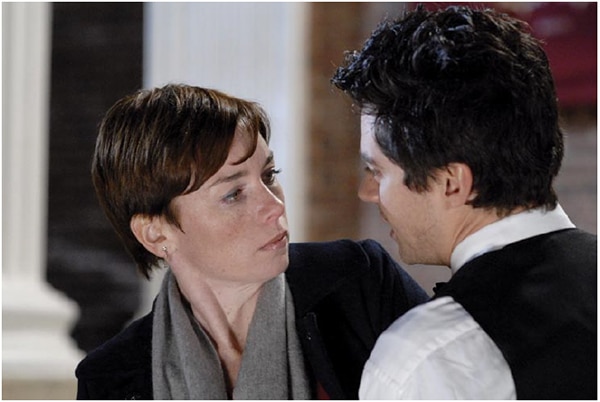
So, what it is like,… it is an incredible momentum. In other words, I’m getting on board with a first time director, especially somebody like John who had such a passion to do this. I’m getting on board a train that’s already rolling at apparently a high rate of speed. And I’m trying to hang on. It’s a lovely sense of there being energy and momentum propelling this thing down the track at the time I get on for the journey. I kinda like that a lot.
To come with it, John has many, many ideas and many kinds of thoughts that he’s had about how the film should be structured and so forth because he’s been living with it for so long.
What do you ‘don’t want’ when working with a first time director?
John Bailey, ASC: Well, the very thing that is so fascinating is this momentum and this vision that a first time director can have, having created his own material, and which I really want to become a part of, help fulfill, also has the potential of a pitfall if the director has kind of ossified and solidified too much in his or her vision of the material, so that when other people come on, there’s really no space for you to kind of be a creative part. And that’s okay up to a certain extent, but a lot of times actually making the movie as a collaborative process is very different from whatever intensive kind of preparation he might have done as the author or would-be director of the film. So the pitfall in a situation like that is essentially coming onto a director that is so hurt and so solid about the vision of the material that there’s nowhere for you to go with it.
That didn’t happen on this film of course. But that is the thing that I’m always looking for as kind of a cautionary thing. Many times you just have to evaluate that.
Taking into consideration the schedule, what would you say was the biggest challenge that came up during the filming of Brief Scene from Brief Interviews with Hideous Men. Close-up Interviews with Hideous Men that’s the most interesting to you and that you would like to share?
John Bailey, ASC: One of the big challenges was that a key role of Sara’s ex-boyfriend, the character, Ryan… John had no intention to actually act in the film, only to play a very small part, one of the minor interviewees. Jason [who was originally cast for the character, Ryan] decided he wasn’t able to do it shortly before we started, and John said, ‘you know, I really don’t know where else to go with such a difficult role.’ So he decided to take it on himself. And, in terms of page count, it’s a huge role.
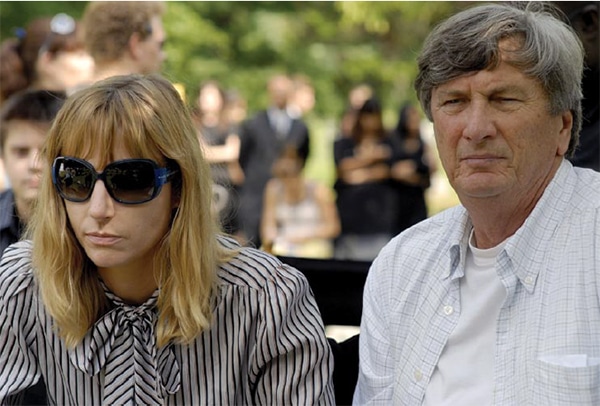
When you get to the end of the novel, there’s a whole description of a scene where one character is talking about a woman he had a brief relationship with who had been kidnapped, held at knife point, and had been raped out in the woods. And he talks about how she realized that in order to survive, she was going to have to find some way to achieve empathy with the man who was violating her. This became an actual scene where the character, Ryan, tells Sara this at the end of the movie.
And so, John decided to take this role on himself, in addition to directing the movie. It wasn’t that many days work, but it was a huge, huge scene. And, you know, we were all very worried about it. In terms of John being able to direct and act. It was essentially a monologue. It was like an eight-page monologue. A lot of stuff to learn. Essentially Sara was not talking, she was just listening to him tell this story.
So, I had met John on a film called License to Wed (2007) that Ken Kwapis directed. That’s how John and I came together. And, John and Ken kind of got into conversation, and it turned out that Ken was free the beginning of December. And Ken volunteered to come back to New York and direct John for the two days that he was in this big final scene. And so it freed John for the most part to be able to just be the actor in that scene, which was really necessary. And then Ken and I, who had done – it was our third film together – and so we had a real shorthand way of working. Ken came right in for those two days essentially, directed that long scene. So, that was the biggest kind of challenge of the entire making of the film.
Of course, every day had its challenges because we had so much to do every day. I mean, we hardly ever had a day that had less than five pages to do. One day we shot over 11 pages.
What was your most favorite scene to light in Brief Interviews with Hideous Men and why?
John Bailey, ASC: I guess my favorite was the actual scenes in the interview room, and some of the characters, usually the ones with the numbers, #15, #40. Or men actually sitting at a table in a very stripped down room against a kind of a brick wall or kind of grey to brick wall just sitting there talking, and it was essentially a two-wall for that. And it was very much kind of like interviews in A Brief History of Time except the set was the same, it never changed, which is a table, a chair, a wall. But what I was able to do was use a completely different kind of light for each one of the interviews. So even though the shots were the same, and the image sizes were the same, and the camera angle and lens were the same, for each of those interviews, I was able to create different a mood and feel just by virtue of the lighting.