By Jody Michelle Solis
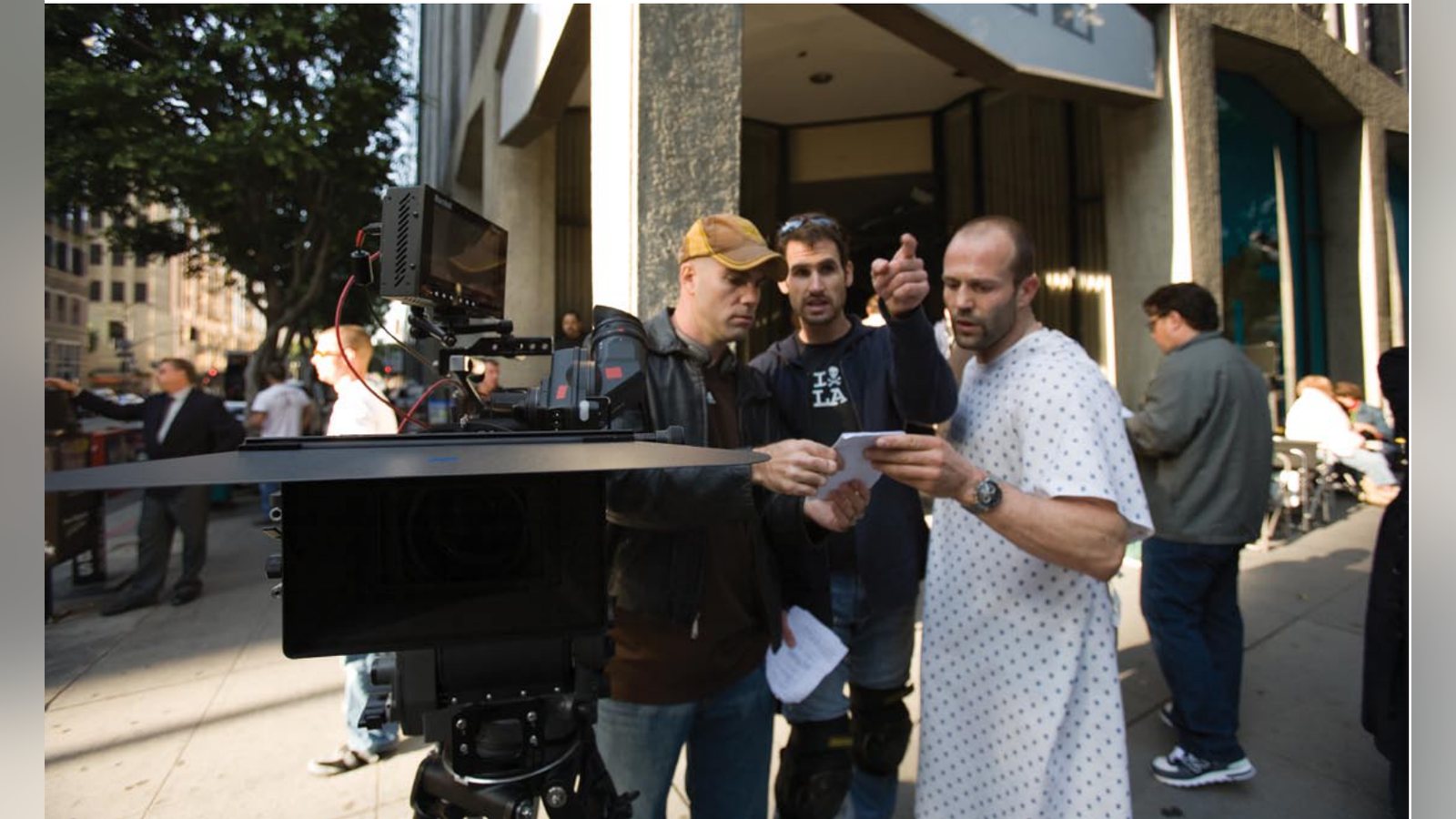
Cinematographer Adam Biddle, who worked on V for Vendetta and Bridget Jones, talks about shooting the action film Crank in HD and his insights.
Cinematographer Adam Biddle, who has worked on films such as V for Vendetta (2005), An American Haunting (2005), and Bridget Jones: The Edge of Reason (2004), details his work on the movie, Crank.
What cameras did you use?
We used the new 950 Sony system that has to be tethered to a deck to record. We carried 2 of these. We also carried 2 Sony 900’s that were made up ‘ready’ to grab at anytime. On top of that we had a Canon XL2 and 2 Sony HDVZ1Us. These DV cameras were used for surveillance style footage or as ‘crash’ cameras on big stunt scenes.
Did you use any in-camera color adjustments?
When shooting HD, I’m constantly monitoring color adjustment on a ‘color temperature’ basis, tungsten or daylight or somewhere between the two. In that respect I treat it like film. Above that, I try to limit getting ‘bogged’ down by color adjustment within the matrix, preferring to leave that until post production unless a very specific look is being sought.
I’m not one to play with the matrix on set. But the real bonus was getting to use the new Sony 950 system which has amazing color rendition, the best I’ve seen.
Did you use a vector scope?
I personally don’t use a vector scope. I’ve become so comfortable shooting HD, I can now feel the right exposure, but I do have my ‘zebra’ settings in the eyepiece ALWAYS on to confirm this.
On Crank, I had the luxury of having a Digital Imaging Tech [Nic Theodorakis]. He is the best I have yet to work with and invaluable member of the team. I would trust him to monitor stuff like the vector scope and bring up any problems he thought we might have.
Tell us about some specific scenes.
The scene that takes place in at the back of the ‘Prince’, when Chev cuts Alex’s hand – we started that scene in full daylight, and the last half was true night by the time we got to it. That was difficult to pull off.
Also, running a high shutter, say 1/250th, eats up two and a half stops of light. When you’re running full speed down hospital corridors [the gurney scene], that covers a heck of a set to light. We must of put at least 200 new fluorescent tubes in that hospital set.
Normal shooting with film takes place at 24 frames per second. The shutter is spinning and each frame of film, or video chip, is exposed for 1/48th of a second creating a ‘normal’ amount of motion blur to the eye if something is moving in the frame. If you increase the shutter speed, any motion blur becomes less and the image sharper. The trade off is each frame of film is exposed for less time and so receiving less light. Therefore, you need more light the faster you want to go. No problem day exterior in California, but try it at night or in a low key interior. Every time you double the shutter speed from 1/48th, normal 24fps shooting, you lose one stop of light. This may not sound that much, but to put it in perspective, to gain one stop of light you have to double your light. So instead of using a 5k, I might need to use a 10k and so on. Sometimes there comes a point when you can just get it so bright, and that is your cut off point. For instance, in some of the interior shoot out scenes at Don Kim’s warehouse, we were limited to a 250/th shutter because I just didn’t have any more light to pump in.
Did you light differently for different characters?
Scenes with Eve, I tried to light a little softer. Also, we turned down some [not all] of the video detail when the camera was on her.
What was the most difficult scene to light?
The most difficult scene to light was the Mall interior. Driving a real car – and that Rivera Chev drives is huge – through a mall at night is really big to light. I knew the directors were going to want to run as high a shutter as possible, so I really did have to pump in some light there.
Tell us more about the lighting.
I find lighting for HD totally different than lighting for film. When shooting in exterior hard sun, I’ve learned never to be afraid of using big, big units of light – often direct, no diffusion, for fill. I would NEVER do this with film, but HD can be so high contrast, it can take it. When we shot the two rooftop scenes, the light change was extreme due to the movement of the winter sun. Downtown the shadows from other taller sky scrapers gave me a real hard time balancing the scene.
Another perception of HD is that you need a lot less light. This is true in that if you have complete control of your set, i.e., in a studio, your actual sources can be a lot smaller. I might do something with a 2k that I would need a 10k to do the same on film. But the bottom line is, I will still need as many lamps, flags, stands, etc. The real turnaround is when you are interior and trying to balance to an exterior looking window. Then you need much more light than film to balance the scene properly. That really became true on one particular scene which didn’t make the final cut. It was in a hardware store which had a large double entrance door that exposed full daylight outside. I had to try and bring the light right up in the store without it looking too lit. Not easy when the camera is seeing about 300 degrees of the store.
Could you tell us a little bit about your inspiration and approach for achieving the look and feel of this film?
Crank was always going to be shot on HD on a limited budget and very tight schedule. Consequently, I made the decision to embrace these factors from the get go, and look at the positives. HD cinematography is only just beginning, and it’s a strange beast. It isn’t film, and it sure ain’t video. Handled right, it really does have a quality and look all of its own, and that was my goal to achieve.
What benefits did you see in shooting HD and shooting digital versus film?
Film is still king overall, but digital does have its advantages. For one, it’s obviously a lot cheaper. Shooting Crank in HD enabled more money to be channeled elsewhere in the movie, and in doing so added production value. Also, the ready availability of cheap digital video cameras and software has really blown the industry wide open. Now anyone can shoot their own ‘movie’ and hone their skills.
What techniques did you use to make the viewer feel like they’re in the shoes of Chev?
In the opening scene when Chev wakes up, we used a ‘body’ mount, a lightweight tubular rig and vest which are worn. This was also the first day of filming. We don’t see any part of Chev’s body except his hands, so we could have had an operator wear the mount but we didn’t. By having Chev ‘operate’ the scene, I think we began as we meant to continue. That got us on to the ‘ride’; we just had to hang on!
What other techniques did you use to help the story and scenes?
A lot of the time we ran a lot of ‘detail’ and ‘crispening’ in camera. These are video settings that add basically artificial sharpness. Coupled with a high shutter angle, 1/250th or even 1/500th, this gave an almost desperate feel to the image.
The camera settings are virtually unheard of! The usual when shooting ‘video’ is to have the sharpness turned way low and a 1/48th shutter angle, completely the opposite of what we were doing.
One definitely new technique we used was ‘roller-cam’. One of the directors was a fantastic roller blader, and we made a backpack rig that he could wear so he could freewheel around without the worry of a cable being snagged. At first, I was a little skeptical of the results we might achieve, but after seeing one shot with it, I fell in love. Indeed, we had budgeted for 8 days of steadicam. Once we saw what we could get with roller-cam, we cut that down to 1.
Was everything storyboarded?
All the big action scenes were storyboarded – rooftop shootout and helicopter fight, Don Kim’s shirt factory shootout, driving thru the mall.
What is your favorite scene in the movie?
My favorite scene is the flashback when Chev gives Don Kim a break. We had virtually no set to shoot so I stylized the lighting to help get away with it.
Were there any challenges that came up working on “Crank”?
The biggest challenge was always just ‘making the day’. On this size movie if you fall behind you really can lose the confidence of the producers. One of our biggest assets was our 1st Assistant Director Bill Clark who really did keep things moving.
Could you describe your working relationship with directors?
We really got on the same page from the beginning. They were pretty clear about how ‘raw’ they wanted this to look, and we wouldn’t have time to ‘Hollywood’ style light – diffusing sun light, etc. I said I was not afraid of shooting in hard sun and trying new things so really we went on from there, in unison.
What was your most favorite part about working on the movie?
This movie had a great crew, and everyone got along. It really did have a ‘family’ feel to it, which is special when that happens. It doesn’t always, believe me!
What was the most difficult problem that you had to solve?
Getting the ‘studio’ to buy into the look we were going for. We shot some tests, the directors cut them together, we did a ‘film out’ and screened a print. They then saw what we were going for and fully supported us. Lions Gate are a decent bunch. How would you describe your personal style as a cinematographer?
My personal style as a cinematographer is to keep things as simple as I can. I don’t like to over complicate things, be it a lighting schematic or camera ‘method’. I like to move the camera as much as anyone, but feel a move is enhanced when the subject matter dictates it. Moving the camera purely for the sake of it can often detract from a scene or an actor’s performance.
How similar or different is your style compared with the style of “Crank”?
The feedback I have had from Crank kind of back’s my style up. It’s quite a raw movie, told in a straight forward down to earth way.
What advice would you give to cinematographers just starting out in their careers?
Get out shooting, that’s the way you learn. I myself worked my way up through the ranks. I started as a ‘runner’ as it was called then, became a loader, 2nd AC and then 1st AC. I didn’t operate, by that time I had seen how the industry was changing. I needed to get out shooting my own stuff ASAP. I think that is the advice I would give now. Additionally, the important thing is to respect technicians that work for you. That way they will respect you.
Related filmmaking guides
Keep learning filmmaking
Want more lessons like this? Join StudentFilmmakers free for live webinars with working pros, and stream on-demand filmmaking classes in cinematography, directing, screenwriting, sound and post.