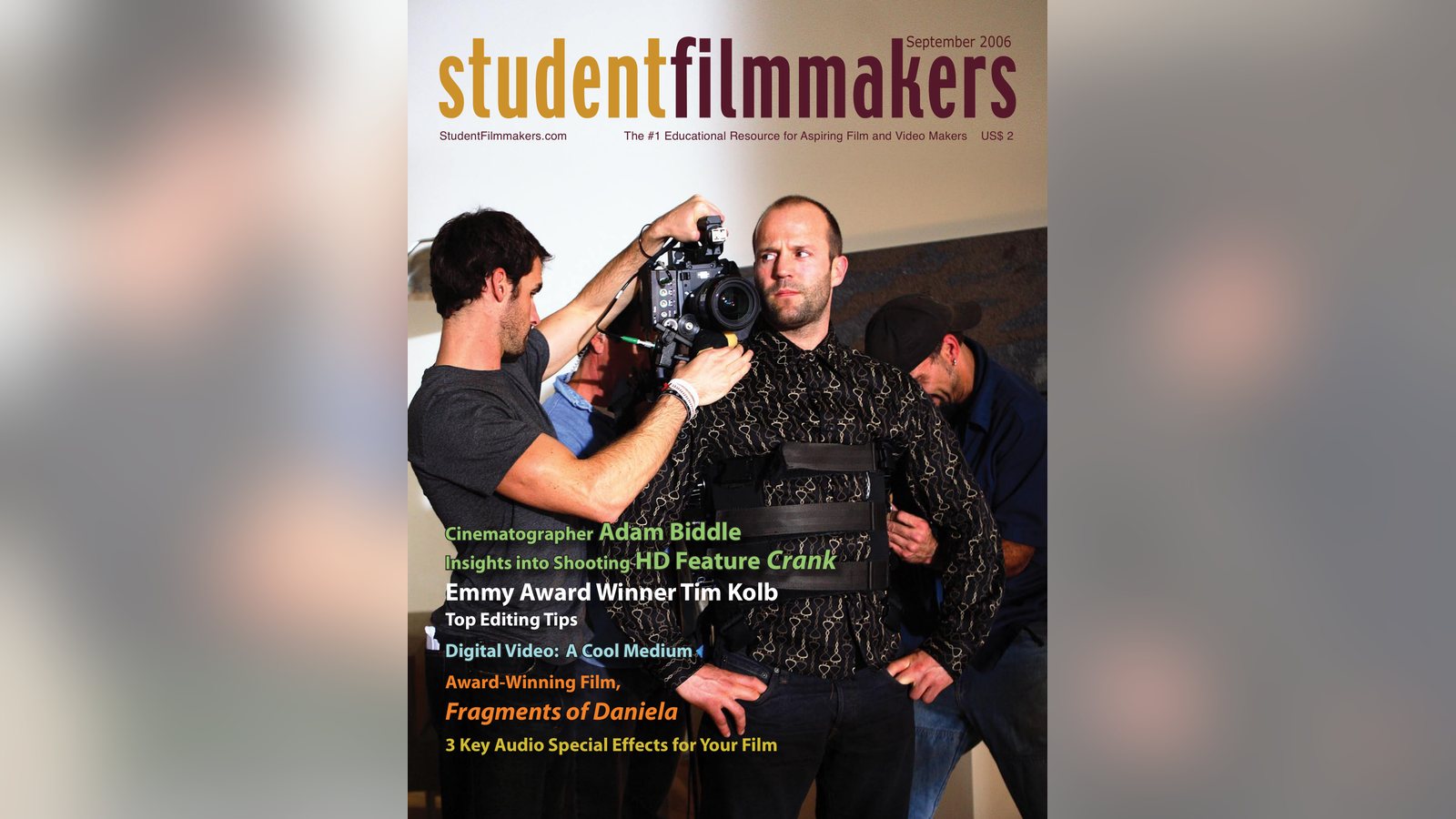
Emmy-winning director and editor Tim Kolb talks about his award-winning projects, his workflow and his top three editing tips for filmmakers.
Your work has received Emmys, Emmy nominations, and other awards. Could you talk a little bit about those projects?
My partner at the time [Mike Syverson] and I – each have three nominations and an Emmy, and in our time working together we had only done two productions that would even qualify for Emmy competition. So between those two productions, we received six nominations and two statues. Those were for a children’s hospital in Wisconsin, and some of the work I’m still proudest of – fundraising type production for some obviously important work the institution is doing. It was an opportunity to spend some time with a lot of children with cancer and other severe health problems. There were dramatic situations. It was a little difficult to do all that, but we did it, and we came up with some good results. A woman called me shortly after the project was done. She had seen it at a fundraising event and was a mother of a patient at the children’s hospital. She was emotional when she thanked me and breaking up when she said, ‘Nobody’s ever told our story like that, nobody’s ever really understood it before.’ The statues are great, but I can’t replace that phone call with awards.
How did you get into being an Emmy judge, what goes into it, and what do you look for as an Emmy judge?
I got into it because I’m active in the Chicago chapter. Once you’ve accumulated some credibility, they like to know you’ve been in the field for a while before you lead a panel; then they want you to accumulate a panel of people. They have instructions for you to follow with the evaluation criteria mapped out for you to keep the judging standardized. It’s a good way to do it and a solid way to judge, so we all use the same scoring sheet and the same system. And then we do the proverbial, ‘fold them up and seal them back in the envelope,’ and send them off to the stripe suit guys at the law firm who then open them with the white gloves and figure out who won. It takes a weekend or day of your time or evening, and it takes preparation time. Then you mail all the stuff and you package all the tapes. It’s a service project. It’s not one of those things where someone comes with a scepter and bestows upon you the title of Emmy judge. It’s trying to be of service to the industry, trying to help to keep establishing what standard of performance is for people in the industry, and giving people something to aspire to. It’s trying to make the field better, trying to spend a little extra time to bring some others up as well as yourself. Hopefully, in the end, the field is better in some tiny way because you try to spend a little extra time in trying to help.
You’re an editor and a director. What came first in your career?
I guess if you’re going to be technical, I’m a director, I’m a lighting cameraman, I do motion graphics, and I’m an editor. In 1990, after spending some time with that community college, then spending some time at a television station and the television market in Green Bay, I went out on my own. At the time, I was 23 years old, and quite frankly, didn’t have a clue about anything. But in a market that size, you have to be able to do most of it because, until we get to the Milwaukee market, there isn’t really a solid crop of freelancers around because there’s not enough work to keep them busy. So if you’re going to play in this market, at least back when I started, you had to have a variety of skills. Lucky for me, I was interested in all of it. That’s probably three quarters the battle right there. If you can keep yourself interested in what you are learning, finding things out, and picking up techniques – if you can just keep yourself engaged, it’s amazing what kind of expertise you can pick up.
There are a lot of these roles that can be combined, and I think you become better in any one of them if you’ve worked in a variety of positions. Great directors already have an eye for shooting because a lot of them have shot before. Great editors can take a look at footage and bring something to it because they’ve directed before.
Could you talk about an instance where being able to combine roles as an editor and director helped you to solve a problem that came up on a project?
I was recently involved in a TV pilot. It’s a car reality show. A nearby shop converts Rolls Royces to convertibles and does a lot of high end car work, and a couple of networks are looking at the potential of doing a show around it.
So what they had done was they brought in a professional videographer who shoots very nice footage, but they never sat down with a director to figure out what the show should be like. So the videographer had no direction. He wasn’t sure whether it should be handheld or on tripod, or shoot a lot of close-ups. Should there be interviews? Should there be audio? Is it going to be narrated later, or is there going to be a host? So he came up with a lot of great footage, and no great story. It’s not the videographer’s fault, there was no director.
So the next thing that I need to do as an editor is to sit down and “direct” it backwards. I need to take a look at the footage and “direct” a story out of it without a script or even a written story treatment. Someone needed to sort out the elements of the main storyline and the sub-plots, as well as verify that the major points in this conversion are technically covered… and also illustrated with footage. I took a look at it, and we did need to go back and do some interviews so that I could have a story-pushing device to try and convey what had happened with this one particular conversion project because I couldn’t just write all of it in narration – that wasn’t going to work with this “spontaneous”
format. So you could take a project like that and make it work if you have experience in a couple of areas. If you’ve got some diverse experiences with some of these various roles in the production process, you could wear both hats at once or flip back and forth three times during the day.
Even though I don’t do all the jobs on a daily basis, being able to do all these tasks helps. When I’m directing, I’m already thinking in the edit. You’re thinking in sequences already as opposed to directing it shot by shot and leaving the editor to run a salvage operation, which is what I do as well.
What are your thoughts regarding how all the bells and whistles in technology and new technologies can get people away from the essence of telling a good story?
Other than I agree?
The issue when I was in school was that the film students and the television/video students were often separated. It wasn’t thought of as one composite set of expertise. The TV students learn where the buttons are, and the film students learn how to tell a story. Film students are taught how to light, and video students are taught where auto iris is. At least that was the stereotype at that time.
I think a good thing is some of this has become much more integrated because the film industry itself is moving electronic, but now the problem is we have several things all changing at once. We have the film industry moving into digital cinema. We have video industry moving into hi-def. We have those two things crossing over, as there are people using hi-def for electronic cinema. There are people mixing standard def and hi-def. There are people shooting hi-def for standard def. There are people shooting electronic cinema for the web… Acquisition file formats that aren’t cross-compatible and editing systems that need procedures in place to handle these disparate and non-compatible image formats… all these different technologies are changing and mixing together.
I think the biggest issue in many schools is a lot of the faculty are being given the responsibility to keep up with this technology, and the problem is, it’s changing the allocation of time they can spend on what is the traditional content – here is what a well-exposed image looks like, here’s what a well-blocked scene looks like, here are the techniques you use within the realm of your toolbox to tell a story. I think that part of the issue here is that we need to hang on to the instructors who teach technique, and we need to maybe delineate the role of teaching technology because I think, unfortunately, it can be very easy for a student who’s coming into the field to get the relative “weight” of the two confused because we all spend so much time talking about technology. The technology is important, but it needs to be taught as being as transient as it is… it is temporary. It’s like learning who the President of Germany is when you are in school… to know the answer forever, you have to read a newspaper every now and then.
I don’t know what the answer is, but again, our focus on technology is taking away from our focus on technique, and if we don’t take a moment to re-prioritize, eventually we’re going to be an industry of people who know everything about the software and hardware and nothing about how to make a compelling piece of visual communication.
What are three of your top editing tips?
One is – if it works as the cut, stop. You’re done. Move on.
Secondly, find the apex of a shot. Every shot has an apex. Every shot has the thing you need to tell the tale. If you’re cutting shots together of a motion, or of a person picking an object up, there is a point where that person is doing the most important part of that shot. Whether it’s grabbing the item, whether it’s the arm coming up – whatever it is – for your own purposes somewhere in that shot there is an apex. Identify the apex, and then start stretching out from there as far as keeping the shot running, cut the apexes together, and then start adding extra trim if needed for continuity, but only what is necessary for continuity.
I find that particularly young editors will fall in love with a shot. And it will be up on screen far too long. Whatever the factor is that you’re emotionally attached to in that shot, you’ve got to get over it and get on with it because none of the rest of us know the history behind getting that shot, nor do we care. It’s got to be about the storyline.
Thirdly, you need to learn about color correction, and it’s not a brightness/contrast, hue saturation kind of a thing. You’re going to start with levels and understanding gamma and move on from there. More editors are becoming responsible for at least some amount of color correction. That’s probably the most important skill an editor can add to his or her skill set. Learn as much as you can and keep learning about it because it’s a nearly endless topic that is much deeper than most people would ever guess.
How did you get started in your career? Did you go to school to study editing and filmmaking before working in this field?
I almost didn’t go into this field. In high school, I was one of those perennial does-not-live-up-to-potential guys. I wasn’t on track for college career but more on track for something more “blue collar”. I had a guidance counselor in high school, and she took the fifteen minutes allowed to her to plan the rest of my life for me, and somehow she had some kind of insight into my character enough to pull out one brochure for one major at one college, and that was Radio/TV/Film at nearby University of Wisconsin-Oshkosh campus. It was an interesting moment for me because I’d never given any thought to going to college, much less the fact you could actually go into this kind of a field and do audio visual production and get paid for it. I had done it as a hobby in high school. That was how I got into it. I jumped right into my major earning television workshop credits by my freshman year, second semester, and got into a lot of the “hands-on” – maybe a lot more than others might have at that age if they had followed the conventional path.
I ended up with a full-time internship at a vocational community college running their studio, met a woman, as is the downfall of most men, and never got back to college. My full-time internship developed into a job, and from there I started working to feed myself in the industry, and that’s what I’ve been doing ever since.
Is there anything you would have done differently earlier in your career?
As a young person my one regret was that I don’t think I paid enough attention to what other people were doing soon enough in my career. It’s easy when you’re a young person to think you’ve got all the answers. Or you get a little hook, you get a little bit of a skill set together, and maybe you see a couple people who are doing work that you think is inferior to yours… you think that you kind of have this thing handled. You no longer need to learn anything, or at the very least, you feel you’re three steps ahead of the next guy – of course at the end of the day, you can learn every day. I’ve learned most every day for twenty years in this business. I’ve learned more on days when I’ve been more open to it than others. No matter who you’re working with, they know something you don’t know, no matter what that is.
I suppose those days when I worked with someone that I thought was less skilled than myself, I passed up the opportunity to try to see the benefits to the way they worked… that would be the prime regret I have regarding my career.
I’ve found over the years the people I enjoy working with the most are those who spend their time asking questions and learning about what the people around them are doing. Even if you’re working with a professional who you know from reputation has an extensive career and a lot of expertise, you’ll realize, the truly good ones never once stop to tell you about their expertise. However, they may have asked you how you do things four or five times in a day. And you realize that’s the key to the deal…
Take every opportunity you can to work with somebody you’ve never worked with before and to learn. That’s the way you accumulate some expertise in all these different areas. Furthermore, in the end, you have to be a storyteller. And you have to have some kind of a vision as to what you want to do. Editing, directing, shooting – the roles are only delineated by the equipment that you use at points in the process in some circumstances.
What advice would you give to new editors and new directors?
You cannot walk away from any sort of formal or conventional school situation, and then, take what you’ve learned and make a living for the rest of your life in this industry or any other industry. You may not be able to make a living for five years in this industry with the knowledge you walk away with from a school situation.
Core technique is still king, but you’re still going to have to keep learning about the tools, about the workflow, and about what the best ways to tackle various problems are. You have to come to the conclusion that you’re never going to stop learning.
Once I got that through my head, it was amazing – once you just open yourself to it and look at every single person as owning some piece of knowledge that you don’t know. Look at every experience as a chance to expand your own abilities. Try and pick up what you can from everybody, and try and share what you can with anyone who you think is looking for that.
You’re going to be learning forever, so you might as well just get on with it, and read, write, do whatever it takes to keep your mind active and stay engaged in this industry. Go to a college and help out once you’re out of college. Do those pro bono projects that the community needs done that are important for other reasons than the check you’re going to get. Go to trade shows and seminars. Whatever you can do to both learn and teach in this industry is going to further your career. And we’re all students.
For twenty years, I’ve always learned more in the current year than I’ve learned the previous year. If you look at twenty years in the business, you’ve got to keep your mind pretty sharp – that means you’re going to be learning more when you’re fifty-five than you ever had to when you were twenty. Keep learning. This career is a journey and school is just a starting point, and your degree only signifies that you’ve completed orientation… Job Notice: Production Assistant,
Plan, execute audio and video aspects of Asian programming for television.
Operate viewing, editing equipment and manage schedules of various programs. Create budget allocations, work with production staff, director and producer. 2 years experience in the job duties. Contact David Chu, ImaginAsian TV, [email protected]
Keep learning filmmaking
Want more lessons like this? Join StudentFilmmakers free for live webinars with working pros, and stream on-demand filmmaking classes in cinematography, directing, screenwriting, sound and post.