By Dean Goldberg
Dean Goldberg goes behind the scenes of Newburgh Rising, a documentary about Photographers for Hope and David and Iris Burnett in Newburgh, New York.
Newburgh, NY. When I first got the call from the formidable team of David and Iris Burnett I was, let me say, intrigued. David is one of the most talented of our modern American photographers. His photographs of famous athletes at the height (or low) of competition has put him on the short list of the Olympic committee’s invitees. He has filmed in countless war torn countries. His photographs of political leaders from Nixon to Obama have helped shaped our vision of the world for the last forty years. His wife, Iris, is a political consultant, professor, author, filmmaker and former chief of staff for the USIA. So I guess in the spirit of full disclosure, my actual response upon getting the call was more like, “Hi, whatever it is, I’ll do it! Pick you up at the Beacon station? Get your dry-cleaning? Sure!”
Fortunately for me, they didn’t need a driver or a gopher – but were looking for a local crew to help cover an incredible group of nine photographers who were about to embark on a ten-day photographic journey through Newburgh. They also wanted a director to do interviews and help fashion “some sort of documentary.” Since I teach film production at Mount Saint Mary College in Newburgh and have produced films (along with my students) for non-profits in the city, I was the name that floated to the surface. Lucky for me, because I was about to meet some of the most talented and passionate people that I’ve ever met. And, trust me, this writer has met a lot of people over the years.
The group, aptly called Photographers for Hope, began as a workshop for passionate and talented photographers, not necessarily full time pros but interesting people with interesting points of view. After shooting in Indonesia as well as the slums of Bangladesh, these photographers quickly became a close knit group. Now they are busy leading a worldwide initiative for those who believe in the power of images to support positive social change. To that end, the photographers themselves are a global reflection of the passion and craft that is photography. They include talents from Switzerland, Italy, Hong Kong, the U.S.A., Dubai and India.
Newburgh, with a population of 28,000, hugs the Hudson River and is a mere 60 miles north of New York City. An amazing city/town with a historic past, Newburgh took a public relations hit upside the head with a 2011 article in the New York Magazine and the headline that read, “Welcome to Newburgh, murder capital of New York.” Ironically, that piece heralded the end of gang leadership and the beginning of a new positive energy on the streets. Newburgh is now finally coming into its own as the “in” place for artists, writers, industry and just plain folks. Today Newburgh sports everything from an annual Hispanic Rodeo to a highly successful shrimp farm. New shops, restaurants, and galleries are popping up all over the city. Some are calling it a Brooklyn on the Hudson. It’s all that and more, making great strides and building new neighborhoods while still dealing with the poverty and neglect that the sixties and seventies inflicted on the city.
Photographers for Hope’s spiritual leader is what Anna Wang, the group’s titular voice and key administrator, as well as a super talented photographer, refers to as the “legendary rock star David Burnett.” In this case it’s more a fact than any kind of hyperbole. American Photo Magazine named Burnett among the top 100 photographers of all time. Within this group, David is the calm of the center of this creative storm, center being the key word here.
So why did these band of visual gypsies pick Newburgh? Well, I’ll give you two very engaging reasons; first, Newburgh is a historic city. Home of the continental army during the American Revolution, home to the second Edison electric plant ever built, as well as the city chosen in 1939 by RCA to test market the first Television sets. Newburgh sits astride the Hudson like the proverbial “city on the hill.” But by the early seventies with a double whammy of new suburban shopping malls sprouting up all over Orange County and an urban renewal plan that decimated a good chunk of the city, Newburgh began its downward spiral. The second and probably most influential reason for this location is that ever since David and Iris moved to Newburgh to be close to their very large family, they’ve been pestering him to film Newburgh. They finally wore him down, to the thrill of all involved and all those who now can share in this amazing exhibit. And it is amazing. The prints are uplifting, sorrowful, passionate, funny and hopeful. Just like the shooters who filmed them. Writing in an article about the assignment, Anna Wang said, “I would even venture to say that it was life changing, life affirming and the best 10 days any of us photographers have spent in a long, long time.”
And how did I feel about working on a film that was supposed to reflect these talented photographers’ works? I was a little nervous, I admit, but let me put it this way: B-roll was never going to be a problem!
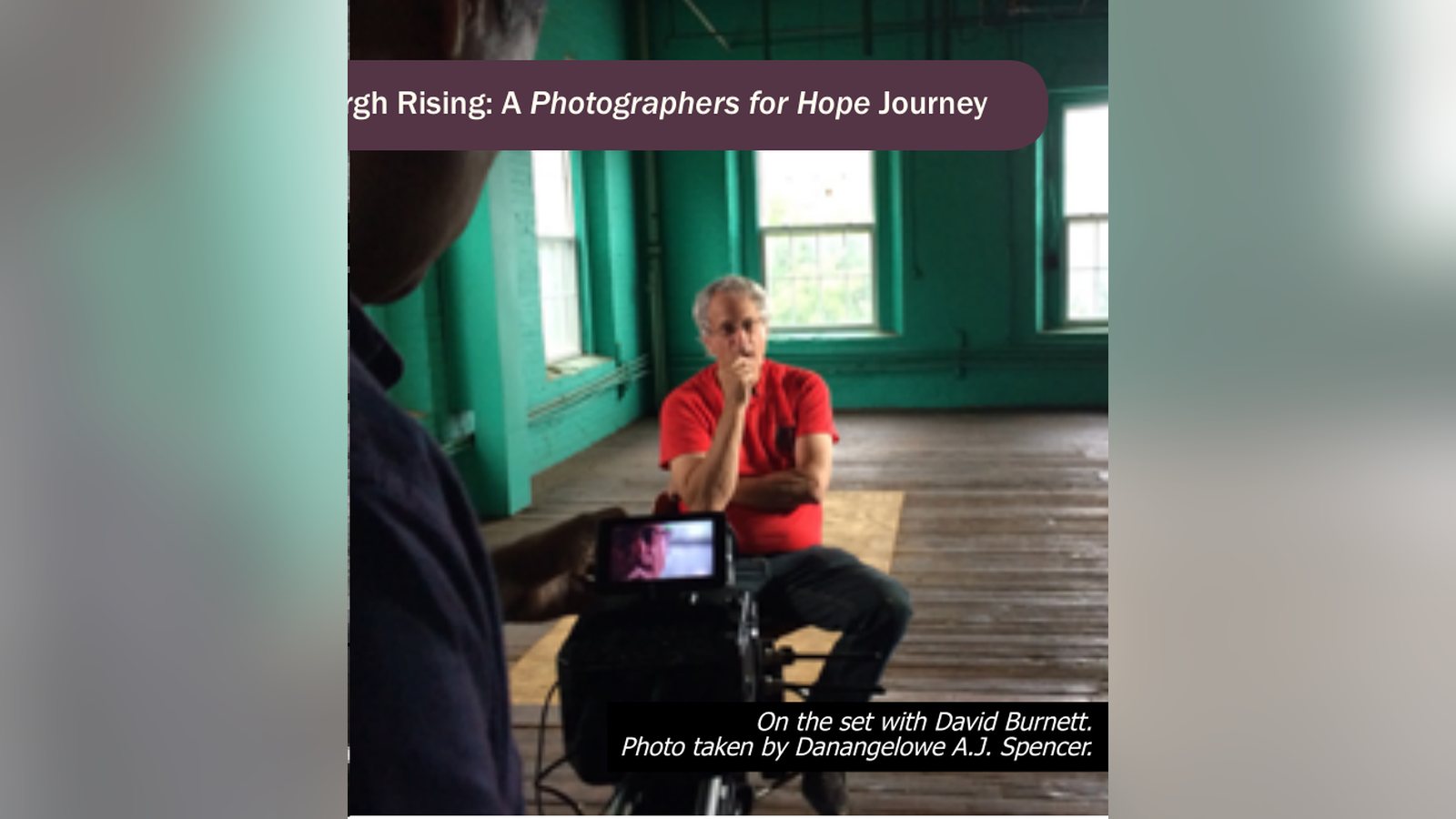
The former Regal Handbag company factory on the shores of the Hudson, Newburgh, NY. Photo ©2015 David Burnett/P4H. On the set with David Burnett.
Photo taken by Danangelowe A.J. Spencer. Here’s how it worked. Our cinematographer, Apal Singh, did double duty as one of the elite group of photographers while shooting some footage with his DSLR on location. By the time I was called in the photographers had already been in town for a week, so we were playing catch-up. No script, no real outline, just a mandate to create a portrait of a city in transition; less cinema verite than a cool narrative improvisation.
We shot the interviews in what once was the largest factory and employer in Newburgh, the Regal Bag Factory, located on Newburgh’s waterfront. Two weeks with a location scout could not have afforded us a better location. Filled with light – or not – depending on where we chose, gritty yet freshly painted in some areas, the location was an embarrassment of riches. I wish we had more time for set ups, but what else is new? The interviews themselves were fantastic.
To echo Anna’s claim of life affirming moments, I too was infinitely moved by these nine artists. And I was plenty happy that I didn’t have to grab my passport and pack my bag to do it. Not so for Apal Singh, the DP for my contribution to the group, who flew in from India. Apal has lensed over twenty-five documentaries and worked with leading international broadcasters including the BBC, National Geographic, Discovery, ABC, ITV, Channel Four, and Al Jazeera, besides Indian broadcasters. His Indian-made feature Highway for Deepak Rauniyar has garnered much critical praise.
Of course, the documentary held second place to the photo shoots around town, so I didn’t get to talk with Apal about what equipment we would need until the night before we were to do the interviews.
“I’m using my DSLR for both shooting and video b-roll,” he explained in his soft voiced Indian accent, “I do need a tripod and a good sound kit.” I told him I would bring my trusty Sony FS100, as well as a couple of lavs, and if he wanted to use them, all the better. “We’ll see,” he answered.
Even though I knew we were only doing interviews, that morning I practically emptied the college equipment room. Besides the FS100, I brought two Astra bi-colored 1×1 Litepanels, a small ARRI kit with two 350s and a pepper lite. Gels, both CTB and CTO, lots of spun, two wireless lavs, and other assorted stuff. With two students in tow, we headed the short mile to the factory. As we did I thought to myself, he’s going to take one look at this and laugh – politely telling me I was bringing an army to kill a mosquito.
In fact, not only did we use much of the equipment, Apal couldn’t have been easier to work with. For me at least, it was love at first sight. That day we shot nine separate interviews, in various locations. Between interviews we shared stories, talked tech, and all in all, had a great shooting day. The next night was the opening of the Photographers for Hope Newburgh exhibition. As fast as they all swooped in, the nine photographers were all packed and ready to fly back to their homes around the globe. Apal’s present to me was a hard drive with all the data, which I turned over to our editor Merle Becker a few days later.
That all took place this past November. Four weeks ago, after a great first cut by our editor Merle Becker, it was decided that we needed to do another round of interviews to “bring some more depth” to the piece as well as to explore some of the new people and businesses that are doing so well in town. Once again Apal made the trip from India and we returned to the factory. This time we were comfortable enough to let the students do some of the setups, with Apal and I acting as mentors and teachers. And so the creative circle continues, with students learning by working in a professional environment. Sure, they’re working with the newest and coolest tools of the trade but just as importantly, they’re learning how to separate the frame in their heads from the environment and actually see the shot. I watched as they made the connections and it was pretty cool. As for the passion and glee that real filmmakers enjoy each time we get out there? I think they caught that too. After all, that’s why we all come back.
After the dust settled I sat down with David Burnett at the Two Alices café in Newburgh, our unofficial clubhouse, to talk tech. This should be a treat for those of us filmmakers who love to shoot stills as well.
Dean Goldberg: What camera or cameras did you shoot with during the project?
David Burnett: I shot with my Leica M9 (digital) with an old (1978 vintage) 50mm Noctilux lens, as well as Canon 5D and 6D. One of the Canon 5D cameras has been altered to shoot infrared spectrum. The normal 6D cameras were fitted with standard 24-105 zoom, 45 and 90mm tilt shift lenses, and 70-200 zoom. Nothing very fancy.
Dean Goldberg: What kind of techniques did you use to get those very special and evocative black and white landscapes?
David Burnett: The B/W was the result of converting an infrared picture to pure monochrome. In doing so, the camera sees some things, particularly skies, clouds and water, differently than our eyes do. You can try and pre-visualize but they never quite look like what you thought they would. That keeps it fun.
Dean Goldberg: What’s the biggest change in this art form since we essentially moved from a chemical process to a digital process? Has anything been lost? Gained?
David Burnett: Not knowing you had a picture made you a different photographer: when you had very little film (even a long 36 exposure roll, which now seems puny, was big in those days) and no assurance you had a picture, you made more of an effort to try and figure out ahead of time what you wanted to shoot, and how to shoot it, and do so in a way which might even yield a good photograph. The great missing element in today’s photographers (particularly young ones who never knew film) is that they lack that pit-in-the-stomach sense of worry, which every photographer, both legendary and awful, felt in the analogue age. That sense of doubt, of worry, was in many ways a key element in the way in which we approached a subject. But much of it was guess work, and all the more fun when it worked out.
Dean Goldberg: How has digital changed the way you work?
David Burnett: I loved the old days of shooting (say, a political campaign… where you work 12 to 14 hours a day following a candidate) when you got to the hotel in the evening, put your film and captions in an envelope, called a messenger, left the envelope at the front desk, and then headed to the bar to socialize, hopefully with some of the staff people who might have tips on what was doing the next day. Now, you end up in your room, maybe lucky enough to get a room service hamburger and deal with uploading your digital cards, editing late, and sending your selects over the wi-fi to the home office. The film scenario was slower, but a helluva lot more fun.
Dean Goldberg: Now that “film” can be shot with a DSLR the line between photography and cinematography has been erased to a certain extent. Do you think that has affected the art of photography – of that “moment frozen in time”?
David Burnett: Ah, the art of photography. And there are those who say it isn’t art?
Certainly the fact that you can shoot a feature film with what is essentially a 35mm digital still camera, means the distance between the two is shrinking. What isn’t changing is the need to see film and video from a ‘continuity’ point of view, and being able to pre-visualize just how the sequences might run into each other. I love having a still camera that, when I push the little red button, it starts shooting at 25 frames per second.
Dean Goldberg: Thanks David.
David Burnett: Don’t thank me so fast; you’re picking up the check.
Words from the Film’s Editor Merle Becker, Film Editor
The fact that the piece had such a loose structure in pre-production has really allowed for some creative storytelling in the edit, and I really enjoy this. The photos are world class and when we paired them with the heartfelt interviews that we got, it really produced something magical. I enjoy emotional pieces with deep connections to the human experience, and this story certainly falls into that category.
I chose to edit this project in Adobe Premiere, primarily because of the program’s simplicity and reliability. I was a huge fan of Final Cut 7, but when Apple reworked the platform for the release of X, I went back to Premiere, and found that it had made significant improvements since its inception.
Merle Becker is an editor/producer/writer at her company Freakfilms, Inc. She and her husband live in Newburgh. For more information about Merle and her work go to www.freakfilms.com.
On the set with David Burnett. Photo taken by Breanna Scott. Dean Goldberg and crew. Photo taken by Danangelowe A.J. Spencer.
Related filmmaking guides
- Film directing: getting good performances
- Coverage and the master shot
- Camera angles in film: a beginner’s guide
Keep learning filmmaking
Want more lessons like this? Join StudentFilmmakers free for live webinars with working pros, and stream on-demand filmmaking classes in cinematography, directing, screenwriting, sound and post.