By David Lent
“Choose your tools wisely.” Cameraman David Lent explains how to plan for the best and prepare for the worst on every shoot, from gear to schedule.
Choose your tools wisely.
When you’re aiming for the highest levels of performance, your tools must be equal to the task. If you can’t afford the equipment you want, rent it until you can. Seek out veteran shooters and people who have grown successful equipment rental businesses for recommendations concerning formats, manufacturers, models and support equipment.
Lighten up. Choose support gear that is small and compact, allowing you to pack light and move fast. Keep your equipment clean, well-maintained and ready to go on a moment’s notice.
Get to know your camera. Check out all the menu items and experiment with settings to find the look that works for you and/or your clients. Read the manual. Visit online forum discussions about your gear. Get out and shoot.
Pack smart. A collection of small, medium and large runbags allows you to assemble your gear into the lightest and most compact package appropriate to the shoot. The result: more time for creativity on location and a grateful body when the work is done.
Everything in its place. Keep your gear visually organized. When each piece of equipment has a place of its own in your runbag, light kit or on your shelves, you can get to it easily. And if something were to go missing on a shoot, you’re more likely to notice its absence before leaving the scene. If you’re shooting some distance from the equipment staging area, you can send someone back for a piece of gear with the confidence they’ll know where to find it.
Do your chores. Once a month, clean every exposed surface of your camera. Check for tiny screws that have been loosened by the vibrations of air travel. Tighten them before they fall off; they are expensive to replace.
I’m not a large person nor do I enjoy hauling heavy equipment cases to and from a location. I like to work fast, so I’ve made it a practice to design – and continually re-design – a gear package that is light and compact yet sufficiently versatile for nearly any assignment.
When using someone else’s camera and gear, arrive early and get familiar with it. What are the zebra and gain settings? Adjust the viewfinder’s diopter for your vision. Record some video and audio and check playback. Go through the light kit, audio package and run bag. Re-pack it your way so you can get to anything fast.
Dress for survival. Always assume that when you’re called for an assignment there won’t be time to go shopping. So have on hand the clothing and protective gear you’ll need for rain, snow, dust storms, hurricanes, freezing cold or blistering heat.
Cart Protocol. Much of our time moving between locations is spent pulling or pushing a two-wheeled equipment cart. There are times to push and times to pull.
Push
- Into the back of an elevator. If it fills with passengers, you won’t have to struggle to turn it around and can get out faster.
- Onto a down escalator, limiting your footprint to 2 steps, not 4 or 5.
- Down stairs and curbs. You don’t want your lights taking a hit.
- Through a revolving door. Use only the big ones; you’ll want your equipment to make it out even if you don’t.
Pull
- Onto an up escalator – again, 2 step footprint
- On a sidewalk or street. Prevents injury to someone’s feet or shoes.
- Through a crowd. You’re a better leader than your cart.
- Up stairs. A good little workout.
On the Road
On an airplane, when traveling without a camera case, cushion the camera with pillows, blankets or a jacket in the overhead bin. If the compartment is otherwise empty, protect the camera from sliding by positioning it at the rear end on takeoff, the front end on landing.
Be ready to shoot. Have your camera within reach, recording media loaded, battery charged. To guarantee at least the minimum of recorded sound in an emergency, make sure one audio channel is dedicated to the camera mic and set to auto gain. Set the filter to current lighting conditions and the camera/bars switch to camera.
Dress comfortably but keep the client and location in mind when packing appropriate and practical clothing.
Carry business cards. You never know when or where you’ll meet an opportunity to create a customer, partner or friend.
Before a live shot, remind crewmembers to mute their cell phones, and see to it that the live shot guest has access to a glass of water. I’ll never forget the pained expression on a guy who sat patiently for half an hour in front of my camera, unaware that his throat had dried up in the air-conditioned studio. When at last he was called upon to speak to twenty million Australians…you guessed it.
Aerial Shooting. When you’re called upon to shoot out the door of a helicopter or airplane:
- If it’s not summertime, dress for cold weather and 90mph wind.
- Bring a pair of good ski goggles.
- Make sure you are fully briefed by the pilot or crew chief in emergency escape procedures.
- Streamline the camera by removing the shoulder strap, camera mic, and lens hood.
- Check and double-check that you and your camera are separately secured to the aircraft fuselage, in addition to the seat belt.
- Coordinate hand signals with the pilot as a backup for the intercom. With the door open, the noise from a helicopter’s engine and rotor can be deafening.
- Explain to your pilot what you want and chances are s/he will accommodate you by flying lower, slower or closer.
A word of caution: Some readers may be offended by the following terms, commonly used within the newsgathering culture, to describe the various stakeout formations.
Nevertheless, crude humor is how many of us—men and women alike—often cope with the dark or distasteful edges of our business. For those readers who aspire to a career in news, perhaps what follows will inspire you to change the culture. And for those who simply enjoy knowing, ‘What’s behind the curtain?’ Walter Cronkite’s legendary sign off, “And that’s the way it is,” applies.
Stakeouts
There are at least four categories of stakeout formations, each defined by the nature and importance of a news story. It’s a good idea to understand what to anticipate from each.
The Stakeout. A newsmaker may be leaving an office building, restaurant, airport arrival gate, hotel or courthouse. A group of producers, reporters, shooters, audio recordists and photographers assemble for the newsmaker’s appearance. A lot of standing or sitting around and shooting the breeze. We’re focused, yet relaxed and cordial. The subject arrives. We get our shots, perhaps a brief statement, and then disperse.
The Scrum. Now we get serious. It’s breaking news, attracting many crews and reporters. Our subject, or perhaps his or her lawyer or media rep, may have timely information that will be the lead story on every Live at Five. We’re following the newsmaker through a building, down a sidewalk or crossing a street. A little pushing and shoving but civility prevails. The Scrum can, and often does turn ugly, degenerating into…
The Gang Bang. A major story, a reluctant or evasive subject. The stakes are high. Many shooters, photogs, audio folks and reporters jockey for position. Former football, hockey or rugby players have the physical advantage. The rest of us have to be wily coyotes. Egos and reputations are battered. The Gang Bang carries the menacing potential to erupt, at any moment, into…
The Pig F–k (AKA Cluster F–k).
Networks and stations throw all their resources into the story, and you’re on the front lines. This may be triggered by the mob mentality waiting to spring from a Gang Bang or out-of-town shooters unaware of the protocols locals observe to maintain civility. People get knocked down and cameras or lenses hit the pavement. Mob pathology rules. The difference between a Gang Bang and a Cluster F–k is that if you fall during a Gang Bang, one of your colleagues might help you back up. In a Cluster F–k you’re on your own. You see the dark side of human nature.
As a Rule…
Arrive early and rehearse. If you’re going to be shooting from a tripod, consider what might happen if you need to grab the camera and run. If you’re hard-wired to your sound recordist or mic stand, rehearse in your mind how you can quickly unplug and go. Use batteries, not a/c, so you can get away faster. Test the audio. If the light is changing, re-white balance the camera. Make sure you know what your client/reporter/producer wants. Remember, you are here for one and only one purpose: to get the shot.
Visualize the outcome. Keep your eyes, ears and brain on “high idle” while waiting for the newsmaker to arrive or depart. Spend a few moments visualizing all the possible ways the situation might go down. From what direction or door will your subject approach? Which side of the car is s/he likely to exit or enter? Where can you stand? What are your boundaries? Can you push them a little further? Where are your colleagues and which way do you think they’ll move? Where is your best shot going to come from? Practice any moves you plan to make and any necessary adjustments to the iris or focus rings. Occasionally, the reporter won’t show up and you’ll have an opportunity to do an interview. What is the story? Have one or two questions ready.
Photo Ops
Get the handshake. At a “photo opportunity,” you’ll be given a brief few minutes to communicate the essence of the event. Your first task is to survey the room and get a good position. Next, identify the key players. If you haven’t seen them before, and photos aren’t available, ask someone who is familiar with their faces to tell you what celebrity they most resemble. If you’re able to download video or photos of the people you’re waiting for, look at the faces over and over until you’ve associated them with people who are familiar. If the newsmaker plans to speak to the media, be close to your producer or reporter so the subject is looking in your general direction. Go to a close shot of the key players and hold it for several seconds. Roll on the handshakes. Then shoot cutaways and a wide shot of the other people in the group and, if time permits, a reverse shot of your reporter and/or the group.
Press Conferences
Get a good position. Locate and plug into the mult box then do a white balance and audio check. Have a spare battery and recording media near your feet. Ask your reporter/producer what they want and agree on a signal that will let you know when you can break off from your tripod for cutaways and b-roll.
Driving Shots
Use a wide-angle lens or adaptor. When shooting a residential neighborhood, ask the driver to maintain a speed of 10 to 15 mph. If you’re inclined to hang out of the open door, make sure some part of your body is fastened to the seat belt. Some people you’re shooting won’t like being on camera. If possible, let them know who you are and what you’re doing.
B-Roll
Roll 8-12 seconds of the shot, more if you anticipate something good is about to happen in your frame. Start with wide shots then zoom in for details. Be unique. Go for shots only you can do. Always shoot more b-roll than necessary; an editor rarely has enough options.
Managing Stress
The wisdom of insecurity. Anticipate nail-biting weeks—or even months— without a call for work. A good practice for managing “freelancer anxiety” is to remind yourself: “I may be having a bad week/month, but it’s going to be a great year!” During slow periods, set aside a few minutes each week to call at least two potential clients: “Hi, I’m Dave Lent, a freelance shooter in DC. Just calling to let you know I’m still around and would love to work with you.” Most clients don’t mind if you rattle their cage every month; it’s also a good way to keep the relationship growing.
Take care of yourself. The better care you give your body, the longer you’ll last in the business and the more you’ll enjoy the work. The benefits of exercise, strength training, and good fuel become particularly important for assignments involving travel, long handheld days and heavy lifting.
Stress without distress. Stress and anxiety bring out the best and worst in people, depending on how we choose to respond to the stressor. Uncreative responses include over-indulgence in nicotine, alcohol, junk food, TV or self-pity. Creative responses include nutritious food, exercise, meditation or taking a break. If you choose wisely 51% of the time, consider yourself a success.
Push the pause button. We love what we do, and want long, fulfilling careers. So we have to make choices. Will we allow a situation to crash and burn? Or will we step back, take a deep breath, then step back in with a calm, creative approach to the problem?
When the stakes are high, you’d better be good.
For the independent shooter, the stakes are always high. When things go wrong, you’re going to agonize over what you did or didn’t do; this kind of stress comes with the territory and is not a bad thing. Accept it and embrace it. When you no longer put a high value on your performance, it’s quitting time.
If there is one thing the Boy Scouts of America got right, it is their motto: Be Prepared. This commandment is tailor-made for video production. The sheer number of things that, at any moment, can go wrong is mind-boggling: dead batteries, fragile electronic components crapping out, airplanes and sirens ruining good interviews, bad cables, hostile crowds, nasty weather, long hours, no meal breaks, falling light stands, TSA inspector breakage…the list is endless. And while it’s impossible to anticipate every potential glitch or disaster, preparing for all those you can imagine is of the utmost importance.
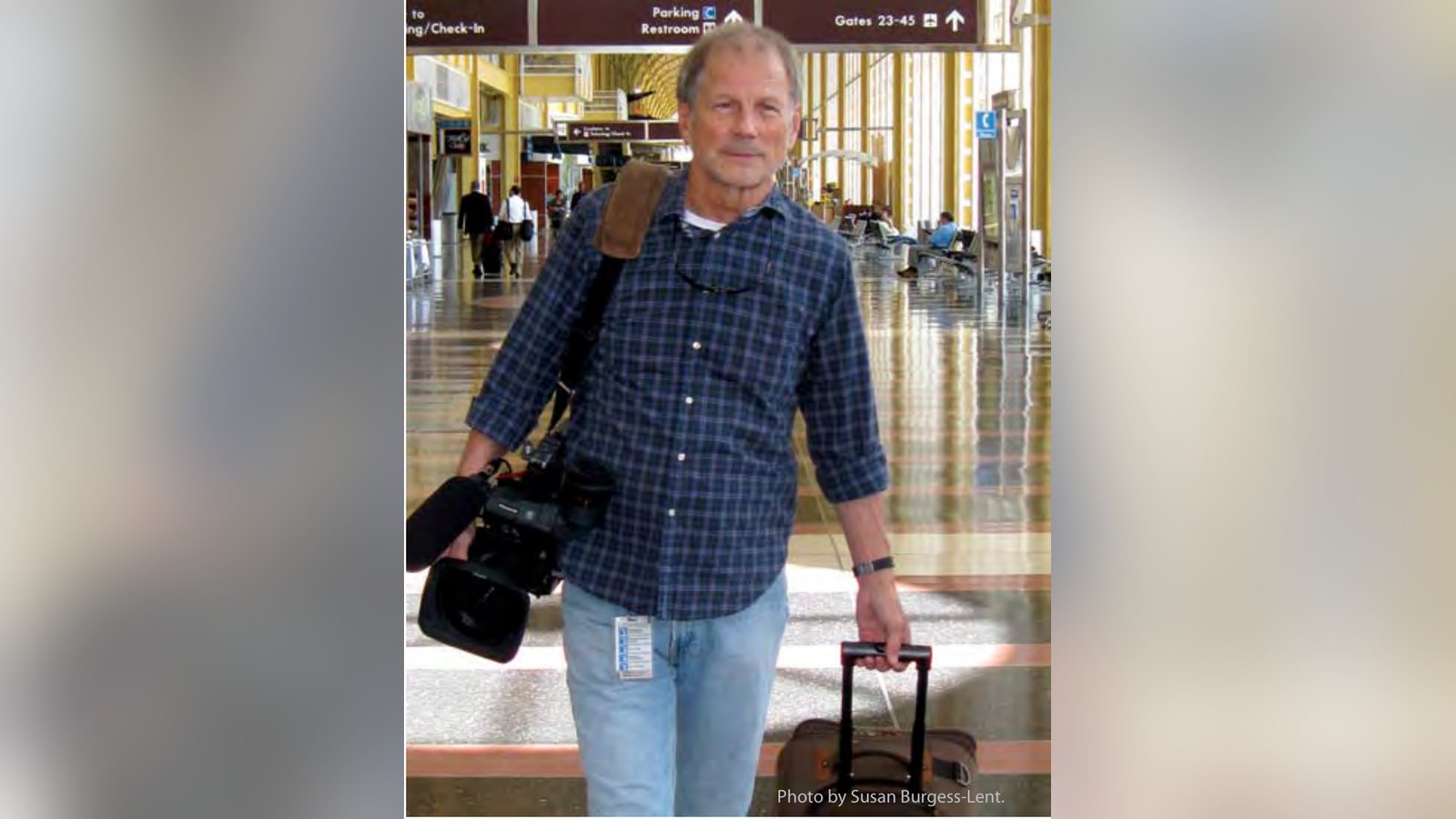
David Lent’s career as a cameraman, producer and product designer spans forty years. His clients include domestic and international networks, local stations, corporations and independent production companies. David’s seven documentaries include the critically-acclaimed Life Without, Hotel Macedonia and The 5 Keys to Mastery. He is the author of The Laws of Camerawork and inventor the Steadybag, PicupStix, GelFile and LensEnd – accessories used by video, film and photo professionals worldwide. David lives with his wife Susan Burgess–Lent in Washington, DC where he continues to work as a news, documentary and sports cameraman.
- Camera
- Camera support: Tripod, ShotSpot,
- Run bag, containing batteries, discs, audio (shotgun mic, hand mic, Rowie clamp, Belt pack and cube transmitters, receiver, fresh 9 volt batteries, XLR cables of various lengths, splitter and connectors), 7-inch LCD monitor (with sun hood and custom cable to power it from the camera), rain cover, camera manual, back-focus chart.
Light / Audio kit (for a one person interview):
- 1 Lowel Rifa eX 44 with diffusion and honeycomb grid
- 1 Lowel Pro Light, dedicated as a backlight, with a snoot covered by ¼ blue gel
- Spare bulbs – tungsten and fluorescent
- 2 light stands and a clamp with a light post
- Boom arm and gobo
- Lowel GelFile with gels, diffusion, black wrap, clips, pressed powder compacts for light and dark skin
- 2 dimmers
- 2 25-foot medium duty a/c extension cords, 3-way and plug adaptors
- 2 Sonotrim lavalier mics
- 3 25-foot xlr cables
- Headphones
- Soft gloves for handling hot lights
- Gaffer’s tape (wrapped around an expired credit or gift card)
- Shotbag
- Lowel hard case
- Kart-a-bag 800 rolling cart.
On hand for backup:
- A third 500w light
- Translucent reflector, holder and stand
- 50-foot heavy-duty a/c cable
- Power strip
- Set of extra cart wheels for heavy loads.
A small belt pouch could contain: tiny hex wrench and screwdriver set; combination pliers/screwdrivers; large screwdriver for tripod plate adjustments; molded earpiece; 9v flashlight; ponytail holder for wrapping cable; toothpicks; spring clip; index cards, Sharpie and ballpoint; stick-on Velcro hook and loop; bank card-sized blade, saw, opener, and 4-position wrench; gaffer’s tape wrapped around old credit card (why pack a year’s supply?); first-aid kit including moist towelettes and floss; mini plug splitter; bnc barrel connector; earplugs (think aircraft carrier!) and lens cloth.
Related filmmaking guides
Keep learning filmmaking
Want more lessons like this? Join StudentFilmmakers free for live webinars with working pros, and stream on-demand filmmaking classes in cinematography, directing, screenwriting, sound and post.