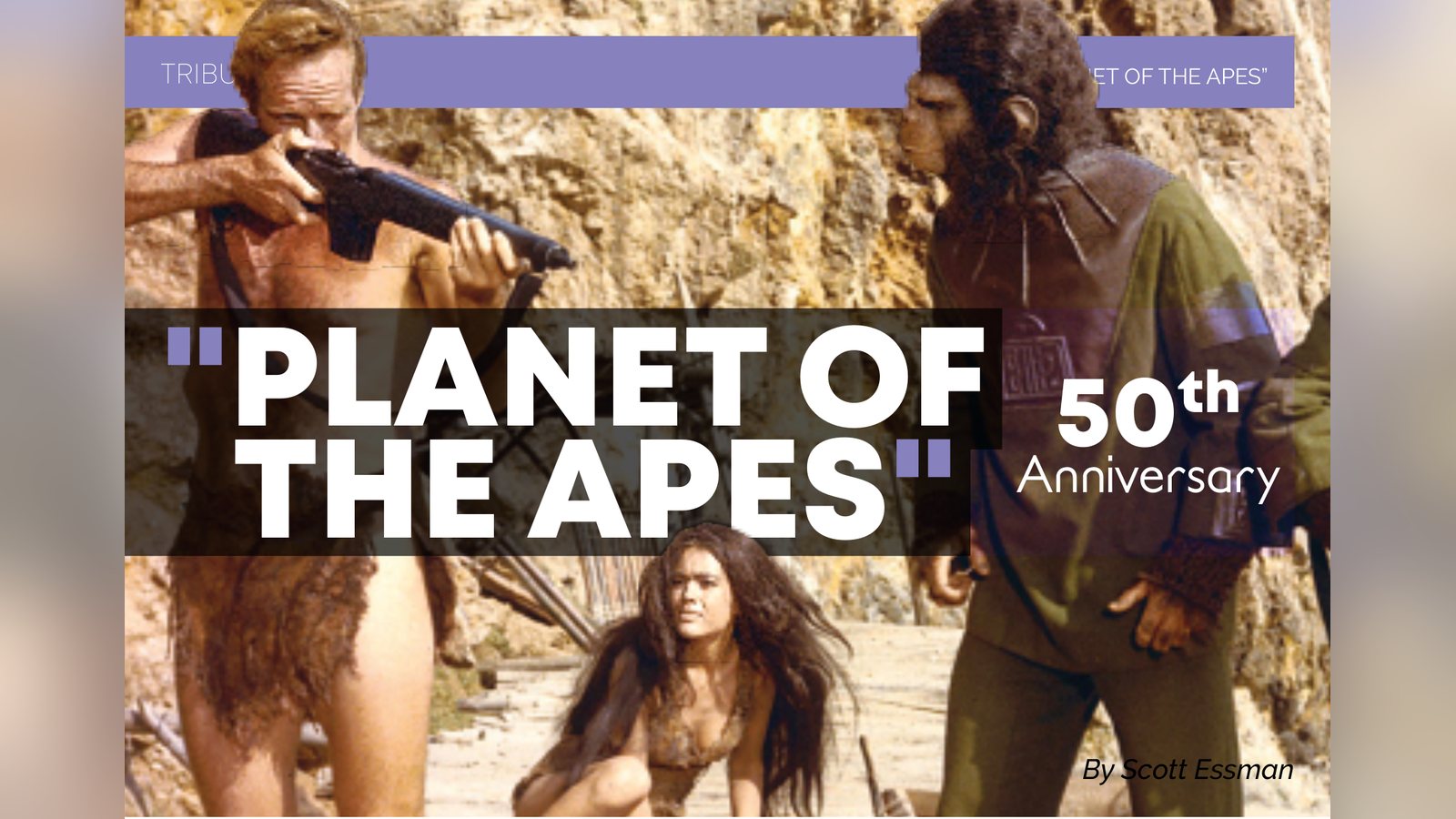
By Scott Essman
Planet of the Apes burst off the screen and changed cinema. Fifty years on, Scott Essman looks at how the classic and its groundbreaking makeup were made.
It burst off the screen, demanding your attention, creating a cinematic revolution in the process. Still, 50 years later, it is widely regarded as one of the all-time great works in science-fiction film. Indeed, Planet of the Apes, based on Pierre Boulle’s 1963 novel, transformed into a screenplay by Rod Serling, and brought to the screen by 20th Century Fox, sparked a movement which lives on generations after debuting in 1968. At the time, Apes floored audiences with a multifaceted cinematic approach, but even movie stalwarts could not have predicted its four original sequels, a live-action television series, an animated series, a full line of action figures and playsets, massive merchandising opportunities, a ill-fated 2001 remake, and three 2010s prequels which raised the bar on performance-capture-based computer animation.
Unquestionably, many different disparate elements of the project needed to coalesce to bring us the magic of the first Apes film. By early 1964, Serling had begun to pen drafts of the screenplay, with contributions chief Richard Zanuck, son of the longtime 20th Century Fox chairman Darryl Zanuck, began in earnest to produce the film, initiating test footage filmed in March of 1966. Makeup department head Ben Nye was tasked with creating the simian likenesses for the screen tests, and the project was greenlit in September of 1966 with producer Arthur P. Jacobs and Mort Abrams aboard, though the makeups would take a decidedly different direction. Few could have imagined then how the prosthetic ape makeups in the final film would spark a revolution in their realization of unique screen characters in movies.
Enter John Chambers, a prosthetics veteran who had found marked success with The List of Adrian Messenger in 1963, a project which struck Abrams and Zanuck as being groundbreaking in its prosthetic makeup likenesses. Critical to Chambers’ achievements on Apes was the casting of appropriate actors. In 1996, Chambers explained how, in anticipation of the difficulties in transforming actors into apes, a key production decision was made. “We cast actors with brown eyes to give them a similar look to actual chimpanzees and gorillas,” he said. “We also sought actors with flat noses to fit into the muzzle of the ape appliances. Some were picked at random and their noses were too large. We found that we needed physical actors, and they were usually among ethnic groups.”
To execute the project, Chambers began in full during January of 1967 with a key artist at his side. Tom Burman, whose father Ellis was a pioneering artist in the use of prosthetic materials, including a mask-making venture, was stationed at 20th Century Fox as a union apprentice when major pre-production on Apes kicked off. “’Tommy, it’s you and me!’” Burman recalled Chambers exclaiming about the budding project. “He holds up the script: ‘I am going to win the Academy Award.’ I knew that there was something special about it.” For almost five months, Chambers and Burman worked on the many formidable tasks presented to them on Apes, including cleaning up the makeup laboratory at 20th Century Fox to prepare for the enormity of the project; it would be the biggest prosthetics film in cinema history to that point. “I knew how to work with foam latex as a propmaker,” Burman said. “Chambers needed somebody who had an understanding of lab work. John could be really tough on you. Being a Marine, I knew how to follow orders. I picked up his methods very quickly — I became a son for him.”
While both leading and supporting actors were lifecasted, and ape makeups were being sculpted and realized in foam latex, locations were being secured and sets were being constructed. With opening scenes shot in Lake Powell, Utah and different locations in Arizona comprising much of Apes’ exteriors, the all-encompassing ‘Ape City’ scenes were filmed at the 20th Century Fox Ranch in Malibu Creek State Park, a location in Calabasas, California— then the ending sequences were filmed in Zuma Beach, California, west of Malibu. All interiors were subsequently filmed on stages at 20th Century Fox’s main lot on Pico Boulevard in western Los Angeles. On the lot, Chambers and Burman were training young artists who Chambers specifically sought out. “He didn’t want seasoned makeup artists adding their own touches,” Burman stated of his mentor. “He wanted uniformity; paint-by-numbers. The younger guys were so green, so new. They had no idea what they were thrown into.”
Certainly, Chambers’ makeup design concepts for Planet of the Apes was unprecedented and forever changed movie history. For the principal actors, the chimps and orangutans wore ‘T’-shaped, three-piece, appliance makeups which included a brow piece, upper lip, and lower lip; gorillas were a two-piece makeup. The principals’ appliances were removed at the end of a day’s shooting with an alcohol acetone solution that cut the glue and washed out the rubber without damaging it. Chambers’ experimentation led to a foam rubber that allowed the actors’ skin to breathe comfortably.
Forced to pioneer many production techniques to meet the demands of such a large scale makeup show, Chambers, who passed in 2001, claimed, “we innovated everything.” The most influential of his landmark practices was the advent of pre-painting the ape appliances. “That had never been done before,” Chambers revealed, “and I was having trouble finding people capable of working in my system. Every individual thought he was a fabulous artist, which was great, but I couldn’t afford to have Da Vinci and Michelangelo; I had to have uniform makeups, so I knew that we had to take it out of their hands.”
To streamline production, Chambers also set up an assembly line technique to create the dozens of slip-rubber shell background masks that would be used in master shots. “When we airbrushed with spray guns to paint the masks,” he pointed out, “we found that one artist could do the work of 20. For appliances, after the foam rubber pieces came out of the mold, we put them on a vacuum-form support, then airbrushed them by lining them up and painting them one by one. At that point, the appliances were ready to be fit onto the actors’ faces using a special spirit gum to attach them.” Chambers’ pioneering mode of production was a great success. Nonetheless, he chuckled, “we still had some artists who wanted to put their touch in there when they applied.” Though information is regularly divulged in present-day interviews, in the 1960s, makeup departments were secretive places with locked doors and little sharing of techniques among artists. But Chambers fought to change that culture on Apes and other projects of his at the time.
In the first five months of 1967, the 20th Century Fox makeup department was turned into ‘Ape School’ where nascent artists created the three main makeups on the over and over again: chimpanzees, orangutans, and gorillas. The late Larry Abbott had been Charlton Heston’s hair stylist and joined the team. Famed artist Ken Chase (who created the realistic age makeups in Back to the Future) worked in a beauty shop before joining Chambers’ group, then ended up creating the Dr. Zaius makeup for Maurice Evans on a daily basis. Other young artists included the late John Inzerella, Leo Lotito, and Maurice Stein, who just passed in the winter of 2018. Apes’ costumes were delivered in perfect symbiosis to the makeups by designer Morton Haack. The unforgettable wigs were created by the late Josephine Turner, who genuinely lodged a storied career in wigmaking.
Chambers remembers that Turner, “was marvelous, very savvy. She ventilated the hair onto a fine mesh flesh-colored base. We created a pattern that allowed her to design separate hairpieces for our makeups. One was a wig, and there was a piece for each of the side burns that came down under the jaw.” Chambers’ team put Turner’s hairpieces onto the actors each shooting day after the ape makeups had first been applied.
Through the process, Burman, in his mid-20s, followed Chambers lead. “Because I was very diverse, I had inklings how to do things and adjusted to John’s methods,” Burman said, “adjusting rubber, making molds, making teeth. I worked seven-days-a-week and made $90 a week. I worked 18 hours a day—I had a lot of responsibility.” When the film started shooting in mid-spring of 1967, Burman’s job was to make sure that all of the makeup artists had what they needed for the entire day. “Everything was laid out like paint-by-numbers: an appliance, a back-up appliance, a vacuum form that the appliance would sit on, a base-coat, a highlight, and a shadow,” Burman detailed. “They also had a hackle to lay their hair in, with the hair and wool all mixed and ready to go. Their hairpieces were laid out, and they had the appropriate flat spirit gum that wouldn’t shine. Because of Chambers’ detailed organization, it wasn’t as hectic as it sounded.”
The proportions of the film, by any standard, were enormous: there were often as many as 60 make-up artists and more than 40 hairdressers working every day; most of these craftspeople handed out masks, made sure that they fit, then colored around the actors’ eyes so that their flesh was not exposed. On select shooting days, there were 160 extras with background masks on.
From May 21 until August 10 of 1967, Apes was shot on William J. Creber and Jack Martin Smith’s, iconic, unforgettable sets, mesmerizing eventual audiences with their collective vision of Ape City, the haunting scarecrow figures, the mysterious beachside cave, and all interior ape dwellings. Moreover, Leon Shamroy provided stellar cinematography under the direction of Franklin J. Schaffner, who used all of his cinematic tools to realize the complete experience of the film. Schaffner was unafraid to shoot his ape actors in closeup, use a zoom lens to frame the action, and take misanthropic Charlton Heston’s point-of-view in an extensive chase scene. Heston, as Taylor, still resonates in his first spoken words in Ape City: “Take your stinking paws off of me, you damned dirty ape!”
When production wrapped, Chambers and Burman took down the project in the makeup department while Hugh S. Fowler edited together the many elements photographed on set with key effects shots, including one of the most unforgettable ending images in movie history. Jerry Goldsmith provided the unconventional, groundbreaking, avant-garde score, a renowned achievement. Apes was released on April 3, 1968 and stunned viewers with its complex humanistic message, its convincing characters, and its shocking conclusion. Though no formal Academy Awards category existed for makeup in 1968, Chambers received an honorary Oscar for Apes, one of only two ever given — the other being The Seven Faces of Dr. Lao, which went to MGM makeup department head William Tuttle.
In the ensuing several years, 20th Century Fox produced four Apes sequels. Of those films, which kept Chambers’ original designs intact, he said, “I was there for three of the sequels, assembling the molds and getting appliances ready, but Werner Keppler supervised makeups in all four sequels.” Though his makeup concepts were used for the Apes television series, Chambers was not involved. Tom Burman worked on the first two sequels, including the first, Beneath the Planet of the Apes, then started work on Escape From the Planet of the Apes, before moving onto other things. For a time in the 1970s, Chambers and Burman had an independent prosthetic makeup business together before Burman proceeded on his own with numerous triumphs, including Invasion of the Body Snatchers (1978), Cat People, Captain EO, Scrooged, Nip/Tuck, and many more, often in partnership with his longtime wife, Bari Dreiband-Burman.
For the 50th anniversary of 1968’s original Apes, Burman proactively assembled and produced a documentary about the creation and impact of the film; 34 interviews have been conducted to date, including John Landis, Howard Berger, and Rick Baker. The film, Making Apes—The Artists Who Changed Film, directed by William Conlin, is now starting an Indiegogo campaign for completion funds, with a full celebratory guest panel taking place at the Monsterpalooza convention in April, 2018. In totality, Burman was reflective about his landmark work on Apes and its overall importance in cinema history. “I think that it was a whole new experience for people back then,” Burman stated. “It was one of those things: producers, writers, and directors changed the way they thought about film. It still holds up after 50 years.”
Related filmmaking guides
Keep learning filmmaking
Want more lessons like this? Join StudentFilmmakers free for live webinars with working pros, and stream on-demand filmmaking classes in cinematography, directing, screenwriting, sound and post.