By Leonard Guercio
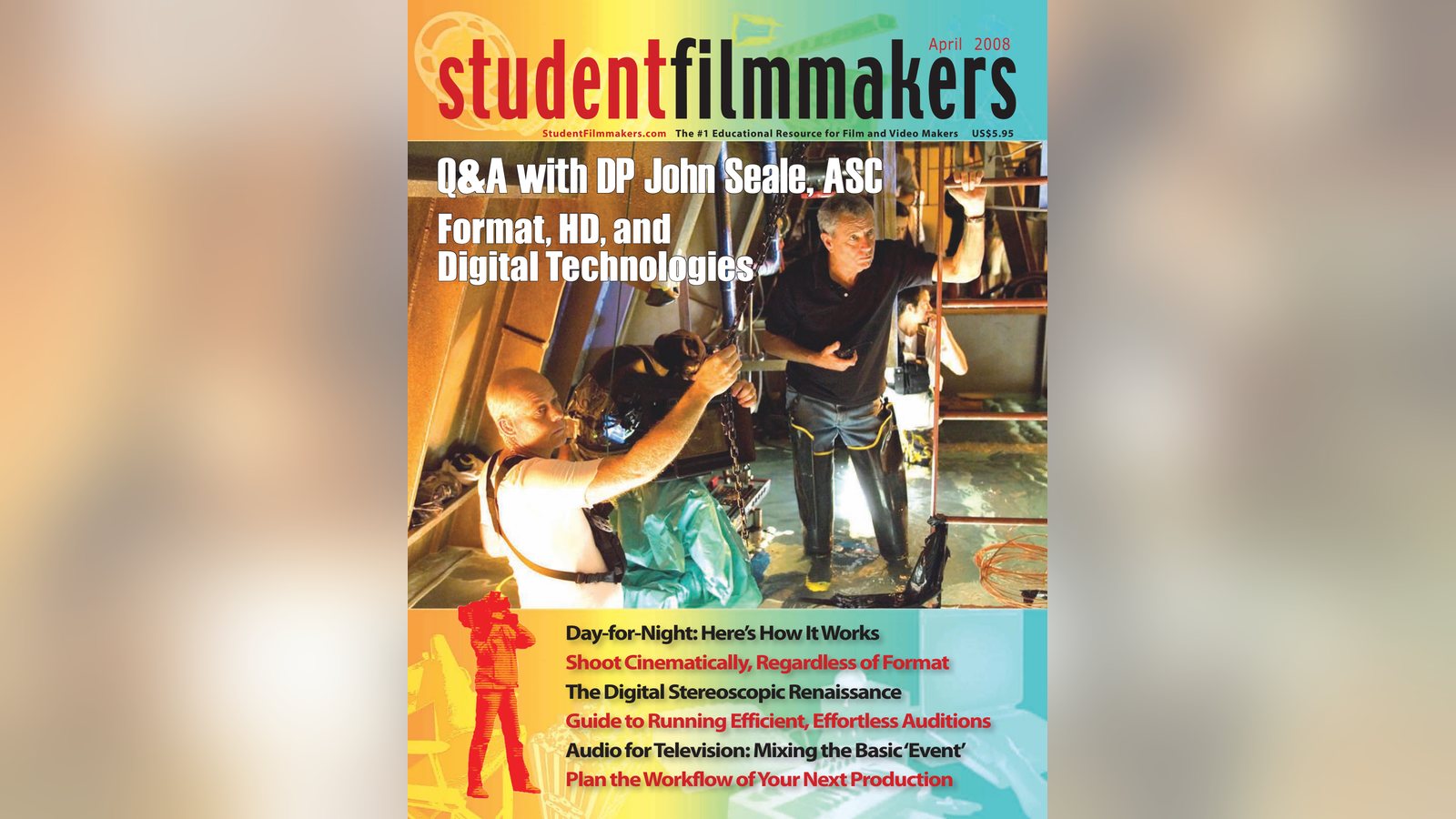
Begin at the end and work backwards. Leonard Guercio explains how to plan a production workflow from delivery to film and video acquisition to save time.
Start at the End
In what may seem a counter-intuitive approach towards planning your next movie project, beginning at the end and working backwards is a very effective way to help you save precious time and money – the two essential factors that affect all filmmakers, regardless of budget.
How does one begin at the end? The answers are to be found by asking several important fundamental questions.
- Who is the audience for this work?
- What format is best for my audience?
- How will they most likely view my movie?
- How will I deliver my movie to my audience?
The answers to these basic questions will clarify and define your project’s workflow at the pre-production phase. After all, there’s no sense spending money to shoot on 35mm color negative film if the end goal is to post your movie on YouTube or view it on standard definition DVD’s. Knowing who your audience is and how you will deliver your movie to them will help you better determine the necessary steps to better realize your vision. Knowing the deliverable medium, you can begin to plan for the post-production phase of your project. Depending on the format you choose, the next step would be to contact a post-production facility to discuss the most efficient and cost-effective way to arrive at your deliverable. Will you edit your movie on your own NLE system at home or at an outside post-house? Will you need compositing and CGI work? How about Foley work, ADR, and other audio sweetening? Answering these questions will lead to answers about the pre-production and production stages of your project. As we move inexorably toward an all 4K digital workflow, it no longer matters much whether you acquire your images in film or digital high definition video. Aesthetic considerations notwithstanding, the new digital cinema cameras – like the Red One, Thomson’s Viper and the Dalsa Evolution – are beginning to close the gap on resolution and image quality, once the sole domain of the film medium. Moreover, the Digital Intermediate (DI) has almost completely replaced the film intermediate in the post-production process. Keeping in mind how you’ll deliver your movie to your audience, should your movie be shot on film, 4K or 2K digital video, 1080p, 720p HD or standard definition video? Let’s consider some of the possibilities in acquiring your movie’s images.
Film Acquisition
If you’ve shot your movie on celluloid, after processing the film there are two ways to view your images. One method is the telecine transfer process whereby the 24 frames per second rate of film are converted to the 29.97 frame rate of video. This process occurs in real time and produces images that can be recorded and played back on videotape or DVD and watched on a video monitor. The other method is to have each frame of processed film scanned and saved as data to a storage device such as a hard drive or optical disc. Currently, this is done in less than real time due to the time it takes to scan all the information in a single frame. To view your images, you have to open the image data files using an appropriate application like Final Cut Pro, the Avid, Adobe Premiere or Photoshop.
Video Acquisition
With the looming February 17, 2009 deadline for digital transmission, the analog video world will take a major, and most likely irreversible, step toward obsolescence. The good news is that most moviemakers today are already acquiring images in the digital video domain. With the increasing sales of 2K and 4K video projectors and flat screen HD televisions, it is in the producer’s best interest to record in the highest resolution he or she can afford. Since 1080p seems to be the prosumer resolution standard for the next few years, selecting this format will ensure viability of your project for the near future. However, filmmakers currently using 720p camera technologies can rest assured that their projects will up-convert sufficiently well for acceptable viewing at 1080 lines of resolution.
Federico Fellini said: “Everyone wants my dreams, but my dreams are expensive.” As filmmakers, we are all keenly aware of the high cost to realize our cinematic dreams. Today, the new digital tools have made it less expensive to do so. Preparing a realistic workflow at the pre-production phase will serve as an indispensable map that will lead us to our desired destination – i.e., reaching our audience. Like all journeys, there are bound to be minor detours but, with a carefully considered workflow in place, we can be confident and secure knowing where we’re going and how we’re going to get there.
Leonard Guercio is an independent filmmaker and an adjunct film professor at Temple University in Philadelphia.
Keep learning filmmaking
Want more lessons like this? Join StudentFilmmakers free for live webinars with working pros, and stream on-demand filmmaking classes in cinematography, directing, screenwriting, sound and post.