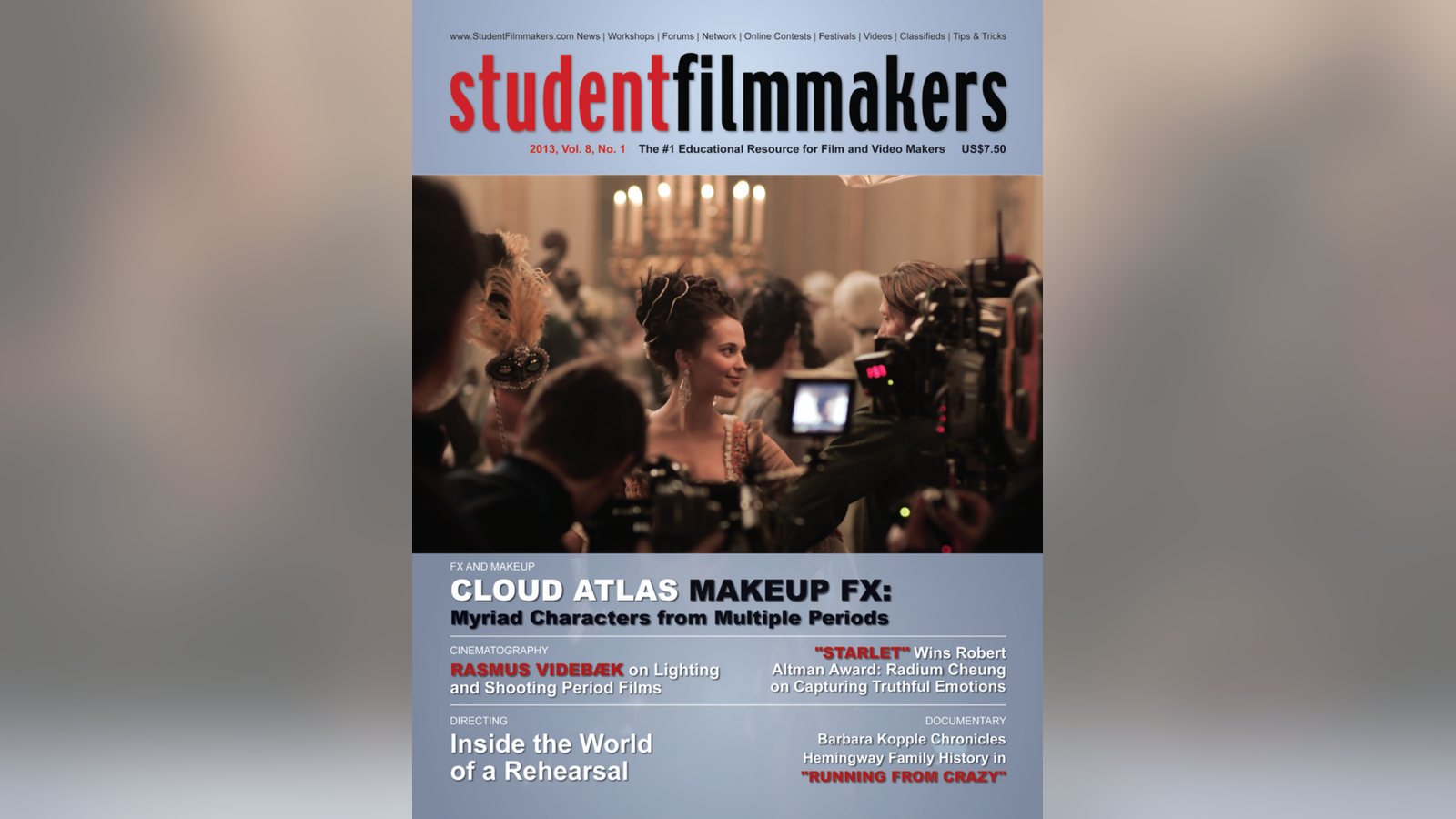
DP and co-producer Radium Cheung talks about working with Sean Baker on Starlet, shooting on the Sony F3 and finding the film’s simple, organic look.
Radium Cheung: Sean and I found an instant rapport when we met on a show called, “Greg the Bunny,” back in 2006. I was very grateful when he invited me along on his subsequent projects which include “Prince of Broadway,” a feature film which also premiered at Locarno and nominated for the same Spirit Award (John Cassavetes Award) and a comedy series for MTV called, “Warren the Ape”. Those experiences further solidify our rapport and our common sensibility for the language and aesthetics of cinema. “Starlet” felt natural to be the next project to collaborate on.
Aside from being the cinematographer, you were also a co-producer of “Starlet”? What came first?
Radium Cheung: After reading Sean’s scriptment (a full script was still being developed with our talented co-writer Chris Bergoch at the time), I was moved by it instantly and expressed to the producing partners that my interest was not only to be a cameraman for hire on this project. I wanted to help get it made and get it sold. So I signed on as a co-producer at the same time. For me personally, besides from believing in the project, another main reason was motivation – it was my way to push myself to give my 110% because it became as much my project as Sean and other partners’.
As the cinematographer, what cameras did you shoot with? What camera techniques and technologies did you use to capture special shots and scenes?
Radium Cheung: We had the Sony F3 with the newly shipped S-Log at the time. That gave us the 12 stop dynamic range we needed for shooting in the harsh direct sunlight in the San Fernando Valley without having to bring in big bounces for fill lights. More importantly though, we had always wanted to shoot anamorphic as opposed to spherical because Sean had wanted to capture the always-present hot blaring sun in the valley and let it become a character. The old uncoated anamorphic lenses would catch the flares and stretch it across the frame just the way we envisioned this film. We were very, very lucky and had just the right Karma to have come across a set of beautiful vintage Lomo anamorphic lenses in the nick of time.
On one shot Sean wanted to track with Jane as she walks along some power lines while talking to her mother on the phone. Sean remembered hearing in an interview where Jim Jarmusch talked about a similar shot on “Mystery Train”. They had a small jib mounted on a pick-up truck and pushed it in neutral gear. So we borrowed that idea. I then remembered one of my old friends and mentor Derek Wan, H.K.S.C. has just the right jib at his company, All In One Productions – the very same jib I used to set up for him when I worked as his grip in the late 90s. They were very supportive and gave us the jib for the duration of our shoot for a nominal token rental. On the day, we strapped it on the pick-up truck of Adam Kolkman, our amazingly resourceful and handy AC. The set up worked for us perfectly and it was also very fun to have the entire team (producers and crew) pushing the truck during those shots.
In your own words, how would you describe the “look” and style of your film? How did you achieve these results?
Radium Cheung: The look is very simple – organic and minimalistic. I had a very small lighting package that wouldn’t even fill up a cargo van. With the sun in the valley being such a constant, I wanted to use it as much as possible without introducing much artificial lighting. For all the apartment scenes, all I used were two bounce boards (poly) mounted outside the window to bounce the light in.
Occasionally, I did have to use a 1.2K HMI to dig deeper in to the apartment. For fill, I’d bounce some Kinos inside at the most. Yes, bouncing the Kinos, not direct or even through diffusion. To keep it even more organic, I tried as much as possible to use only the elements that’s already in the space of the particular locations. A perfect example was a breakfast scene at a diner. The beautiful and reliable valley sunlight was pouring in onto the back of our main characters Jane and Sadie. For key light, I just grabbed a big “breakfast special” sign off their window and handheld it in place. There it was, a beautifully naturalistic image. Sure I had some bounce boards we would’ve used had the sign not been there. But each room has its tone and energy. Bringing in any outside element even as simple a bounce board would be that much less organic and I think it does register in a sub-conscious level. I’m definitely not oppose to using technology to the best our advantage but I just tried to explore what’s available to us before introducing any traditional equipment.
We really didn’t want any special camera movement to distract us from this beautiful and genuine connection between our main characters so we kept it very simple and organic. My primary concern was to capture the truthful emotions of our performers while staying out of their way. One technique we did develop very organically was what we called the use of a “satchel” (I don’t know how that term began but it just stuck). Often we’d place a thick pillow on the tripod and operate the camera on top of it without locking it in the head. This allowed us to give the shots some breath so they’d have the life and feel of handheld without really being handheld, which has its own distinct feels. And to go back to the point of embracing the elements, we learned quickly that with these old anamorphic lenses and the external recorder mounted on the camera, it got really heavy and would inevitably get more shaky on longer handheld shots. It was a problem we had to solve. Then Sean had a very profound awakening and said (something to the effect of), “if that’s what the camera is dictating us, then it becomes a style”. It was truly defining moment for us because that’s when I knew we truly share the same sensibility and philosophy. Our trust for each other had deepen from that very moment on.
Could you describe your camera to post workflow and technologies used?
Radium Cheung: We recorded S-Log 10 bit 422 ProRes HQ externally with a Cinedeck EX which was at the time the best option available to us. An AE would log and make proxies out of these big files for Sean to edit on. When editing and onlining was done months later, it was then graded with Avid by Elsa Lai at Next Millennium Productions in NY who also graded Sean’s last movie, “Prince of Broadway”. During that process I was abroad on a multi-continent country trip shooting B-rolls for an adventure/food show for BBC America. Sean would send me sample clips of the grading and I’d reply with notes. Of course, viewing those on my uncalibrated laptop monitor was nowhere near accurate but again, that was the best option available to us and it did show the general direction and approach to the color. After seeing that version projected at our SXSW premiere, I’d realized there are improvements to be made so in June of 2011 while working on another picture at Baja Studios, Mexico, I’d drive up to West Hollywood several weekends in a row to supervise a final grading with Sean which resulted this final release DCP.
One thing worth mentioning is that the old anamorphics were 2x squeeze which on the F3’s 16×9 sensor, resulted a 3.5:1 aspect ratio. Obviously that was much wider than the 2.39:1 we’d intended. Our solution to that was to frame for 2.39 and simply crop away the extra space but still preserve that entire 3.5 space as much as possible so that we have the room to reframe in post if needed. This did indeed become handy in a few occasions. Sure we were a bit concerned about the lost of resolution but it proved to be a non-issue. We’d seen this film projected in a dozen countries with various size screens including the giant screen at our Switzerland international premiere venue which housed 3000 seats. The F3 held up incredibly well not only in terms of resolution but also on the few night scenes where we shot at +12 gain (3200 ISO). There was absolutely not a problem at all.
By the way, what was the pre-production and development process like?
Radium Cheung: Development process was much like any other indie movie. We pitched to various potential investors and pool together a tiny budget barely enough to get us through the shoot. More was raised during post production for finishing funds (DCP, music licensing, festivals…etc)
Pre-production was different for everyone involved. At four weeks out, we all moved into a house in West Hollywood few blocks from Sean. Those four weeks mainly consisted of a lot of location scouting, casting and rewriting/fine tuning of the script. Perfect example would be Sadie’s house and the subplot of the insurance company forcing her to have a yard sale and trim her tree. As Sean was driving around the valley weeks on end looking for locations, he came upon this corner house completely hidden by an overgrown tree which he thought would play nicely as Sadie’s house. He knocked on the door and introduced himself to this lovely woman who was very friendly and welcoming. She invited him in and told him about how the insurance company was making her do all these things to clean up the property because of hazard. So Sean and Chris wrote that in and it fit in perfectly and gave more depth to Sadie’s character. We had to time our shoot accordingly. All the scenes prior to the tree cutting had to be shot before the actual tree cutting and the post-cutting scenes after. On the day of the cutting, we got there way early, put a 2x extender on the 200mm lens and once again strapped the camera on Adam’s pick-up truck and waited for the tree cutters to show up. After we got our safe shots from far, we moved closer a little at a time to make sure the workers feel comfortable with a camera pointing at them. It all worked out great. The shot when Sadie was laying on the couch feeling the pain of her tree branches falling outside the window is to this day one of my favorite shots in the movie.
In your opinion, what was the most difficult part of filming “Starlet”? How did you resolve or work around it?
Radium Cheung: That’d have to be the logistical, legal and contractual issues that come with shooting the brief adult video scene. Due to the extremely sensitive nature, it’s understandable that there were a lot of lawyers, agents and manager involvement from Dree Hemingway’s team. Sean and the two main producers Blake and Kevin definitely grew more than a few white hairs over that. They had to be very patient, very, very patient in assuring Dree’s team that scene is vital to the integrity of the picture and that it’d absolutely not be sensationalised or exploitational in any way. At the end I think the film speaks for itself.
By the way, after shooting scenes with the adorable Chihuahua (named Starlet in the film), what can you share about shooting scenes involving animals?
Radium Cheung: After shooting a movie with a dog in almost every scene, I think the rule of thumb, “don’t ever shoot with a dog or a baby,” still holds true. I’d just add if you had to shoot with dog, find a sleepy dog. It helps. (laughs)
Starlet has received a lot positive attention across the board, and being nominated for the John Cassavetes Award and winning the Robert Altman Award at the Independent Spirit Awards is a testament to that. Is there any particular factor that you feel made this movie such a success?
Radium Cheung: Very simple, we made an honest movie about two people making a genuine connection in the most unexpected way. The characters, the plot, the emotions, locations, production design, costume design, visuals… etc… Everything was as authentic as it could be. Pick out any scene, Sean and I could tell you a true story that inspired it. I believe it’s because of this genuineness, viewers from across many countries and cultures could universally relate to and resonate with it. It’s coincidental that I’d also worked on last year’s Robert Altman Award winner, “Margin Call,” as the gaffer. Let me borrow a quote from the DP, Frankie Demarco, another one of my dear friends and mentor, “We didn’t lie to the audience.”
If you could share some advice or insights for filmmakers in regards to getting their films and labors of love nominated for such prestigious awards as the Spirit Awards, what advice or insights would you share?
Radium Cheung: I’m absolutely nobody to give advice on that or on anything. All I would say is do not even think about any awards or prestige because as a creative person, if that’s what you’re after then you’re not coming from a genuine place. Remember that karma is results of intentions. So stay true to yourselves and try to create projects that speak for who you are as a person. I don’t think there’s any award out there that’d give you the sense of accomplishment like when you’re part of a team creating something genuine. To me, that sense of accomplishment, no matter how small or big the project is, is the award. Sure it would’ve been nice if we had taken the Golden Leopard home from Switzerland but I don’t think we’d be any more proud of the project than we already are. Certainly wouldn’t make us feel we’re anymore as a person than who we are now.
Keep learning filmmaking
Want more lessons like this? Join StudentFilmmakers free for live webinars with working pros, and stream on-demand filmmaking classes in cinematography, directing, screenwriting, sound and post.