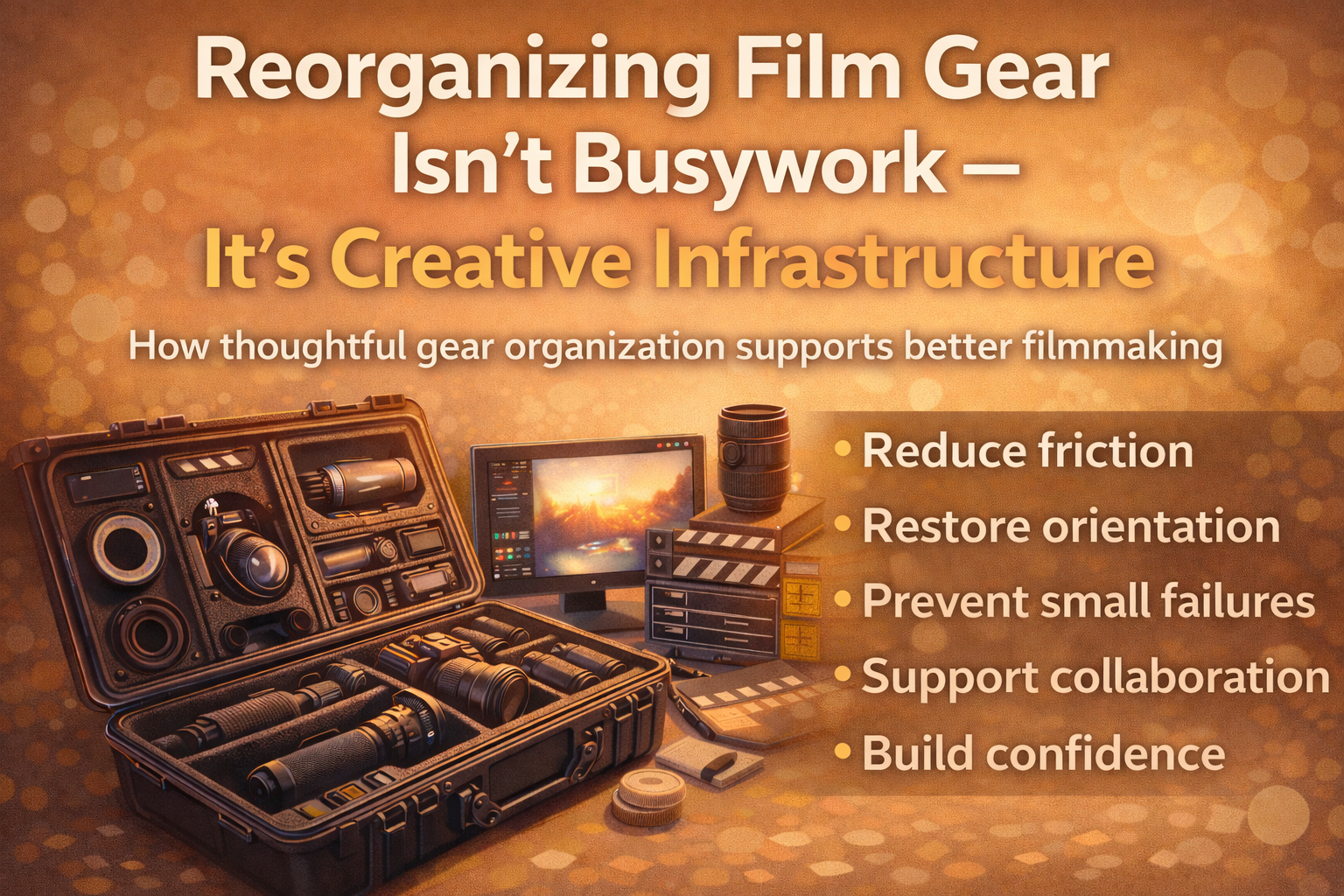
Reorganizing Film Gear Isn’t Busywork — It’s Creative Infrastructure
Why reorganizing equipment can elevate filmmaking practice instead of distracting from it
At some point between projects, many filmmakers look at their gear and feel a familiar resistance.
Cables tangled. Cases half-packed from the last shoot. Accessories scattered across drawers, shelves, backpacks, or the trunk of a car. It feels like clutter—but also like momentum paused.
Reorganizing equipment is often framed as housekeeping. Something you do when you’re not making work. Something secondary to “real” filmmaking.
That framing misses the point.
For filmmakers, gear organization isn’t about neatness. It’s about reducing friction, restoring orientation, and rebuilding trust with your own process.
In other words: reorganizing gear is not a detour from creative work. It’s part of the infrastructure that makes creative work possible.
Why Reorganizing Gear Can Feel Hard (Even When You’re Organized)
The resistance isn’t laziness. It’s psychological.
Even filmmakers with strong organizational systems revisit them—not to fix mistakes, but to keep pace with how their work changes over time.
Reorganizing gear forces you to confront:
- unfinished projects
- tools you bought but haven’t mastered yet
- systems that worked once but no longer fit
- evidence of how busy (or scattered) you’ve been
This is similar to cleaning out a closet or workroom. You’re not just sorting objects—you’re sorting identity, habits, and intentions.
That’s why many filmmakers avoid it until something breaks, goes missing, or slows a shoot down.
Gear Organization Is Really About Decision-Making
Every piece of gear answers a question:
- What kind of work am I actually doing?
- What do I reach for most often?
- What slows me down when I’m under pressure?
Reorganizing equipment surfaces these answers.
When gear is disorganized, decisions multiply in the worst moments—during setup, under time pressure, or in front of collaborators.
When gear is organized thoughtfully, decisions disappear. You move faster not because you’re rushing, but because the system reminds you what matters.
Think Like a Closet, Not a Storage Unit
Most people don’t organize closets by owning everything they’ve ever worn. They organize by what fits their current life.
The same principle applies to filmmaking gear.
Instead of asking, “Where do I put all this?” ask:
- What gear supports the kind of filmmaker I am right now?
- What gear creates friction rather than flexibility?
- What do I need immediate access to?
This shift turns organization from accumulation into curation.
Reorganization Is a Reset Without the Fantasy
Unlike goal-setting or resolutions, reorganizing gear deals with reality.
You can’t pretend you own equipment you don’t have. You can’t imagine workflows that don’t exist. You’re working with what’s in front of you.
This makes gear reorganization a powerful mid-season reset for filmmakers—especially between projects, semesters, or creative phases.
It acknowledges where you are, not where you wish you were.
What Good Gear Organization Actually Does
Thoughtful organization:
- reduces setup time
- lowers cognitive load
- makes collaboration smoother
- prevents small failures from cascading
- builds confidence before a shoot begins
These benefits aren’t aesthetic. They’re operational.
When filmmakers say, “The shoot felt calmer,” organization is often the invisible reason.
For Educators: Why This Belongs in Film Education
Students often believe professionalism appears later—after they graduate, after they get better gear, after someone hires them.
Teaching gear organization reframes professionalism as a habit, not a title.
When students learn to:
- pack intentionally
- label consistently
- return equipment to a known state
- anticipate needs before a shoot
They’re learning systems thinking, accountability, and collaboration—skills that extend far beyond film.
For Independent Filmmakers: Organization as Self-Respect
When you’re working alone or in small teams, gear systems are often personal.
Reorganizing isn’t about impressing others. It’s about respecting your own time and energy.
A system that supports you says:
“I expect myself to keep going, and I’ve prepared for that.”
That expectation matters on days when motivation doesn’t show up.
Optional Exercise: The Gear Reset Session
This can be used in a classroom, shared studio, or solo practice.
Step 1: Empty Without Editing (15 minutes)
Lay out all gear from one category (camera kit, audio, lighting, accessories).
No decisions yet. Just visibility.
Step 2: Group by Function, Not Price (15 minutes)
Organize gear by what it helps you do:
- capture image
- capture sound
- shape light
- support movement
- solve problems
This reveals patterns that brand- or case-based storage hides.
Step 3: Identify Friction Points (10 minutes)
Ask:
- What’s hardest to find?
- What do I forget most often?
- What causes last-minute stress?
These are system issues, not personal failures.
Step 4: Rebuild for Access, Not Perfection (20 minutes)
Organize so the most-used items are the easiest to reach.
Label lightly. Over-labeling creates its own friction.
Step 5: Write One Rule You’ll Keep
Examples:
- “Everything returns to neutral after a shoot.”
- “Nothing goes back loose.”
- “If I hesitate to pack it, it doesn’t come.”
One rule is enough.
Reorganization as a Creative Signal
Reorganizing gear doesn’t mean you’re not creating.
It often means you’re preparing to create more clearly, more calmly, and more sustainably.
Like reorganizing a closet before a new season, it’s a way of saying:
This is the work I’m living in now.
And that clarity tends to show up on set—even if no one knows why.