Reference: StudentFilmmakers Magazine, July 2007. Shooting Abroad in Tanzania: A Remote Journey by Carl Filoreto. Pages 42 – 45.
Even after years of working in the TV business as a DP, the hunger to travel and explore remote places still burns in me. I’ve maintained a curiosity about the secrets and mysteries of Africa, but I had never been able to score a working trip there. And the massive distances involved conspired to keep it off the vacation itinerary.
This year though, I discovered a solution. A missionary group from Rockland Community Church, a non-denominational congregation located in the foothills of Denver, was planning to return to Arusha, Tanzania. Here they did outreach work involving a local church, girls’ school and hospital. I approached the group and offered to travel with them and produce a documentary style video that would help them with their fundraising efforts. I felt I could use my video skills for a good cause, quench a travel thirst, and get to know something about the people living in an incredibly poor East African nation. A place where the average annual wage is around $300; where HIV, TB and malaria are major killers; and where accepted modern conveniences like electricity and running water are erratic or non-existent.
Enthusiasm often results in mentally minimizing obstacles. I pondered that thought as I began to focus on the hurdles I faced as a one-person production crew working in a third world outpost located over 9000 miles from my comfortable home in lovely Golden, CO.
Planning is vital and ideally I would have eons of time to meticulously research each facet of the trip, the shoot and the story to be told. Instead, in between shoots with paying clients, family time and the sometimes overwhelming number of mundane tasks that we all perform in a hectic world, I pieced together a strategy. Let me take you through the process.
First, the editorial side was a challenge. I operate from the principal of storytelling, and I needed some type of unifying theme for the piece. Mission leaders David and Nancy Clement were spearheading the church efforts, and they had traveled to Arusha several times. Their knowledge was extremely helpful, and they also shared pictures and video from their previous excursions. After a lot of brainstorming, we settled on building the video around the Swahili word, Uzima, which translates to a concept that life, health and wholeness are intertwined, and if in balance, can create true fulfillment. The work with the church represents the spiritual leg of the tripod, the school represents education and fulfillment, and the hospital symbolizes health. So I had a framework, even if it was somewhat tentative.
Specific plans were impossible to create. Most of the people we were working with in Arusha didn’t have access to computers and e-mail. While some had cell phones, costs were prohibitive. So plans were going to take shape on a fluid level when we got there. And I had to remember that my needs didn’t take precedence over the needs of the mission workers. They had a job to do. I was along for the ride.
On the production end, I needed to make some very basic decisions, like what format and camera I would use. Initially, I thought I would go with the DVCam format. It would work well with Final Cut Pro, and I could use my Ikegami HLDV7W, a full size DVCam. Sure, it’s a bit of an old school approach, but I reasoned that the full size camera would let me use my Canon SD regular and wide angle lenses, and my Chrosziel matte box. With these tools, I knew I could guarantee some great images. I had concerns, however, mainly size and excess baggage charges. Although I’m used to traveling with 15 to 20 cases of gear, I knew I was footing the bill on this trip. And a bigger camera meant more stuff. I also wondered what Kilimanjaro airport would be like and whether there would be a hassle with customs.
After speaking with a colleague who had traveled to Uganda last year to do a video, I began to question my decisions. She highlighted the great ability to fly under the radar with a small format camera. It simplified travel hassles and made things easy in the field. I continued to explore the issue and finally decided to go with my new Sony HVR-V1U HDV camera. It’s a versatile small format camera that can shoot the problematic HDV format, as well as DVCam and DV. It’s the first to use CMOS imaging sensors instead of CCDs, though they’re only ¼ inch rather than the usual 1/3 inch. In Tanzania, I would shoot in HDV at 1080i onto tape, edit in HDV on Final Cut Pro, and probably output to in SD.
I didn’t make this decision lightly. Prosumer small format cameras are amazing boxes, and they can do a lot of different things. I’m spoiled, though, by the ease of using a larger format camera. Sure it’s heavy, but all the controls are laid out in easily accessible ways. The glass in front of the lens is extremely high quality, and a matte box allows for quick and easy image enhancement. Small format cameras are not as user friendly. Many user controls are buried in menus, audio can be a bit problematic, and in bright conditions it can be difficult to see the LCD screen. When conditions make it difficult to see the LCD, and you want to shoot from some interesting angles, it can be next to impossible, no matter how you contort your body, to get your eye to the viewfinder. And matte boxes and filters for a small format camera are quite pricey, and actually not much less than their bigger brothers. For me, the investment was never worth it.
As soon as I got to the airport, I was thankful I had decided to travel light. It costs $130 for each excess bag, and I was only one over the limit. I managed to get everything into three pieces. One was for clothes. I also took a hard case that contained tape stock, batteries, and audio gear. And a tripod case was stuffed with a light pair of carbon fiber Gitzo sticks with a Sachtler head, a pair of hiking boots, and a small backpack. I decided to put the V1U in a carry-on bag so that I could protect it from the rigors experienced by checked baggage. I also brought my PD-150 as a back up, but I relegated it to the hard case.
One small but vital item to have on any foreign trip is the correct power adapter plugs. If you can’t plug your battery charger into the socket, your shoot will have a short half life. There are several helpful websites that list voltages and plug types for countries around the world. An electric converter that changes 220 volts to American 110 is also necessary. I brought two, since a replacement was a world away.
In the audio department I brought two Lectrosonic UHF wirelesses, several Tram mics, and a Sennheiser shotgun mic. I have a small plate that allows me to neatly attach one wireless receiver to the camera’s hot shoe. I can attach a second one with a small carry bag, but it’s not the best set up and can get in the way. It turned out that time and circumstances never let me use both at the same time anyway. Again, I had a back up, though. In addition I also packed some XLR cables in case I had trouble with the wireless mic systems.
Every day I was in Tanzania, I was reminded that minimal gear was the way to go. Our transportation consisted of four safari size SUVs. Over twenty people were shuttled in these vehicles daily, and space was always at a premium. I got a reputation as a space hog even though I pared my daily gear to the camera, my sticks, and a backpack.
I quickly learned that wearing all the hats on a shoot is constantly challenging. I was often trying to balance logistics, language barriers, editorial content, and the mechanics of shooting. Fortunately I was being offered a lot of opportunities to add elements to the story, but I had to make a lot of decisions on the fly. Do I need this element? How long will it take? What will I miss in the interim? Often, the best opportunity I had to sort out the day and determine what I needed to do tomorrow was when I jumped into bed at night, and I could calmly reflect on my plans. One area that suffers is gathering hard information. It’s tough to jot down a lot of notes when you’re trying to set up shots, do interviews, and keep up with the day’s activities. In this instance, I have access here at home to the people who made the trip, and I can pick their minds for information here in a relaxed setting. But it’s a major consideration when planning a venture of this sort.
The camera performed well, and when I later looked at the tape on a plasma screen, I was pleasantly surprised by its quality and depth. It did frustrate me at times, but overall I’d give it good grades. There were some features that were really valuable. I constantly used the camera’s six assignable buttons, especially the three located between the lens and the LCD door (three are under the LCD door). I used the external three buttons for auto focus control, display info and color bars. It would be handy if you could assign zebra control, but it’s not an option. The quarter inch sensors do limit the camera’s light sensitivity, but it will compensate by increasing the db gain level. But even at 18 db, I didn’t find the image to be so grainy as to make it unusable.
I did find the ability to control the iris and gain to be frustrating. It could take another article to fully explain how the camera uses aperture setting, gain and shutter speed to produce an optimal image, especially in low light conditions. For now, I’ll just say that it made me cranky, and I was often fighting with it. One neat feature I found very useful is the white balance shift. With a manual white balance, I could warm the picture at different levels by using a thumb wheel control. When shooting outdoors, it could give the image a pleasing warm tone.
The audio capturing system also has some drawbacks, since it’s recording the signal in an Mpeg-2 format, which has its limitations. And I found that using the audio settings in auto provided more reliable sound capture. In manual it seemed you usually needed to crank up the levels. The headphone outputs were a real problem. I couldn’t find any way to increase the audio level to the headphones, and it tends to run fairly low.
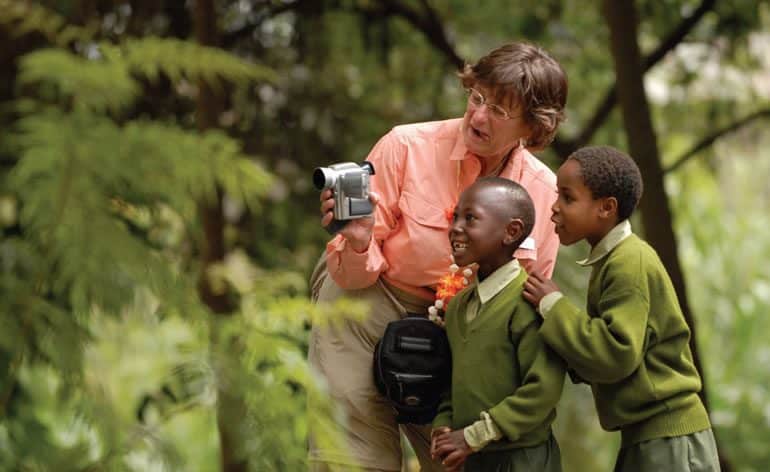
Looking back, my experience in Tanzania was incredibly rewarding. Even while mired in poverty, the people were incredibly warm and friendly. The children were fascinated by us, and they wanted to touch you, hold your hand, and would try to communicate with you in any way possible. I’ve shown some of the footage to family and friends, and they’re fascinated by it. When you enter the culture it’s like a step back in time, but the energy of the natives is inspiring. And now I’m tackling the task of sifting through over seven hours of tape and forming a coherent narrative that will do justice to the people I met.
All photos by Carl Filoreto.
Carl Filoreto is an award-winning DP, and his company is Elk Run Productions, Inc. (www.elkruntv.com), which has a roster of clients that spans corporations, production houses, crewing agencies, and broadcast and cable networks, including Dateline NBC, The Food Network, and The Travel Channel. Prior to starting his business, Carl won seven regional Emmy awards, numerous national and regional National Press Photographers awards, and multiple awards from Colorado Ski Country and the National Snowsports Journalists Association while working at KMGH-TV in Denver, WTNH in New Haven and WGGB in Springfield, Massachusetts.