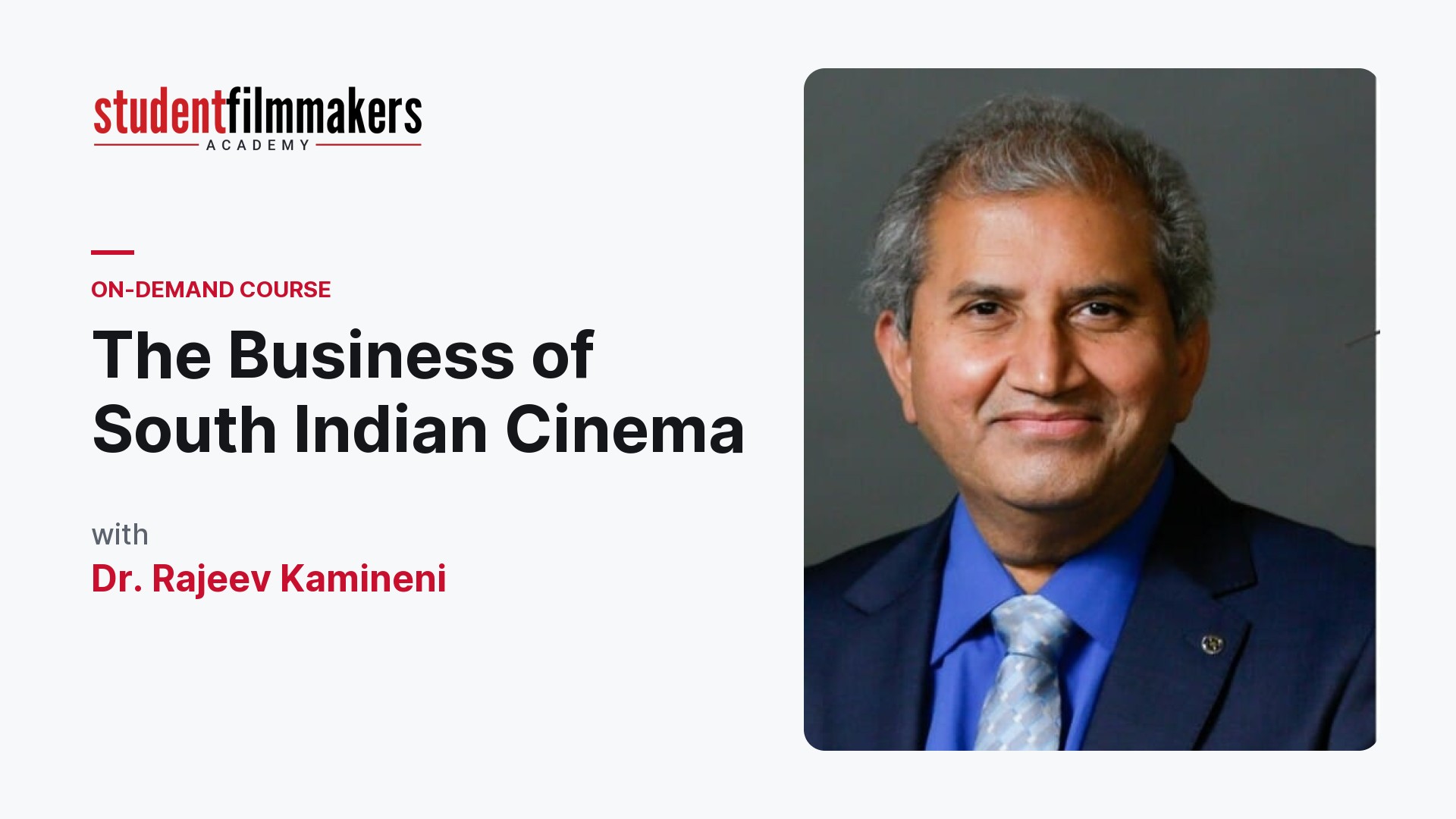
Dr. Rajeev Kamineni has helped produce 14 feature films in India and co-wrote the Routledge book Indian Movie Entrepreneurship: Not Just Song and Dance. In a live class with StudentFilmmakers, he walked through the four big South Indian film industries the way a producer sees them: as businesses where the script, the budget and the audience decide everything. His first lesson is about a word. Stop calling it all Bollywood.
Why isn’t Indian cinema just Bollywood?
India releases roughly 2,000 films a year, and they come from at least eight cities: Chennai, Mumbai, Kolkata, Hyderabad, Bangalore, Kochi, Patna and Amritsar. Bollywood is the Hindi industry centered on Bombay, now Mumbai. Kamineni’s view:
“My point is to start with, it’s not any wood.”
He compares it to Europe. If you lumped French, British and Italian films together and called them “Eurowood,” those industries would be annoyed. So he says “Indian cinema,” and he narrows his own focus to the South, where four languages each run an industry of their own.
| Industry | Nickname | Home base | What Kamineni says sets it apart |
|---|---|---|---|
| Tamil | Kollywood (after Kodambakkam) | Chennai | The root of the other southern industries; strong markets in Malaysia, Singapore and Sri Lanka |
| Telugu | Tollywood | Hyderabad | The largest in the South, with strong distribution and a big audience in the US |
| Kannada | Sandalwood | Bangalore | Long squeezed for screens; roots in live theater; changed by KGF and Kantara |
| Malayalam | Mollywood | Kochi | Smaller box office, but known for realism, scripts and top technicians |
What did the old Madras studios get right, and wrong?
After the Second World War, businessmen came home to Madras from rubber plantations and finance houses in Malaya, Burma and Ceylon with money to invest, and many put it into movies. By 1980 one city was turning out close to 1,000 films a year in four languages. About 30 studios ran within five miles of each other, around the clock: one language on the day shift, another on the same set at night.
Two studios show the business lesson. S.S. Vasan’s Gemini Studios made grand spectacles in the style of Cecil B. DeMille, but Vasan had no succession plan and no corporate structure, and the studio faded after he died. AVM Studios, more than 80 years old, is still working in post-production and digital media. When Kamineni interviewed the founder’s son, the man sat him in the exact spot where his father used to hand out pay checks. Five of the stars who collected checks there went on to become chief ministers of Tamil Nadu.
That link between screen and politics is real: from 1967 to 2016, every chief minister of the state came from the film world.
Does a formula film still work?
One senior Telugu producer told Kamineni he had made all 25 of his films the same way:
“It has to be 30% emotions, 30% comedy, 30% singing and dancing and 10% bringing it all together.”
If a scene got too serious, a comedy bit went in, whether it fit or not. Kamineni is blunt about the result: the industry made 300 to 400 films a year, and only 10 to 15 percent made money. Then Baahubali (2015 and 2017) changed what producers believed was possible. He puts the franchise at close to $250 million, when a $50 million hit had once seemed huge. Director S.S. Rajamouli kept pushing with RRR, whose song “Naatu Naatu” won the Oscar in 2023. Now producers plan for pan-Indian and global audiences, and the target has moved from 600 screens to about 7,500 worldwide.
Hyderabad’s Ramoji Film City, about 2,500 acres with three hotels on site, was built on a simple promise: a producer should arrive with a bag of money and leave with a finished movie.
Where does the money go wrong?
Borrowed money is expensive. Kamineni stopped to make sure everyone heard him:
“The interest is 36 percent. So that means the meter will be running from, for me, right from day one.”
A $1 million film really costs $1.36 million, and none of that interest shows on screen, which makes it what he calls dead investment. Distribution is the other trap. In the Tamil market, one or two distributors control most releases, so a producer who spent $1 million may be offered half that and have to release at a loss. The overall success rate in South India, he says, sits at 10 to 20 percent.
Budgets today run from about half a million dollars to roughly $50 million, with most large-screen films at $3 to $5 million. His company’s next film is a small one: about $1.2 million and 56 shooting days.
Why are Indian films so long?
A filmmaker in the class asked why features run past 120 minutes. The average is about 135, and 85 percent still have an intermission, so directors need an “interval bang,” a climax before the break when the audience goes out for popcorn. A ticket can cost as little as one US dollar, and for that price a family expects an outing of three hours. That is also why song sequences are often shot in Europe or the US: they take viewers places most could never afford to go.
For overseas release, his team cuts the intermission and extra songs and adds subtitles, about a week of extra work. Multiplex owners push for shorter films too, since a 90-minute film can play twice as many shows a day as a 180-minute one. And streaming changed the calendar: by an unwritten rule, a film can go to a digital partner about four weeks after it opens.
How does a producer pick a script?
Kamineni wants a fully written, bound script before any pitch. A one-line idea can sound brilliant, but he points out that George Lucas could not have narrated Star Wars in one line. He read more than 100 scripts to make his 14 films and still lost money on about half, partly because taste shifts in the 18 months before a release.
His worst flop started with a beautiful script and a wonderful narration. The writer could not translate it to the screen as director, and the company lost everything it put in.
“You cannot predict audience taste. But you can predict one thing. You can control the budget and ensure that you give out a quality product.”
One of his mentors gave him a rule he still repeats: “Do not ever think that the audience are fools because they will hurt you at the box office.”
What can any independent producer take from South India?
- A producer wears four hats: creative lead, marketer, project manager and script picker. Plan for all four.
- Build a company that outlives you. Gemini’s fall and AVM’s survival came down to structure.
- Count the true cost of money before you shoot, not after.
- Know your overseas audience. Tamil films sell in Singapore and Malaysia; Telugu films sell in the US; Malayalam films reach the Gulf.
- Get the script fully written, and make sure the director can actually put it on screen.
He also spoke about the people behind the camera. Around 80 percent of Indian film workers are paid by the day, and during the COVID shutdown the South Indian Film Chamber of Commerce, founded in 1939, fed 200 to 300 of them every day for seven or eight months. The film unions for all 24 crafts belong to the chamber, and in ten years of producing, he says, he never had a problem with them.
For more from Kamineni, read his earlier film producing tips. If you are planning an overseas release of your own, see this guide to selling a film abroad and the tension between art and commerce.
The full class covers the Malayalam and Kannada stories in more depth, including Prem Nazir’s 720 leading roles, and answers filmmakers’ questions on labor unions and regional markets.