

Filmmakers Forums Community Spotlight: StudentFilmmakers takes five to chat with Ian McMahon, a music composer we interacted with in the Filmmakers Forums Online.

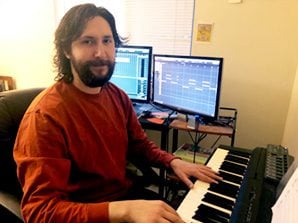 Ian McMahon is a composer and pianist living in Portland, Oregon. He began playing piano at the age of seven and was influenced by the cinematic composers of the ’90s. As a teen, he began composing music digitally and found inspiration in Japanese video game composers such as Nobuo Uematsu and Koji Kondo. In his twenties, he wrote songs and played percussion for several rock bands in California and Oregon. Now in his thirties, he’s returning to his orchestral roots with the intention of breaking into the video game and film score scene. His video game music website, questharmonics.com, is launching in February.
What technologies, software and gear, as well as instruments do you use to compose your music?
Ian McMahon: I connect a portable digital piano to my computer via USB cable and then perform the music into it. The software that records my performance is Cubase, an excellent industry standard. The music is captured in MIDI format, meaning that instead of recording actual audio like a vocal performance, it’s just signaling what notes I press and when. This allows me to tweak any aspect of the performance after the fact, such as deleting a bad sounding note or switching to a different instrument entirely. I have a lot of stringed, brass and woodwind instrument sounds—known as samples—that I’ll use to layer separate melodies over each other to emulate the sound of an orchestra or band playing.
Also, what is your creative process?
You have a new video game music website launching in February. Congratulations on your website. Can you tell us about your passion for video games and composing music for video games?
Ian McMahon: Thanks, I’m very excited for the website launch! I had an old Nintendo growing up and was hooked from an early age. I spent a ton of time playing Mario and Zelda, and I absolutely adored the music in these games. It’s fascinating that the composers had to express their visions through a sound chip that was only capable of producing digital beeps and boops. Compare that to the present day where video game soundtracks rival those used in big budget Hollywood productions. It’s fun writing a classical sounding orchestral work one day, and then something that sounds like it came from an ’80s arcade cabinet the next.
When creating a new piece of music, I like to start by browsing around the instrument samples on my hard drive. So, I’ll be tapping notes out on my keyboard but actually hearing all these different instruments or combinations of instruments and eventually something will leap out at me. I’ll think something sounds cool and start recording some notes that carry the idea. I’ll find another, complimentary instrument and lay a second recording on top of the first. It kind of just evolves from there, guided by previous trial and error.
By the way, what kinds of music are you into these days?
Ian McMahon: I’ve been really digging pop musicians like Adele and Regina Spektor because their voices are so emotional and powerful, and Beyonce’s “Lemonade,” deserves the highest honor. I’ve definitely been a fan of a band called Murder by Death for a while now; they’re like a new, electrified version of folk or Americana music. Kendrick Lamar is amazing. And last but not least, the 25th Anniversary Zelda: Symphony of the Goddesses album – a video game music nerd’s dream.
What are some of your new year goals for 2021 as a composer?
Let’s not talk about new year resolutions, but instead, let’s talk about new year goals.
Ian McMahon: My immediate goal for 2021 is to be reaching out to the local video game creators here in Portland. There’s a bunch of talented programmers and artists, known as the Portland Indie Game Squad, who used to meet up in person but now have online events and an ongoing Discord server. I’ll be asking their creators if I can write music for any of their projects and hopefully forge some ongoing relationships. Other than networking, I really hope to keep studying music theory and learning what I can by listening to my favorite composers.
Ian McMahon, Composer
soundcloud.com/imcmahon
questharmonics.com