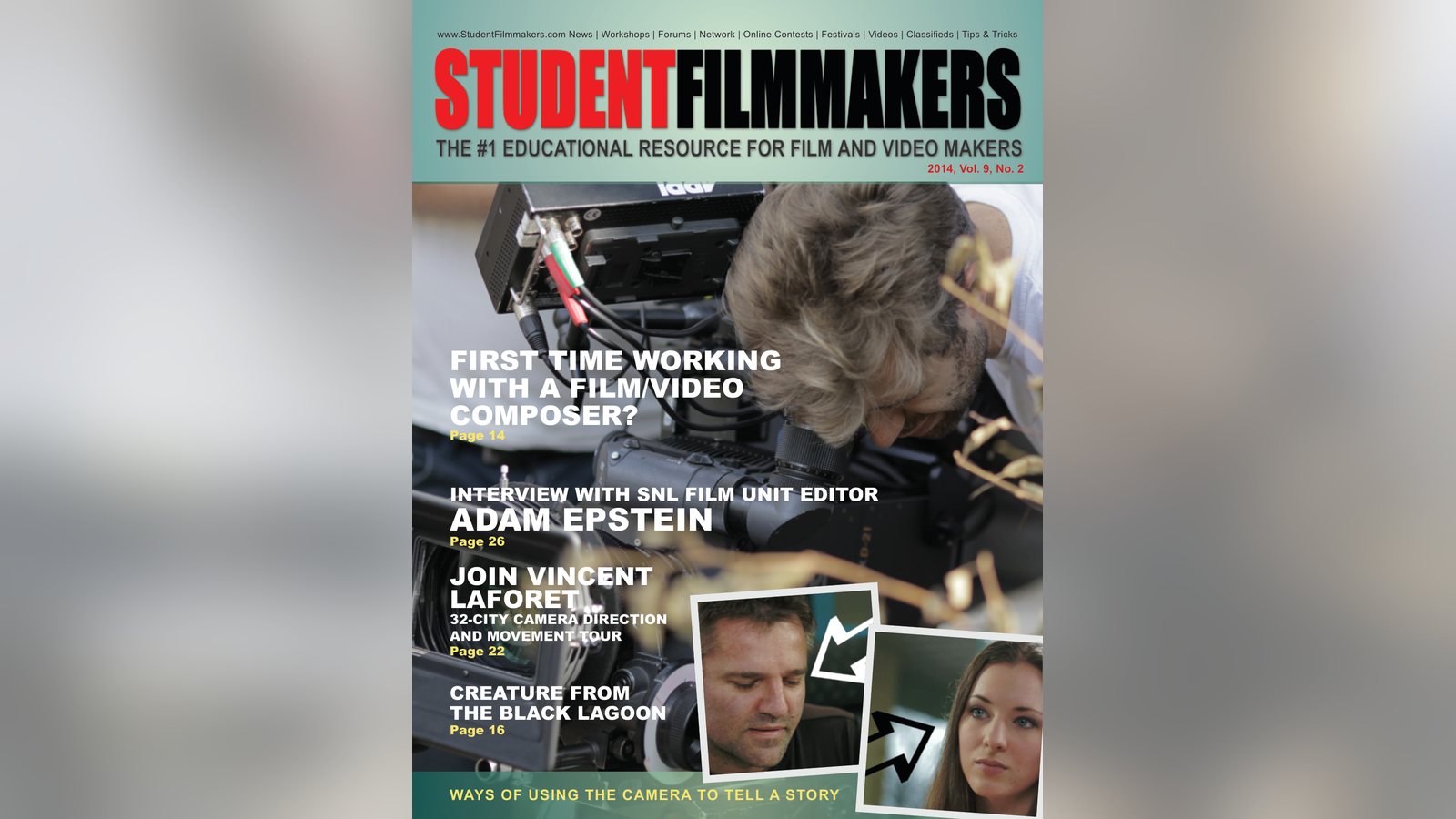
A good filmmaker and composer relationship is essential. Learn how to define your film’s artistic world so your composer can turn it into music.
Working with a Film/Video Composer for the First Time?
A good relationship between filmmaker and music composer is essential. The role of composer is to listen and transfer into musical terms what a director is saying. For this, the most important thing to the composer is to understand precisely your code, what you have in mind. To avoid misunderstandings and wasting time, here are some quick tips.
If it’s the early stage and you don’t have your movie edited yet, when you speak about your film, describe it with some examples. If you say, “I’d like to have a sad mood in this scene,” give an example of your sad mood scene with a song that could fit, or a movie scene with the same sensation that you want, because your “sad mood” could be very different from the composer’s “sad mood”. If you don’t know exactly what kind of music you want, let the composer help you and be open-minded. The composer is your partner, and the more you communicate, the more you’ll make a good team.
If you’ve already edited your movie with “Temp Tracks”, you can choose to have the composer listen to it if you want him to recreate the same color. Or you can choose to show him your movie without temp tracks to let the composer bring you his color.
If you don’t have a music editor for your first movie, you’ll have to decide with the composer where each music cue begins and ends in your movie. Even if you have your idea, let the composer propose to you his view of it, and you could have a good surprise.
Some composers will propose you almost a final mix, and some others a demo. In both cases, try to note the differences between the arrangements of songs and the melodies. Don’t be categorical. If you like the melody but you don’t like an instrument’s sound, keep in mind that everything can be changed. Don’t reject the song, but communicate what you like and don’t like to help the composer create the best music for you.
If you are working for a trailer, edit in rhythm with music, so the composer can match the tempo, and the trailer will be more effective.
Choose a composer based on his completed projects and bodies of work, and you won’t be disappointed!
Dialogue and voice over editing are the two least understood aspects of audio postproduction for some novices just starting out. It is our job to remove the filmmaking from the film and to illuminate the actors under their best light by eliminating slurred words, over-breathing, mouth clicks, hums, wind, boom handling and crew rustling. We essentially articulate the voices and make them sound more enticing with various plugins, tools and constant playback with software systems. I use Pro Tools. A proper sound editor will listen intently to all the nuances within each waveform, knowing what to edit out and keep depending upon the character’s disposition and the shot.
Proper dialogue and VO editing is approached manually and sometimes through a minimum amount of signal processing. The goal is to create smooth transitions between each syllable and line of dialogue to not distract the viewer away from the story. If you are using Pro Tools, deleting intrusive breaths and replacing it with room tone is usually a good idea. Shuffle mode is useful here (the ` key switches between each mode). Make sure to fade each clip in and out. To clean up mouth clicks or mic rustling I use the scrubbing tool to pinpoint the source of the problem. As you scroll over the waveforms with the scrubber, you will hear faint popping sounds. If you zoom fully into the damaged waveform (control + 1, select problematic area) you will see a series of sine waves and one spikey area. This is the clicking sound. Use the pencil tool (control + 6) and draw over it to smoothen out the sound.
Plugins prove to be useful when a certain frequency needs to be eliminated such as a hum from the camera, airplanes or any kind of background noise. A LPF or HPF can be used for this or narrow Q cuts which eliminate the entire unwanted frequency and nothing else. There are a plethora of after-market plugins that are accurate and easy to use for cleaning up clicks, crackles, rustles and even distortion such as Izotope RX, allowing you to see a visual map of all the frequencies.
Great care and extensive resources must be set in place and utilized when working on sound for film, including the composition. Film is truly 50% visual and 50% audio, yet less time and money is focused on audio due to the advent of digital cinema, which demands more in less time. But with the current innovations within 3D sound, 7.1 & 11.1 mixes, sound now has the ability to completely envelope and enrapture the listener. There has never been a better time to design and modify sound or compose – the possibilities are endless in the hands of a great sculptor.
Keep learning filmmaking
Want more lessons like this? Join StudentFilmmakers free for live webinars with working pros, and stream on-demand filmmaking classes in cinematography, directing, screenwriting, sound and post.