By Ira Tiffen
Ira Tiffen explains the split-field diopter, a close-up lens with a split personality that keeps near and far subjects sharp in the same shot.
It’s all well and good to know to use a close-up lens when you need to focus more closely on a subject than the lens would otherwise; it’s another thing entirely when you need to focus both near and far in the same shot.
Harrumph, you say? Can’t be done, you say? No way, you say? Well, as you might by now be starting to suspect, in fact, you can. You do it with a variation of a close-up lens that we call the ‘split-field lens.’
Split-fields are essentially close-up lenses cut in half. While you can get them in exotically-mounted square sizes for film and television cameras, they typically come in round mounts that allow you to rotate them in alignment with the needs of the shot. They come in the same array of diopter strengths that close-up lenses do, and as far as the lens-half goes, they work in the same manner.
It’s a classic case of what is not there being what’s important. The lens half lets you focus up close. It’s the other half, without the glass, that allows you to focus on things that are a great distance away, since it is exactly like using the lens with nothing attached. So on one side, you focus up close; on the other, you can focus farther away, and you can do both at the same time.
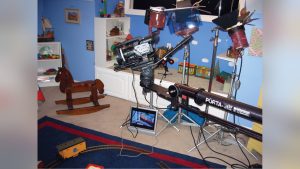
In our picture examples, we can see that without a split-field lens, the camera can only obtain good focus individually on either the background or the foreground but not both at once. With the addition of the split-field, in this case a +2 diopter, you can get both sharp together.
Now using split-fields may seem tricky, but I’ve found that there’s a general procedure to follow that simplifies things greatly. Here’s how to do it:
(1.) Select a focal length that will give you the overall framing you want;
(2.) Select a diopter strength that will allow you to focus on the subject in the foreground when the lens is set to focus on the background;
(3.) Using the split-field in that chosen strength mounted on the camera, align the lens-half with the foreground subject;
(4.) Set the lens to focus on the background, frame the shot, and then simply move the camera in or out from the foreground subject the short distance needed to get it in focus.
(5.) Record!
The idea is that the far focus will unlikely be affected by the small movement needed to get the foreground in focus; once they are both in focus, you’re set to go.
You may be wondering what happens to the area in the image that coincides with the cut-off edge of the lens. Excellent thought! You will want to align that, where possible, with part of the scene that has little or no detail, as that will be a relatively narrow out-of-focus area corresponding to a line from one edge of the image to the other, and angled the same as the lens is. If you have the lens on the lower half of the image, with the edge aligned horizontally, then you’ll have an out-of-focus area running horizontally to match.
In our split-field example, you can see this soft-focus area running horizontally just above the top of the base; it is the ground detail that is affected most.
Changing the lens opening allows you to define the amount of image softness at the lens edge. Closing the lens down will increase depth-of-field and minimize the softness. Conversely, opening it up can enhance the softness.
With some lenses and formats, closing the lens down a lot can allow you to get both near and far focus, too. However, you will want to turn to split-fields when you aren’t using such a lens or format, or when you don’t have sufficient light or exposure latitude to allow closing the lens down suitably. In those instances, the split-field lens may be your best bet.
Split-fields are great in situations where you can readily define foreground and background: in a hallway, with something happening up close and something else going on farther away, with the demarcation line aligned with a door or corner in the wall, for example.
CAUTION: Be careful not to have action moving between areas of focus (unless you are looking for that ‘special effect!’). An object moving from background to foreground will very suddenly loom larger in the image than you would normally expect, most unrealistically.
When in a tough spot, split-field lenses can be your best friend: a pinch hitter, so to speak, with a split personality. In over 30 years of making optical filters, Ira Tiffen created the Pro-Mist, Soft/FX, Ultra Contrast, GlimmerGlass, and others, netting him both a Technical Achievement Award from the Academy of Motion Picture Arts and Sciences and a PrimeTime Emmy Award. Elected a Fellow of the SMPTE in 2002, he is also an Associate member of the ASC, and the author of the filter section of the American Cinematographer Manual.
Related filmmaking guides
Keep learning filmmaking
Want more lessons like this? Join StudentFilmmakers free for live webinars with working pros, and stream on-demand filmmaking classes in cinematography, directing, screenwriting, sound and post.