By Scott Essman
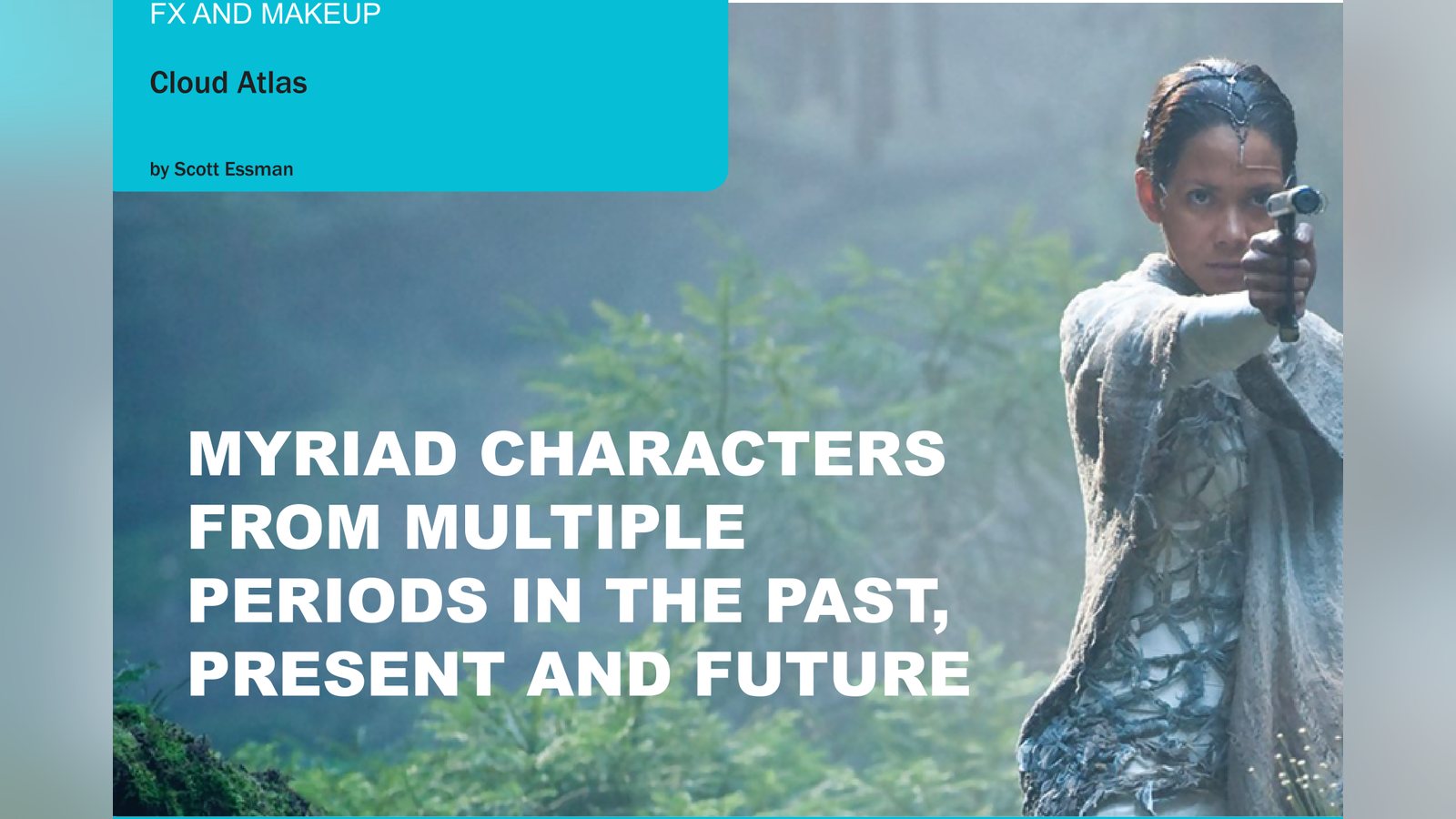
Scott Essman talks with the makeup artists who transformed Tom Hanks, Halle Berry and the cast of Cloud Atlas into multiple characters across six stories.
The transformative power of special makeup effects – the ability to alter an actor’s appearance by implementation of prosthetic materials, careful facial painting, and the addition of hair pieces – is on full display with the myriad characters brought to life in the currently released film Cloud Atlas, starring Tom Hanks, Halle Berry, Jim Broadbent, Hugo Weaving, and Jim Sturgess, all in multiple roles. Sectioned off into six intertwined storylines, the enormity of the film warranted its division into two independently functioning crews: one on a team led by the American Wachowski directors, and the other manned by German director Tom Tykwer. To realize the three stories each team undertook, two separate makeup teams were established in Europe. While the Wachowskis brought aboard Jeremy Woodhead to supervise their sequences, Tykwer enlisted the skills of Daniel Parker. Further complicating an already ambitious project, the makeup teams’ preparatory period evolved over time, with makeup concepts being added to the film as shooting progressed.
In the film, Tom Hanks played six characters as he appeared in each of the six major vignettes in the film (in chronological order of each vignette’s timeline): Dr. Henry Goose, the Hotel Manager, Isaac Sachs, Dermot Hoggins, the Cavendish Look-a-Like Actor and Zachry. Also in all of the stories was Halle Berry who played a Native Woman, Jocasta Ayrs, Luisa Rey, an Indian Party Guest, Ovid, and Meronym. The unmistakable Jim Broadbent played five roles: Captain Molyneux, Vyvyan Ayrs, Timothy Cavendish, a Korean Musician, and Prescient 2. Versatile actor Hugo Weaving played six separate characters, including Haskell Moore, Tadeusz Kesselring, Bill Smoke, Nurse Noakes, Boardman Mephi, and Old Georgie. The youthful British actor Jim Sturgess also played six different characters, one for each vignette. His roles included Adam Ewing, the Poor Hotel Guest, Megan’s Dad, Highlander, Hae-Joo Chang, Adam, and Zachry’s Brother-in-Law. Considered another leading star in Cloud Atlas is the Chinese woman, Doona Bae. She played in all six sections of the film as Tilda, Megan’s Mom, Mexican Woman, Sonmi-451, Sonmi-35, and the Sonmi Prostitute.
Of course, the supporting players required complex makeups as well even if they were not as prominently featured as the major stars. Ben Whishaw played a Cabin Boy, and also played Robert Frobisher, a Store Clerk, Georgette, and a Tribesman. Noted African-American star for over 30 years is Keith David who performed as Kupaka, Joe Napier, An-kor Apis, and Prescient. James D’Arcy contributed the roles of Young Rufus Sixsmith, Old Rufus Sixsmith, Nurse James, and the Archivist. Xun Zhou played Talbot, Hotel Manager, Yoona-939, and Rose. In just three roles, David Gyasi played Autua, Lester Rey, and Duophsyte. A major star for almost 40 years in America, Susan Sarandon, now in her mid-60s, played Madame Horrox, Older Ursula, Yusouf Suleiman, and Abbess. Even though he had smaller roles than his co-stars, Hugh Grant played six parts, including Rev. Giles Horrox, the Hotel Heavy, Lloyd Hooks, Denholme Cavendish, Seer Rhee, and a Kona Chief. Playing just three parts each were Robert Fyfe as Old Salty Dog, Mr. Meeks, and Prescient 1, and actor Martin Wuttke as Mr. Boerhaave, a Guard, and Leary the Healer.
Of his aspects of production, Jeremy Woodhead stated, “I designed all the makeup and hair for the three Wachowski stories in the film. This included prosthetics, tattoos, teeth, lenses, wigs, facial hair, and implants.”
On a daily basis, Woodhead was responsible for the makeup applications, first to be considered in the Wachowskis’ segment entitled, “The Pacific Journal of Adam Ewing” (set in 1849). This included Tom Hanks as Doctor Henry Goose. For that makeup, Woodhead arranged for Tom Hanks to have a silicon bald cap and double chin, a gelatin nose, a wig, sideburns, laid-on beard and eyebrows, and false teeth. For that same segment, Woodhead also fashioned the makeup for Doona Bae as Tilda to wear a prosthetic gelatin forehead, brows and nose, a wig, and contact lenses to change her eye color. Additionally, for the Ewing piece, Susan Sarandon portrayed Madame Horrox. For that character, Woodhead had fashioned and applied a gelatin nose and wig.
Woodhead’s next major challenge was for the Wachowski’s “An Orison of Sonmi~451” story set in 2144 in a location called Neo Seoul. In that vignette, Jim Sturgess played the Asian character Chang and wore a silicon forehead, gelatin eyelids, pro-bondo “implants” and a wig. To play Seer Rhee, Hugh Grant performed in a full silicon forehead, gelatin eyelids, a wig, eyebrows, and contact lenses. Hugo Weaving also appears in the Neo Seoul segment as Boardman Mephi. For that role, Weaving wore gelatin brow-blockers, eyelids, eyebrows, contact lenses, a wig and “implants.” In a similar makeup conception, for his Neo Seoul scenes, James D’Arcy played the Archivist and also wore brow blockers, eyelids, eyebrows, and contact lenses. Lastly for Neo Seoul, Susan Sarandon played Yusouf Suleiman. This complicated makeup included a brow piece, forehead, contact lenses, a goatee, eyebrows, a moustache, and a wig.
In the “Sloosha’s Crossin’ an’ Ev’rythin’ After” storyline, set in 2321, Woodhead had four major character makeups which he designed and created. In this 24th century section, Hugo Weaving played Old Georgie in a complicated seven-piece full prosthetic makeup, including lenses, teeth, a feather wig, and fingernails. Furthermore, Zhou Xun played the character of Rose who wore a forehead and brow piece, nose, lenses, tattoos, and a wig. Susan Sarandon played Abbess but did not need prosthetics. Instead, Woodhead’s team applied full-face tattoos and Sarandon wore a wig. Lastly, Tom Hanks played the old character, Zachry. For this role, Hanks was donned with a full seven-piece prosthetic, lenses, a beard and moustache, tattoos, and false teeth.
For Woodhead’s other characters, he divided duties among three makeup artists on his team, including Paula Price, Deborah Jarvis and Lesley Smith, with Sian Richards doing straight and prosthetic makeups on Halle Berry. “The nature and complexity of the work meant that we often double or triple teamed on many characters,” Woodhead elaborated, “one doing the head, another the arms and a third the legs. Examples being Hugh Grant’s Kona chief and David Gyasi’s Autua.”
Certainly, a makeup starts with the actor, so Woodhead’s process began with his actors. “First thing was to think about the casting which was mostly in place when I joined,” he said. “We broke down the characters and determined the best approach with prosthetics, lenses, teeth, wigs to suspend the disbelief for their six different looks. We didn’t want to lose the actors faces altogether. There’s no point in not recognizing these great famous faces. We couldn’t change them radically.”
Woodhead noted that working with the Wachowskis was challenging in the best possible way. “They come to a project with an open mind,” said Woodhead. “I made drawings and showed them the idea first and have something to comment on. Not all of them played in all of the stories. As we carried on in the filming several actors asked the directors to be in more of the stories. Can we turn Ben into a Korean man tomorrow? Jim Broadbent was in a story he wasn’t scripted in.”
When Woodhead began work on the project, initially, he did not have access to the actors, a crucial aspect for a makeup artist so that he or she can take lifecasts of the actors and sculpt makeup concepts. “The problem was we didn’t have access to the actors until shortly before filming began,” said Woodhead. “We had to borrow lifecasts from other productions. We had two weeks with the actors before filming started and really hoped that [the makeups] would work.” First up for Woodhead was Tom Hanks’ character Dr. Henry Goose in the Ewing story. “It was the first thing we shot,” Woodhead explained. “It was lucky that it worked because we didn’t have time to redo it.”
With only six weeks to prepare his aspect of the film before principal photography began, Woodhead knew that his prep period had to be optimal. “Some of them were quite complicated,” he revealed. “To minimize changes, we had to do the planning beforehand. We had all of the drawings approved. The characters were signed off when we started sculpting prosthetics. There is a company in Shepperton Studios called Animated Extras that I use for my prosthetics. We used a mixture of gelatin and silicon depending on what faces we were using. I sent my drawings from Berlin to Shepperton and they did test sculpts. Then they molded them, cast them and send them to me in Berlin.”
Throughout the filming, Woodhead received a daily delivery of boxes of prosthetics of silicon and gelatin from England. “We tried to have two or three in stock,” Woodhead said of the prosthetic appliances. “They could only be used once. They had about six people [at Animated Extras] working on supplying. We were jumping around from 1849 to 2200. It was all over the place based on actor availability between the two units.”
Considering that the Wachowski segments were filmed in the same period as the Tykwer elements, and given actor availability, Woodhead described Cloud Atlas’ scheduling as “mind-blowingly tight, like a jigsaw puzzle. There was no sense of daily continuity. It was anything goes every day.”
Given Tykwer’s German roots, all of the directors’ segments were filmed at Babelsberg Studios in Berlin plus Dresden and a few weeks in Spain’s island, Majorca, with a few additional scenes in other parts of Germany and Scotland. “It was tricky – a luxury that we didn’t have was actor flexibility,” Woodhead stated. “We had to shoot whatever we could on them. They were all challenging. Changing men into women and women into men.”
Though Woodhead described Hanks’ makeups being the most straightforward prosthetically, every makeup had its challenges. “Most of the time, we had to make sure that the actors looked like the actors,” he stated. In an example of a fulfilling fun challenge, he stated Berry’s character, Dr. Ovid, in the 2144 sequence, a three-hour makeup job that was only applied and shot on one day. “It is difficult to make Halle into that, but it was great fun. It was an eleven-piece prosthetic. There wasn’t much of her left – one right eyeball – and an implant made under the prosthetic. Halle wore false ears and teeth.”
As with the Dr. Ovid character, noting Cloud Atlas’ tight schedule, Woodhead conveyed the need for economical time-sensitive makeup applications. “Everyone was pressured to not being indulgent in terms of time – we had to crack on,” he said. “One unit could not afford to go over their day because the actor would fly off the next day. Because of the time restraints, there were three of us on that Halle makeup.”
Among Woodhead’s additional preferred makeups Hanks’ various characters are included. “I loved Dr. Goose—to be able to play with Tom’s face and give him a double-chin and big false teeth with a bald cap,” said Woodhead. “The old-age one at the campfire bookends the film with a scar down his face and blind in one eye. Zachry younger was Tom as Tom with tattoo work and a beard. Jim [Broadbent] is featured most heavily on the other team [Tykwer’s segments], so for us [Broadbent’s characters] were cameos as a sea captain and a busker (musician) in another. All of them didn’t have any lines.” In terms of working with Parker, who came onto the film later than Woodhead, the latter artist described their mutual process and respect. “Right at the beginning, Dan Parker and I had adjoining rooms and we’d discussed and traded looks because we didn’t want to clash,” said Woodhead. “’You can have a beard if I can have a baldcap.’ Early on in the prep period, we barely saw each other. They were in Scotland when we were in Spain. We very rarely saw each other in the filming. There were changes and last minute things and characters being thrown in stories – it was spinning plates – teeth, wig, facial hair flying in. Trying to keep everything moving and keep it afloat.”
Working with the Wachowskis was also a special experience for Woodhead. “The Wachowskis love throwing a wild card in the mix,” said the makeup artisan. “They have the most inquiring minds. They are wonderfully open minded and their genius is in allowing other people to be as creative as they are. They are very loyal to their core crew. There is a mutual trust – a safe environment in which to be creative. They never dismiss anything without humor. It’s encouraging to work in that environment where they are completely open.”
Lastly, Woodhead related how his character started off by having many more prosthetics than he ended up using, especially in modifying the European bone structure of an actor to resemble an Asian face. “With a young character like Jim Sturgess, we drew it back to a forehead piece and eyelids which left most of his face free to act and be visible,” Woodhead noted. “In this point in the future, there would be homogenized people, so he could conceivably be a blend of races. We wanted everyone to still know it was Jim Sturgess. Jim is as European in his features as is possible to get: deep set eyes and prominent brow and fairly low hairline. We tried to take out the most European features of his face. It was great fun to do – I’ll probably never get that opportunity again.”
Though Woodhead’s prep period was unquestionably short, Daniel Parker’s entry into Cloud Atlas was even more abrupt. “Because they got their green light so late, I was asked to do this film quite late,” he said. “I was going to do another film. All of a sudden I was to go to Germany to meet Tom Tykwer. I thought it was incredible. When I started the movie, it was too good to say no to. I was such a fantastic outrageous project, there is no makeup artist I know who wouldn’t be terrified of it and dying to do it.”
After his initial meeting with Tykwer, Parker was asked to supervise the makeups in the three stories which the director would undertake: “Letters from Zedelghem” (set in 1936), “Half-Lives: The First Luisa Rey Mystery” (set in 1973), and “The Ghastly Ordeal of Timothy Cavendish” (set in 2012, which represented the present day). “There was a lot of discussion and seeing what was practical within the budget and schedule and trying to achieve what the directors wanted,” said Parker. “It was a balance. In Europe at that point, everybody on the effects side were gainfully employed. Because we were shooting in Germany, I was asked to use a German crew as much as I could. I made inquiries and I think as my right hand person, I got the best makeup artist / hairstylist in Germany. I then came on board with my British right hand, Natasha. On the prosthetic side, I used British, Italian, Hungarian, Scandinavian; I picked out people from around Europe.”
Due to his abbreviated preparation period, Parker had to maximize his pre-production time. “We had to do an awful lot in a short amount of time,” he said. “I had to find good people that I trusted. I had workshops in Berlin, London and Budapest. I had to fly to these places all the time to look at the work. I made it work and my people helped make it work.”
Entering the makeup testing stage, Parker butted against a hasty period in which production began quickly. “A lot of the tests we weren’t able to do before shooting,” he stated. “The fittings were the same. We were taking the design work well into shooting. Every day, I also had to do makeup. It was very hard work, but it was really good work. It was joyful work too – very tough but really nice to do. Generally they don’t go together.”
Citing a total of 30-40 different characters which he and Woodhead had to produce, Parker underscored Woodhead’s note that the makeup duties would often change during principal photography. “Occasionally there is something thrown in – Jim Sturgess to be an early 20th century starving artist walking down the stairs,” Parker remarked. “There were so many designs and so many makeups, it kept flowing. I have always very much believed in paint and sculpting with paint. You can do an enormous amount just with highlight and shade and color. You can sculpt with paint.”
A veteran of both heavy prosthetic films such as Mary Shelley’s Frankenstein and non-prosthetic films such as Apt Pupil, Parker is clearly comfortable in both arenas. “Apt Pupil is one of the makeups I am most proud of,” he commented. “I had to persuade [director] Bryan Singer to let me use paint. I said if he didn’t like it, we would use prosthetics. Bryan came back from lunch and he loved it. In Cloud Atlas, we did that a lot with old age makeups that didn’t have prosthetics. Those that had prosthetics were less because we used the skills of painting. It’s more comfortable for the actor, generally faster than prosthetics and it’s their own skin that is coming through”
When prompted with which aspects of Cloud Atlas was most challenging, Parker politely indicated that every makeup on the film was a challenge. “Everything was given the same amount of care and attention as everything else,” he said. “The biggest challenge was time. Thank god that Jeremy and I are very experienced in what we do. We had to rely on our experience that what we were doing was correct. We didn’t have enough time to test properly. We were praying that it would work.”
With regards to his specific makeup tasks on the film, Parker cited characters in all three of his vignettes. “Certain makeups worked extremely well and were very simple – Tom Hanks as Isaac Sachs,” he stated in an example from the 1973 scenes. “Everything fell into place. Hugo Weaving as Kesselring [from the 1936 scenes] and another one as Nurse Noakes [from the 2012 sequence] – a gender change which is probably the most difficult thing to do. What I wanted to achieve was not just to look at the bone structure between a man and a woman, but I also tried to change the skin texture to give a feminine peachy downy feeling – I achieved that in the sculpting and the painting.”
Above all, Parker cited the varied cast who brought his work to life. “We had fantastic actors,” he said. “You can put a makeup on someone but you can’t make them act. We had young James D’Arcy playing young and old Sixsmith. The actors could make a makeup work. We had Halle Berry as Jocasta Ayrs – a white European. They all made the makeups work: Jim Broadbent and the lovely Hugh Grant who had never done anything like this before. There was nothing easy, but nothing was too difficult because we were working with great actors. We knew we were working with something that everyone was enthusiastic about – a makeup character film, and I am a character artist.”
Speaking long after production wrapped, Parker continued to point out his personal favorites from Cloud Atlas. “So many of them came out well,” he said. “I think I love old Sixsmith and Nurse Noakes with Hugo Weaving—turning a masculine man into an obnoxious woman who was a hideous beast, but definitely a woman. He was brilliant with it. I love Jim Broadbent playing Vyvyan Ayrs the composer [from the 1936 sequence]. There were some really challenging make-ups and that was one of the best reasons for taking on the film.”
Because Halle Berry’s character from the 1973 scenes were non-prosthetic, she had her personal makeup artist on the film in addition to Parker’s people. “The designs were done before she came on board,” said Parker of all of Berry’s characters. “At the end of the day, it was looked after by her own makeup artist, Sian Richards.”
Moreover, Parker highlighted Tom Hanks’ portrayal as the hotel manager from 1936 and his role as Dermot Hoggins, the obnoxious gangster from the 2012 scenes as standouts in Cloud Atlas. “They are small parts but they work so well,” Parker said. “It’s also getting characters right.” In a smaller role, Parker specifically mentioned Ben Wishaw as Robert Frobisher from the 1936 story. “It’s mostly about the hair,” he said. “Getting that feeling right.”
In a final citation of his work on Cloud Atlas, Parker mentioned Zhou Xun’s portrayal of a hotel manager in the 1973 sequence even though it was a minor role. “It was another really amusing little makeup,” Parker detailed. “We had to make her into a young man. That was highly entertaining. She said, ‘Daniel I hate it, but I love it too.’ She is famous for being the most beautiful woman in China, and I made her into an uninteresting Oriental man – all done with paint and hair work. I changed her eyebrows and painted every hair on one-by-one with a very fine brush — it looks perfect.”
In closing, Parker summarized both his work on Cloud Atlas and the film’s overall impact. “This is a fun film with a serious message,” he said. “It’s a piece of fun and a real romp, and I love the way that was done. People will think that they will really want to see the film again because it has a serious message. It was great fun which is why people should be going to the cinema — to be entertained.”
Keep learning filmmaking
Want more lessons like this? Join StudentFilmmakers free for live webinars with working pros, and stream on-demand filmmaking classes in cinematography, directing, screenwriting, sound and post.