By Larry Jaffee
Buddhist monk Neten Chokling talks about directing Milarepa, a film based on centuries-old oral traditions about a boy thrown into sorrow and betrayal.
of the Rings trilogy.
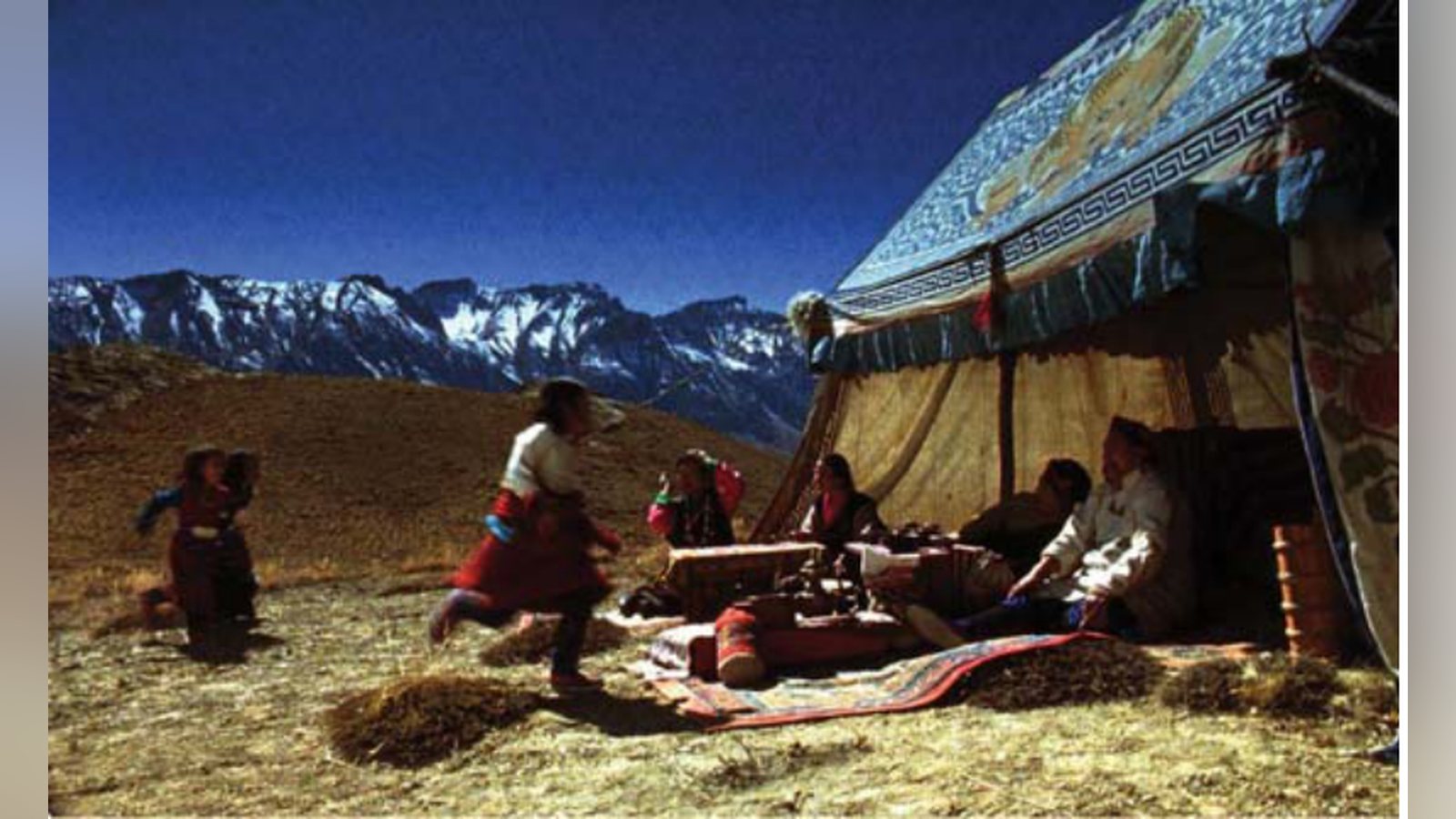
A true story based on centuries-old oral traditions, Milarepa tells the story of a boy propelled into a world of sorrow and betrayal after his father’s sudden death. Destitute and hopeless, his mother sends her son once he becomes a teenager to learn black magic — and exact revenge on their enemies — encountering magicians, demons, an enigmatic teacher and unexpected mystical power along the way.
Chokling was born in 1973 in Wandipodzong, Bhutan, a landlocked South Asian nation situated between India and Tibet, People’s Republic of China. He is the spiritual head of the Pema Ewam Choegar Gyurmeling Monastery (www.gyurmeling. com) in India and Tibet.
Fascinated with the power of cinematic art and the emotional influence of storytelling through sound and moving pictures, Chokling had no formal film education before making Milarepa. However, he had a taste of film production, working as principal actor in Khyentse Norbu’s The Cup and assisted in Norbu’s latest production Travellers and Magicians as a stuntman, assistant to the director and 2nd unit director.
For Milarepa, Chokling also managed to attract some experienced Western film professionals, such as editor Suzy Elmiger, whose impressive credits include cutting films for the likes of Woody Allen and Robert Altman, while Milarepa’s special effects supervisor, John P. Nugent, worked on The Lord of the Rings trilogy, Terminator 3, and The Matrix.
Photographed in the stunning Himalayas, Lahaul-Spiti region of Northern India, Milarepa uses English subtitles and is in the Tibetan language.
StudentFilmmakers: For how long had you wanted to make a film about Milarepa?
Neten Chokling: I wanted to make a film on Milarepa for many years, but we started working on it only two months before pre-production/filming. The thought was there for years, but that thought materialized only two months before the whole production.
SF: What kind of formal film production training had you received prior to Milarepa?
NC: I have never been to a film school.
SF: How were you able to make such a film with no film training?
NC: In the Tibetan culture, we believe that if a work or a project is based on good motivations (and is able to benefit people in a positive way), the work or project has the backing and the protection of the “soong-mas” or the “protectors.” These are supernatural entities, either in male, female or in the form of animals. So in a way, it is sort of like Lord of the Rings. But in “real life,” in order to get the Ring, the main character gets the protection of specific characters on the way.
The other reason why I think I was able to make this even though I had no training as a filmmaker is because of karma…it required a lot of patience, determination and optimism even in the worst days but because of my “karma,” I was to be the one who would slough and bring the story of Milarepa to the film medium. The film was worth everything that we went through.
SF: Speaking of Lord of the Rings, Milarepa reminds me of Peter Jackson’s trilogy in many ways: a sweeping epic, the spiritual journey aspects of both stories— only that yours is a biopic, not a work of fiction, the majestic mountainous backdrop, etc. Do you see a similar connection?
NC: Yes. Many people tell me that there are similarities to the Lords of the Rings trilogy… the only difference is the budget. Mine is not even 1% of the budget of the trilogy.
SF: Did you shoot film or DV?
NC: The film was shot in super 16mm.
Post production was done in New York. Picture editing was done on Avid.
The size of the budget was USD $1.5 million. The most amazing part of this film was the fact that most of the crew and cast were monks from my monastery in India. The monks were of course, wearing wigs!
SF: How was it working with inexperienced actors?
NC: Working with inexperienced actors was difficult. First of all, I myself didn’t have any experience, and on top of that, I had to teach them how to act! When they got the act ready, they forgot the lines! It was tough but also very funny. We had good laughs.
SF: In the same way Milarepa, the person, goes through a spiritual journey, did you find the film production process a similarly exhausting yet satisfying journey?
NC: Definitely YES. Not having prior [filmmaking] experience, not getting funds and waiting for funds to come in, it was very frustrating sometimes. But at the same time, one reads about the life of Milarepa and then one knows that “my” problems are nothing compared to what he went through. This encouraged and inspired me on many occasions. It still does. In the end, we came out with this film, and it seems to be touching people in different ways. This is very satisfying to know that what you made is touching people in positive ways.
We worked hard. Like Milarepa, our hard work had good motivations to start from. Anything that is based on a good motivation, it comes through good.
SF: How did you approach such an endeavor?
NC: Basically, it was the thought that “once this is done, this will benefit many.” The film has lots of beautiful messages, right for today’s confused and turmoiled world. It talks about the importance of compassion, understanding, the futility of revenge, impermanence. Once we are able to think of these more in our daily lives, our actions and reactions will also change in a positive way. This thought was basically how I started this project.
SF: While making a film was new for you, there were some pretty experienced people on your crew.
NC: We had some of the most wonderful people doing post production: Suzy Elmiger was the editor. She had cut Robert Altman’s Short Cuts and Stanley Tucci’s Big Night. Bob Hien, the sound editor, worked on Woody Allen’s Deconstructing Harry, Alice, Bullets Over Broadway, and Mighty Aphrodite; as well as Wes Anderson’s The Royal Tenenbaums; Secret Window; Jim Jarmusch’s Ghost Dog; Before Night Falls; John Sayles’ Eight Men Out. Joel Diamond, the composer, was best known for his work on Henry Bean’s The Believer. John P. Nugent and his team at Sandbox was the visual effects supervisor on The Lord of the Rings trilogy, Terminator 3: Rise of the Machines, and The Matrix, among others.
SF: How did you attract such talents with major Hollywood credits?
NC: Basically they were people who had some interest in Tibet, the Buddha Dharma and the Himalayas! I personally think that they had faith in this film and the messages that it was portraying. They have been very kind to us, to the project.
SF: How did you approach getting Western interest/financial backing in the film?
NC: We did try fundraising many times, and we were unsuccessful most of the time. Nobody wanted to invest in an independent film and on a first-time director without any background or experience. We approached prominent people who were interested in Buddhism and who were capable of investing. But when it came to money, everybody just wanted to be attached to it!
SF: Where did the $1.5 million budget come from?
NC: A close family member knew about the project. Every year in France, there is a gathering of Buddhist practitioners under Sogyal Rinpoche, the author of the Tibetan book of living and dying. This close family member met his friend there and told him about the project. The friend of his invested $100,000. With this money, we started the project. We rented our cameras and shipped them to India, got the crew ready and started filming.
We started filming and then again ran out of money. I got some loans from my friends and also put in whatever I had at that time—around $50,000. With this money, we just managed to get by the filming.
By the end of the filming, I owed money to the western crews. The best part was that I had “monk power.” I had 88 monks from my monastery doing part-time crew work and cast work, all on a volunteer basis. The western crews would joke, “Hollywood has money power” but “you have monk power!”
All the assistants to the camera man and sound man were monks. The boom swinger was a monk!
In order to pay the western crews, this friend of the family member invested another $100,000.
After filming, we stopped for a couple of months. We had no money to do post production. During this time, a lady from the Buddhist Broadcasting Foundation, based in Holland, came to the scene. She invested some money.
Another Buddhist organization in Colorado invested some money. Some money was invested by some Buddhists in Taiwan. The rest of the money was put in by the same guy, who initially invested in France.
SF: How frustrating is it to hold off on Part II until 2009? Why is it taking so long? A lack of financing?
NC: Because it had been difficult to finish this one (Milarepa), I wasn’t sure that I wanted to make the second part. I thought people could read the biography in order to figure out the rest of the story. But now, it seems that many people want to see the second half of the story. That is why I would like to finish the second part. One of the biggest reasons to start in 2009 is financial. It is not frustrating to hold off until 2009, but I would like to finish as soon as possible.
SF: How long ago had you written the script for Milarepa?
Two months back before the day of the shooting/filming. As I told you, Milarepa had been in my thoughts for many years, but he materialized only two months prior to the actual day of the filming.
SF: It seemed like you had fun with special effects, which I assumed were computer-generated, such as the rocket-fast runner; the fire and brimstone; the floating stones, which reminded me of the Harry Potter films. Were they an influence at all?
NC: The special effects were not influenced by the Harry Potter films. If one reads the biography of Milarepa, as well as some of the other saints of Tibet, their stories are brimming with such effects.
Yes, all were computer generated except for that big boulder. We had ten monks on top of the hill, trying to roll down that boulder. It took them two days to sort of uproot it from the ground. But the boulder coming down on the people was definitely computer generated.
SF: Do you have plans to make films other than with a Buddhist theme? Any hope to work for a Hollywood studio on an American project?
NC: Even if I don’t make a “traditional” film, I would definitely like to make something with a Buddhist touch. I have no hopes that I would ever work with a Hollywood studio. Since I have no experience, I think it is maybe difficult to work with big people. So, maybe I should stick with independent films and work with small people.
SF: What type of feedback have you received from audiences?
NC: Until now, (maybe they didn’t tell me their honest thoughts)
it has been very positive. They are very appreciative of the fact that this film has been made. I think the messages within this film are striking people’s hearts in today’s turmoiled world.
SF: What’s your impression of the international film festival circuit?
NC: I think it depends on what type of festival you are going to. Some festivals are good to go because all the business is there (market/distributors). Some festivals are a good way to get noticed. Some festivals are basically a way to lose money (buying your own tickets, lodging, etc.).
SF: Any final advice for aspiring filmmakers?
NC: Definitely. If your film is “commercial,” you’d have an easier time getting funds. If you want to make an art (independent) film, it is difficult to make because of the limited audience, and hence, limited budget. I found that there is still a way to make your “dream film” (independent). Don’t think what you would like to make, you should make “what people want.” One should apply this for one’s FIRST film, get some money and then proceed on to their independent films. I found it quite important.
Chokling and the producers are still working on gaining U.S. theatrical distribution. In the meanwhile, a DVD is available for purchase from the film’s website http://www.milarepafilm.com. Larry Jaffee is a New York-based freelance writer specializing in the entertainment and media business. His writing has been published by The New York Times, Rolling Stone, Hollywood Reporter, and Billboard, among numerous other publications. He may be reached at [email protected].
Related filmmaking guides
- Film directing: getting good performances
- Coverage and the master shot
- Camera angles in film: a beginner’s guide
Keep learning filmmaking
Want more lessons like this? Join StudentFilmmakers free for live webinars with working pros, and stream on-demand filmmaking classes in cinematography, directing, screenwriting, sound and post.