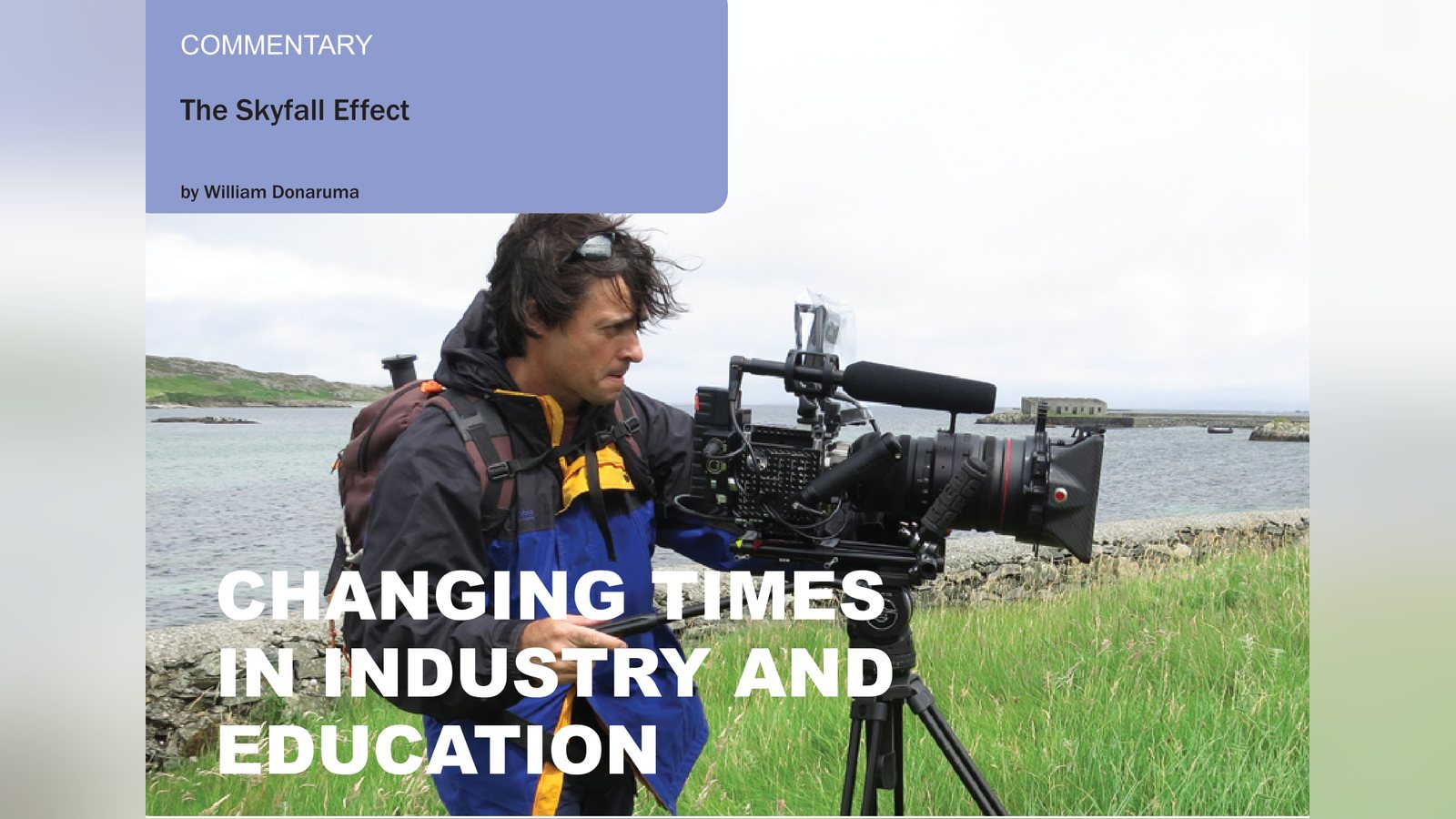
By William Donaruma
William Donaruma explains why his film program moved from Super 16mm to digital cinema, from Skyfall and the Alexa to what still matters most: story.
It doesn’t seem that long ago that we had to make the decision to move from tape to high definition digital, but we are now conforming to the industry transition from film to digital cinema. We, as an educational program, had to decide if the Super 16mm film format was truly a viable medium for professional level storytelling that we have relied upon for so many years. I am proud that we hung on for so long and have been able to teach the true value of imagery in story and cinematography based in the medium that has captivated us for over 120 years. There has been a discovery of vision, whereby students have learned the virtual perception of light and exposure and composition and immediacy of the shot when the camera runs.
Despite the trials and tribulations of film and the potential mess of loading a magazine incorrectly, students of the medium have found an appreciation for the form and discovery of the beauty of the well-shot moment that transcends any of their previous work in video that has been haphazard and relatively easy in its immediate gratification. Those students really learn to value the effort that goes into the creation of each shot to tell a story. What we as an industry and as educators have to battle is the “good enough” attitude whereby the lightweight camcorder and DSLR are all it takes to make a product good enough for broadcast or theatrical exhibition. Thus, it becomes bittersweet that I must retire my Arri SR cameras in favor of the RED One MX.
Each semester it became a monstrous challenge to prove that film was still a viable, professional format being used on Walking Dead, Mad Men, Mission Impossible: Ghost Protocol, and any Spielberg movie for as long as he lives. Then, as I call it, “The Skyfall Effect” happened. Roger Deakins, ASC, BSC, sent a shockwave across the industry when the grand master of cinematography declared that he didn’t need to shoot film again and would shoot the new James Bond movie, Skyfall, on the Arri Alexa. He has since clarified that film, as a medium, serves the story at hand and would certainly shoot film again given the project, but the hammer had fallen. The all-digital workflow was becoming the norm and film has become a choice and not the default for quality. That said, there is an elite status that still follows film as an acquisition format such as with Christopher Nolan, J. J. Abrams, P. T. Anderson, and Steven Spielberg. Quentin Tarantino has even threatened to get out of the business because digital acquisition and exhibition isn’t what he “signed up for.” Fuji recently announced that they will discontinue making motion picture film stocks and Kodak has been on their own fiscal cliff as demand for film wanes. A friend in the ASC, Adam Kane, ASC, who now directs and produces narrative television, admitted to me that it may no longer be valuable to learn film cinematography as he hasn’t work in film for years and that lighting for each set up is about one third faster than the old days of film. That said, he also remarked that, “good lighting is still good lighting, no matter the medium. One always has to light, as we know … whether that means lighting with one 25w light bulb or removing light that exists to create ‘good lighting’.”
And there lies the rub as we move forward. The perception that video is easier, uses less equipment, lighter cameras and requires little or no lighting, because exposure is easier to achieve versus the aesthetics driving the story. A recent student commented that “working with digital softens you” after working with film. This is a perception that can be easily appreciated after the discipline of working in film. A friend and I shot a commercial the other day using a Scarlet camera and a small crew and in no way did we have less equipment that was lighter and easier over the course of 11 hours for 16 shots. And so lies the challenge ahead to prove that digital can be as beautifully done as it can be ugly and lifeless when not done well. The language and experience of the digital workflow is too important to ignore at this point. I do have to admit some excitement over not dealing with troubled mags, film jams, jittery footage from not mounting the mag properly and collecting badly labeled cans for shipment to the lab.
I will also enjoy seeing the realization that grip and lighting equipment is still heavy and necessary and that they will have to deal with their own processing of footage. Film will still have its place among the elite and most beautiful films created, but with the rise and proliferation of the Alexa, Epic and the incoming F65, it is an age of realization and discovery in the digital world of filmmaking. “The Skyfall Effect” has taken effect, but in the end, the story will matter most.
Keep learning filmmaking
Want more lessons like this? Join StudentFilmmakers free for live webinars with working pros, and stream on-demand filmmaking classes in cinematography, directing, screenwriting, sound and post.