By Dean Goldberg
We learn to read as children and forget we are reading. Dean Goldberg explains the visual grammar and syntax of film that audiences read without noticing.
Most people don’t really think about the act of reading while engrossed in good story. Reading is something we learn how to do as children, and after those first tentative steps the actual “act” of reading comes pretty easily. Sure, it becomes more complicated when we are asked to conjugate a verb or split an infinitive. But the simple things, the important parts of reading, that magical process of understanding a story, comes pretty naturally. For example, we know the sex of a character if we see the word He or She. We know that using that particular word makes it clear that the narrative is being told from the author’s or author’s character’s point of view, just as we know that quotation marks within dialogue usually mean that the words are being spoken out loud — and adding, he said, or she said, or, heaven forbid, he exclaimed — makes the identity of the speaker even clearer to the reader.
Like written language, film — and by the term “film” I mean any visual narrative medium — has its own rules of grammar and construction. But while we all have to be taught our ABCs and work our way through grade school primers before we can travel through the magical world of Harry Potter, or hunker down with the latest issue of Rolling Stone magazine, there is really no learning curve when it comes to watching movies. In fact, by the time we are three or four we can follow a simple story on television and by five or six, we are able to understand and enjoy a two hour film filled with many plot points and complicated characters.
But here’s the rub.
While we can watch films without any formal training, in order for us to make films, that is, to make good, interesting narrative visual stories — or for that matter — to study films, we must first learn how to use the grammar of film. For example, just how do we show emotion? How do we illustrate point of view? How do we make something visually funny? Or sad? The answer is both simple and complicated at the same time; the filmmakers tell their story through two or three major functions.
The visual composition (the “frame”).
The editing or the juxtaposition of images.
The use of sound, (although D.W Griffith did pretty well without it).
The Syntax
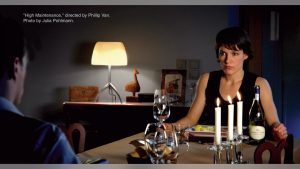
The actual structure of these functions can best be described as the visual syntax or grammar. And as in all good “writing” this syntax is built upon very simple structures: The wide shot, the close-up, and the medium shot.
The wide-shot: Think of it as the filmic equivalent of “Once upon a time…” in a fairy tale. It is usually the establishing shot and is always the frame in which we see environment of our story.
The close-up:
Probably the most important tool in narrative filmmaking. It is the frame that puts the character’s emotions on display. It works with dialogue and with silence. It illustrations a state of mind or a reaction to something has happened or is happening at the moment.
The medium-shot: If the wide-shot and close-up are narrative and visual exclamations, the medium-shot is the
Related filmmaking guides
- Film directing: getting good performances
- Coverage and the master shot
- Camera angles in film: a beginner’s guide
Keep learning filmmaking
Want more lessons like this? Join StudentFilmmakers free for live webinars with working pros, and stream on-demand filmmaking classes in cinematography, directing, screenwriting, sound and post.