By William Donaruma
Digital production became a mindset for students and studios alike. Film professor William Donaruma asks where film stands and why it still matters.
Digital production has made such leaps in the last few years that it has become a mindset amongst students and studio executives alike. In fact, we can no longer simply refer to it as video or HD, because the variances in terminology and the expanded resolutions have gone beyond such terms. We now have to be familiar with 2K, 4K, RAW, log, linear, CCD, CMOS, LUT, and various workflow options. The lobbying back and forth various camera manufacturers have been in full swing for years and now camera comparison tests have been Olympic events of sorts as filmmakers, studios, executives and manufacturers try to sort out what the “best” option is right now. However, figure skating is not speed skating and film is not digital. There are perceptions about each format and an apparent revolution is taking place that has put film on its heels, while also being able to perch atop the mountain as the standard bearer of quality. But, has top quality been forsaken for being good enough in an economy that increasingly puts budgets above artistic merit?
Economics has certainly had its hand in the production arena as it has affected many industries and lives. Touching off the digital era in television was not the economic downturn, but the 2007 writers’ strike. With the looming actors’ strike to follow, studios operated under AFTRA contracts for the pilot season, which allows for video or digital productions.
All of Fox Television pilots were digital and the number of them dropped dramatically that year. Increasingly, the very idea of a digitally based production caused executives and producers to latch on to it as a budget saver. Granted, the advancements of camera systems by Sony, Arri and Red in the last couple of years has created an efficiency in the fast-paced television pipeline without a major sacrifice in quality for HD exhibition in homes. Producers can immediately see dailies from distant locations and editing can begin right away. This, however, has not been a factor producing a distant show like Lost, and one can argue that it had not been a factor prior to the shift. So, did it make it better, faster or significantly cheaper and are audiences any wiser to the change? Can you tell the distinctive differences between film shows like Lost and 24 and their digital counterparts like Rescue Me and The Good Wife?
The growth of digital capture on motion pictures has been slower, but it has had a high profile group of advocates adding to the publicity for a digital revolution. The George Lucas push with the burgeoning format on the last three Star Wars movies kicked off the discussion, but since then, Francis Ford Coppola, James Cameron and the Red touting Steven Soderbergh have made the push more prevalent. Budget constraints for these heavy hitters didn’t seem to be a factor in their transition so much as efficiency, immediacy and a new way of creation, because the sacrifice in quality wasn’t so much of an issue anymore as sensors became larger, more light sensitive, and allowed for better lens choices. A recent on set conversation between a producer and DP stated they preferred the Red for efficiency, but the F35 “looked more like film,” thus digital always finds itself in the shadow of film. It is ironic that the most expensive movie this past year was digital (Avatar), and one of the least expensive was Super 16mm film (The Hurt Locker), yet both competed in the same categories of awards. It is with the latter that film, as a medium, can and should tout itself as alive and well. This and the fact that artistic merits in cinematography largely go to actual film-based productions.
Educational institutions have been embracing digital as an economic and practical alternative, thus doing away with film for production programs. Even graduate programs, where you would have to attend for a chance at shooting 35mm film, have been moving away from the costs of film production. Adam Kane, ASC, recently told me he could foresee a day when DPs coming into the industry will have never shot a frame of 35mm film. The benefit of this change is that one such school allows anyone to direct a thesis “film” on a Red One versus choosing a smaller number from the class to shoot on film. This is also where Red has had a tremendous affect on the industry as a whole. Not only are individuals able to buy into cinema quality production tools, but educational institutions, mine included, are able to offer professional level filmmaking without the costs of film stock, processing and transfers. Universities are barely able to stay ahead of the curve on new technologies having to upgrade cameras every two to three years to make the program attractive and viable, and they are certainly not going to offer the Sony F35 and the new Arri Alexa any time soon. The economics of independent and educational production such as this has an advantage, but there is a caveat to this situation. Are we to throw away 100-plus years of proven filmmaking technique for the latest developments?
No one has looked back since audio left tape on the Nagra to digital recording. Of course, there are varying opinions on the subject, but in a recent list of postings on Cinematography Mailing List regarding “Kodak to the new generation,” it has been noted that this new generation can be seen as “its good enough film makers” (Jim Matlosz) and that taking short cuts or the easy way out is a mindset when comparing film to their newest digital camera. One of the best examples stated about the new generation is that producers, directors and crew have become “’frightened’ of shooting film, because they ‘can’t see’ what they are shooting.” (Anna Carrington). This is, of course, a false notion, because the viewfinder students are monitoring is not calibrated, and they have no sense of how a digital image needs to be handled and the ramifications of varying camera systems in a professional world. On the other hand, once you learn how a film stock reacts to light, you know what you are going to get and how much flexibility you are going to have in post.
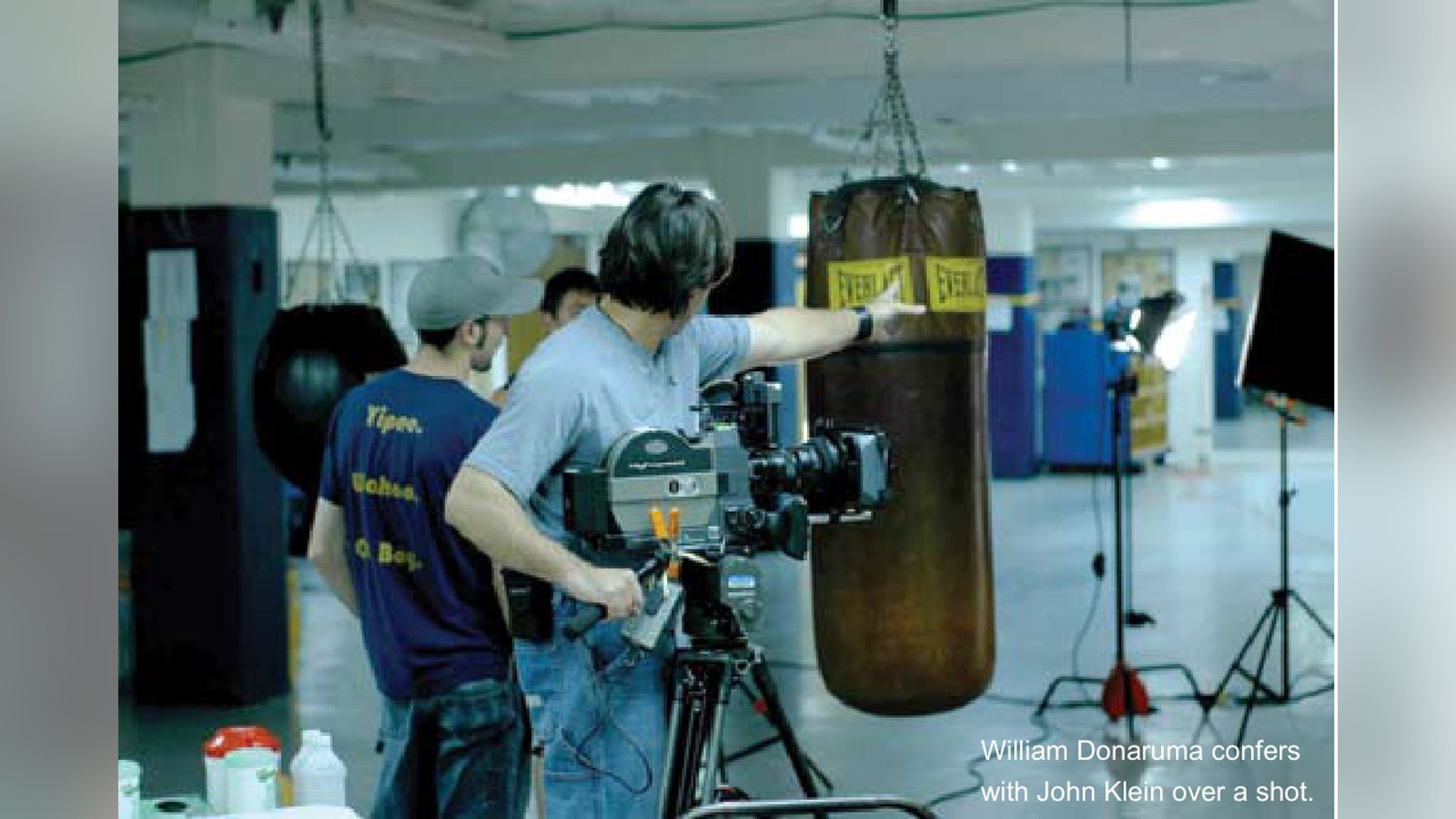
From my position, as filmmaker and professor, who teaches and uses both film and a variety of digital formats, I can attest to the various perspectives regarding these issues. One student was glad she got to use film at least once because it would soon be a dead medium. Some find it easier to shoot more (not better) when they shot with a DVX100, which is no comparison. I can easily show how an Arri SR2 is actually less complicated to use than an HD HVX200. Many others have proclaimed film far more “satisfying,” despite their initial fears, because of their appreciation for the image. When I exit poll certain classes, most everyone proclaims it to be important that everyone take the film class before moving on to upper level digital production in order to better understand what they are doing. It is in these moments that I really feel I have done my job!
What you also find is that students who study film history and critical analysis, and then, take film production will see it in a whole new way. I have students who start telling me how they notice how beautiful Inglourious Basterds looks compared to other films, which is, of course, on film. I should also say that my stance is such that I believe that the image is a vital part of telling the story. So, when someone says you don’t need to shoot actual film to teach, or learn, filmmaking as storytelling, I do agree with that to an extent because the story should help dictate the format just as filmmakers have chosen to shoot anamorphic, varying film stocks or use various processing techniques versus choosing an F35 over the Red. However, when you can shoot film, you can have the confidence and knowledge to make images digitally with respect to the master format. First AC Sean O’Shea (Local 600/LA) told me that in his experience of working in both formats extensively that while HD is certainly here to stay, “Cinematography is the perfect mix of science and art in my opinion. Not teaching its principles would rob any budding filmmaker.” Perhaps the best perspective I have seen lately, after swirling through the sea of technical comparisons, color space bit numbers and dizzying array of charts was from David Mullen, ASC, who said, ”Let’s judge tools by their quality, practicality, and their effectiveness in achieving artistic goals – not by their newness or level of technological advancement.” I thanked him personally and went back to teaching the beauty of film stocks and exposures.
William Donaruma has years of production experience having worked for Universal Studios as well as a variety of production companies and major television networks in film and video production. Returning to Notre Dame to teach production courses, he has won the Kaneb Teaching Award and was granted a fellowship at the Academy of Television Arts and Sciences. His website is www.williamdonaruma.com.
Keep learning filmmaking
Want more lessons like this? Join StudentFilmmakers free for live webinars with working pros, and stream on-demand filmmaking classes in cinematography, directing, screenwriting, sound and post.