By Dave Lent
From a Super 8 camera to Marshall McLuhan, Dave Lent explains how to think about shooting: why understanding the medium makes you a better camera operator.
How to think about how to shoot video like a pro
What came first into my life – my coveted Beaulieu 4008zm Super 8 camera or Marshall McLuhan’s The Medium is the Massage? Each amplified of the other. Once I began reading McLuhan, I knew exactly why shooting came naturally for me. The camera and I were joined at the brain. McLuhan believed that the content of film or television is irrelevant to understanding the medium. He explored the ‘lines of force’ of old and new media, the environments they create, and what these environments do to us. He had a reputation for being way ahead of his time, but he was with his time. The rest of were lagging behind, “Backing into the future while looking into a rearview mirror,” he liked to say.
As digital technology transforms us from passive consumers of information to active creators, McLuhan’s discoveries are more relevant today than when he first conceived them fifty years ago. His core principle: As a tool for extending—amplifying—our thoughts, observations, and ideas, the camera puts the world in our hands. Video is more a tactile than a visual medium. Not the finger-on-object kind of tactility, but the feeling we have when all of the senses are working together. Think of a time when you were deeply touched by something or someone you saw or heard. That kind of tactility.
Think of a video camera not as a seeing device, but as a listening one with two essential functions: As a microphone for your brain and as a stand-in (body double) for the viewer’s brain. Cradled in your hands, the viewer’s brain wants order, clarity, and simplicity. Composition is an operation performed on the viewer’s perceptions. It’s as much a form of brain surgery, and no less invasive, as is surgery with a scalpel.
Beams of light translated by the lens and camera are displayed as a video image. The image is received by the eye and focused on the retina. Millions of rods and cones translate these beams into neural impulses. Using dozens of processors, the brain interprets these impulses, allowing it to understand what is seen. This blend of camerawork and brainwork results in new perceptions, new emotions, and new ways of thinking about ourselves in relation to the world.
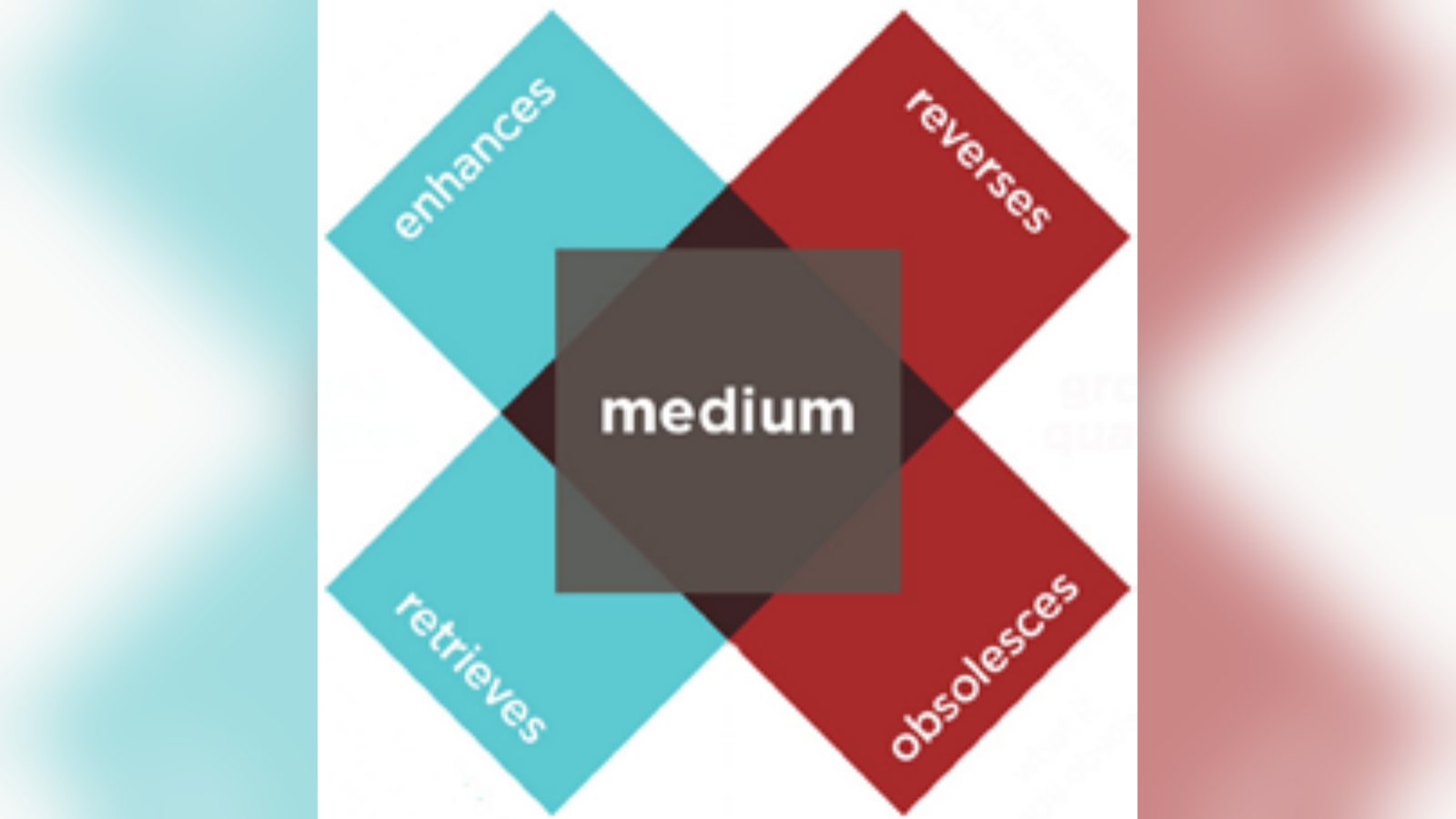
One of McLuhan’s most durable contributions was a formula for understanding the effects of any medium, old or new. Using a Tetrad, a “group of four,” McLuhan posed these questions: What does the medium enhance or improve? What does it make obsolete? What does it retrieve from the past? And, when pushed to its limits, what does it reverse into?
Let’s take a look at the video camera using McLuhan’s Tetrad. These ideas are ‘first draft’ on the subject. I’m an Open Source guy, so let’s keep the conversation growing.
Enhances the reach of our voice to the entire world.
With the ability to witness everything, everywhere, cosmic consciousness is fast becoming a digital fact.
Retrieves the past as present—tribal culture, storytelling, immortality of subjects, one-room schoolhouse (Earth).
Obsolesces privacy and anonymity – the traditional classroom, corporate gatekeepers.
Reverses private life into public domain. For those who excel as filmmakers, their role flips from personal choice to social responsibility.
As video craftspeople, we’re still in the pioneering phase of The Video Age, still inventing and learning the grammar and syntax of our language. McLuhan’s job was to transmit what he observed through the printed word. The job for those of us willing to step up, is to be responsibly masterful stewards of the language of video and critical observers of the changes our lens / brain collaboration will unleash.
Keep learning filmmaking
Want more lessons like this? Join StudentFilmmakers free for live webinars with working pros, and stream on-demand filmmaking classes in cinematography, directing, screenwriting, sound and post.