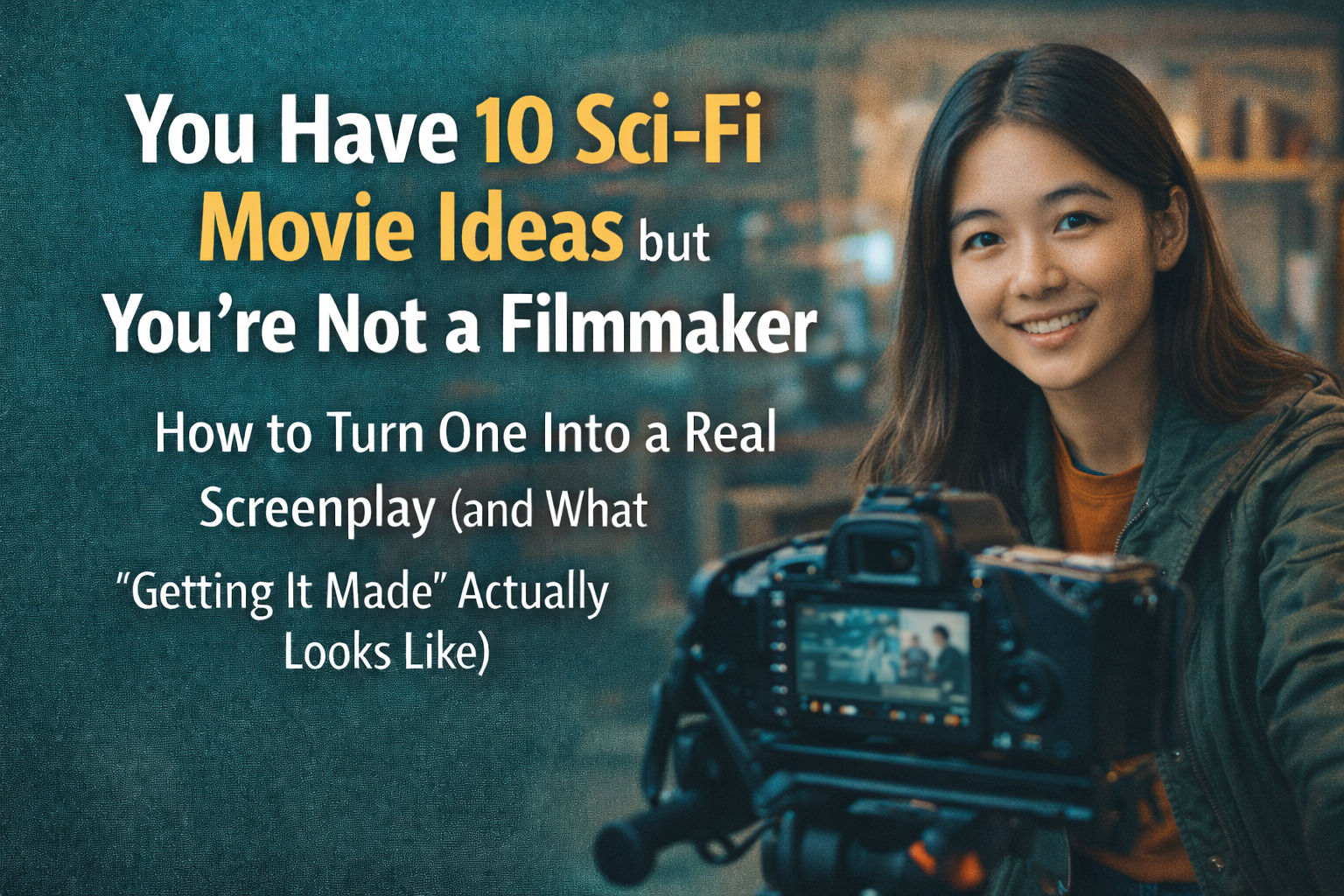
You Have 10 Sci-Fi Ideas but You’re Not a Filmmaker: How to Turn One Into a Real Screenplay (and What “Getting It Made” Actually Looks Like)
If you watch a lot of sci-fi, it’s almost inevitable: you start seeing gaps. “Why doesn’t anyone do this concept?” “What if the twist was that?” Next thing you know, you’ve got ten movie ideas in your notes app and a growing suspicion you could write a screenplay.
You probably can. But there’s a catch: most people don’t fail because their ideas are bad. They fail because they treat ideas like finished products—and because they misunderstand what “getting it made” means.
This is guidance for the sci-fi fan with a stack of concepts and no industry pipeline yet. It’s not a fantasy about getting discovered. It’s a plan that respects reality—and still gives you a legitimate path forward.
If you’re passionate about creativity and storytelling, here are 10 Sci-Fi Ideas to inspire you.
First Reality Check: Ideas Are Common. Finished Scripts Are Rare.
In sci-fi especially, the “cool idea” is the easiest part. The hard part is turning one concept into:
- a story with emotional momentum
- characters who make the premise unavoidable
- a structure that sustains attention for 90–120 minutes
- a version of the film that can be produced in the real world
Most “ten idea” people never pick one. Or they keep polishing the premise instead of writing pages. Your job is to become the rare person who finishes.
Do You Write All 10 Ideas?
No—at least not as screenplays. Not yet.
Here’s a smarter move: treat your ten ideas like a development slate. In other words, you’re not choosing which idea is “best.” You’re choosing which one is most likely to become your first finished script.
Step 1: Turn All 10 into One-Page “Movie Cards”
Create a one-page for each idea. Not a synopsis. A decision document. Each should include:
- Logline: one sentence that forces the premise + protagonist + stakes
- What’s new: what this does that other sci-fi doesn’t
- Emotional engine: what the main character wants and why it hurts
- The “inevitable ending”: the kind of ending your premise demands
- Budget reality: micro / indie / mid / studio
Now you have ten concepts you can actually compare.
Step 2: Choose One “First Script” Candidate Using 3 Filters
- Clarity: Can you pitch it in 20 seconds without explaining rules?
- Containment: Can it be shot without requiring ten alien worlds?
- Character pressure: Does the premise force hard choices?
This doesn’t pick your forever idea. It picks your first finished screenplay. That’s the milestone that changes your trajectory.
Write One Script First—But Don’t Start With the Script
Most new writers open Final Draft (or a template) too early and get crushed by format pressure. Start with a blueprint that makes writing the pages inevitable.
Build a “Premise Proof” Before Drafting
Do this in 2–3 pages:
- The rule: the sci-fi mechanism (what changes the world)
- The cost: what the mechanism breaks
- The human story: who suffers, who benefits, who changes
- The trap: why the protagonist can’t just walk away
If you can’t identify the cost and the trap, you don’t have a movie yet—you have a thought experiment. Sci-fi audiences love big concepts, but movies run on consequence.
Make Your Sci-Fi Idea Cheaper Without Making It Smaller
This is where a lot of sci-fi fans accidentally self-sabotage: they write an unproducible first script. “Unproducible” doesn’t mean “not good.” It means “no one can take a risk on you at this scale yet.”
Instead of shrinking the idea, scale the delivery:
- Choose one primary location type (lab, station, apartment block, ship corridor) and use it creatively.
- Externalize the world through behavior, not exposition. Let rules show up in what characters can’t do.
- Use “implied spectacle” strategically: what we don’t see can feel larger if characters react realistically.
- Limit creature/tech reveals to one or two unforgettable moments rather than constant display.
The most believable sci-fi isn’t expensive. It’s specific.
Stop Trying to Be Original in the Wrong Place
Here’s a quiet truth: most sci-fi premises can be described as combinations of existing ideas. That’s not a problem. What matters is where your originality lives.
Instead of chasing a premise no one has ever imagined, focus on:
- a character perspective the genre rarely centers
- a moral dilemma that can’t be solved cleanly
- a consequence that’s personal, not just global
- a world rule that creates surprising emotional behavior
Sci-fi becomes forgettable when it’s a Wikipedia page. It becomes memorable when it’s a human being trapped in a new reality.
What a First Draft Should Actually Do
Your first draft is not your final draft. Its job is to become a complete object you can improve. Aim for:
- a finished story with an ending
- characters who make consistent choices
- one strong sequence you’re proud of
- a clear tonal identity (cold, playful, existential, satirical, etc.)
Don’t overcorrect mid-draft. Finish it, then diagnose.
How to Get It Made: The Real Paths (and the Reality)
Most first-time writers do not sell a screenplay and watch it become a movie. That’s the fantasy. The reality is a set of incremental wins that build leverage.
Path A: Use the Script as a Calling Card
This is the most common outcome, and it’s not a consolation prize. A strong script can get you:
- representation (manager/agent)
- assignments (rewrites, adaptations)
- general meetings
- collaborators (producers/directors)
In this path, the script’s job is to prove you can write.
Path B: Make a Proof-of-Concept (Without Making the Whole Movie)
For sci-fi, a short proof-of-concept can be more persuasive than a pitch deck—if it proves tone and world rules efficiently. The key is restraint: show one thing perfectly rather than everything cheaply.
Path C: Package It with Emerging Talent
Sometimes a script moves because a director or actor (often also emerging) falls in love with it. Packaging turns a script from “a document” into “a project.” This is relationship-driven and usually slow.
Path D: Adapt It Into Another Form First
If your concept is enormous, consider turning it into a novella, audio drama, or limited comic. Not because those are easier, but because finished IP can make people take the risk more seriously—especially if it builds an audience.
What You Should Do Next (A Practical 30-Day Plan)
Week 1: Reduce the 10 Ideas to One First-Script Choice
- Create ten one-page movie cards
- Choose the best “first script” using clarity/containment/pressure
- Write a 2–3 page premise proof
Week 2: Build a Beat Map You Can’t Escape
- Write 12–15 beats (not scenes): inciting incident, first turn, midpoint, low point, climax
- Define what the protagonist believes at the start and what they believe at the end
Week 3–4: Draft Fast, Edit Later
- Write 5 pages a day, four days a week (or any cadence you can sustain)
- Don’t rewrite until you have a complete draft
- Keep a “fix later” list so you don’t stall
If you finish a draft in a month, you’ve done what most “ten idea” people never do: you’ve created something real.
Final Reality Check (The Good Kind)
If you write one finished sci-fi screenplay—one—your situation changes. Not because it automatically gets made, but because you can now:
- show your work
- improve your work with targeted feedback
- build a track record
- collaborate with filmmakers who can help move it forward
Having ten ideas is a starting point. Writing one complete script is a threshold.
The real superpower isn’t imagining futures. It’s finishing.