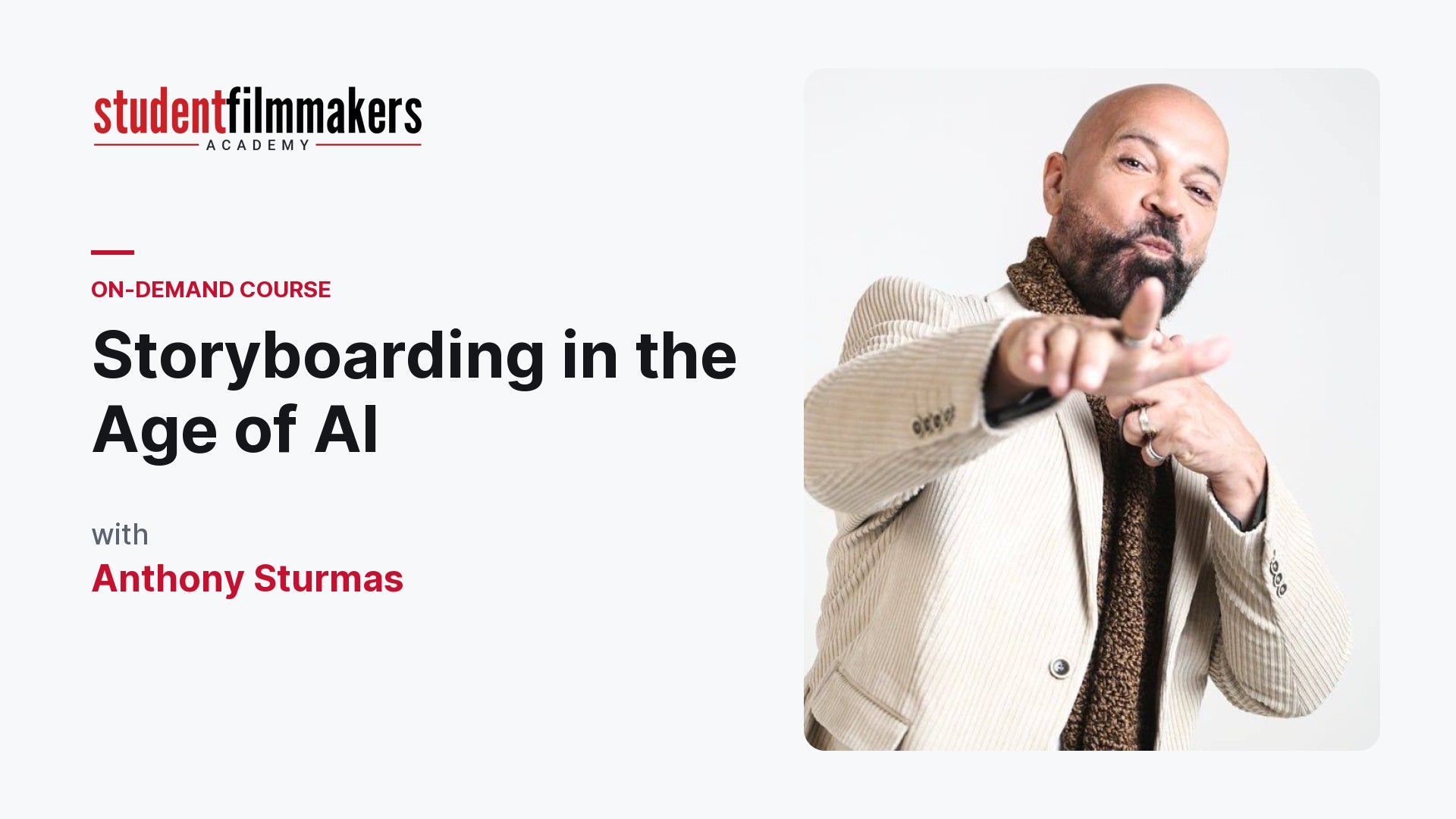
Anthony Sturmas is a Los Angeles storyboard artist whose boards have guided features, music-world shoots like a scooter commercial with Iggy Pop, and his own animated series, Ninja Girl. His message to storyboard artists worried about AI is blunt: draw first, let the software handle the heavy backgrounds, and keep the acting, the pacing and the story in your own hand.
Sturmas started as a graffiti artist in Los Angeles and Long Beach in the early 1980s, moved into comics and murals, and has spent his career boarding for directors, studios and brands. In this live class he walked through the exact order he works in, the tools he trusts, and the sequences that got him hired again.
Will AI replace storyboard artists?
His short answer is no, but he adds a condition. The artists who should worry, he says, are the ones who refuse to learn new tools or never learn how films are built. He compared it to the arrival of computers in graphic design, which many people feared and which ended up as one more tool.
“AI can generate images, but it cannot direct a scene.”
The reason is what he calls emotional beats. A bank robber about to grab a hostage, the fear in a woman’s eyes, the moment a hero falters: software does not know why a character moves or why a beat matters. It only follows the command you type. His summary line to the class: “AI will replace artists who only draw, and AI will never replace artists who tell stories.”
What does his AI storyboarding workflow look like?
It starts and ends with drawing. AI sits in the middle as an assistant for the slow, repetitive parts of a frame, such as a battle with hundreds of soldiers or a skyline behind a chase. His order of work:
- Sketch by hand. Thumbnails and rough frames come first, always.
- Bring in AI for the busy parts. Upload the sketch with any reference images the director sent, and let the tool test lighting, fill backgrounds or build crowds.
- Clean up in Photoshop. When the output goes strange, or as he put it, “it’ll go weird on you,” fix it by hand. He keeps the palette under his control and uses AI only for base tones.
- Review every 20 to 25 frames. Read the sequence back. Does it tell the story? Cut a frame or a page if it doesn’t.
- Final polish. AI can come back at the end for a color pass, a texture or a filter.
He puts the hit rate of a good AI pass at about 80 percent. He also found a hard ceiling: the most frames he has ever gotten a tool to generate in one go is five. Full sequences still come from the artist.
Which AI tools does a storyboard artist use?
Sturmas went through the tools he has tried and was honest about the ones he hasn’t used much. Some are free, some charge a monthly fee.
| Tool | What he uses it for |
|---|---|
| Adobe Firefly | Lighting variations, quick color passes and mood, right inside Photoshop |
| Runway ML | Composition cleanup, background replacement, rough animatics to test pacing and camera moves |
| Midjourney | Fast concept ideas for environments, props and costumes; not for final frames |
| Photoshop Generative Fill | Extending a background or patching a hand-drawn frame |
| Clip Studio Paint | Color suggestions, perspective fixes and pose references |
| After Effects | Animatics and motion previews, mostly for commercials |
He rarely builds animatics for features. Commercial clients want exact timing before they present to the brand, so that is where After Effects earns its place. On a feature, he might animate only a fight or an opening.
How fast does a storyboard artist have to draw?
Very. On a feature he delivers black-and-white boards with directional arrows at about 100 to 125 frames a week, and on a heavy day 20 to 25. He told the class the expected pace has climbed to around 200 to 250 a week, because programs like Toon Boom and AI let artists turn out more. To keep up, he gets up at three in the morning and draws for at least two hours before anything else. “Slow is not an option in production,” he said.
His practice drills are simple: one-minute poses, five-minute scene breakdowns, and ten-panel sequences finished in under an hour.
How do you make a quiet crime film exciting on paper?
He showed his boards for Wages of Sin, a crime feature with Danny Trejo about a cop framed by meth traffickers. Unlike a sci-fi film, most of the script was mid shots and close-ups.
“A lot of shots aren’t really exciting. So you got to really dig deep to make them exciting.”
The catch is the budget. Push the angles too far and you draw shots the production can’t afford, so he reads the cast list and the scale of the film to judge how much room he has. The chase scenes were where he let himself go bigger. He also labels every board with its scene and shot number, because when a film runs to thousands of boards, a page and shot number (page 67, shot 199 in his example) is how a director finds a frame.
Why should the hero lose first?
For the subway fight in Ninja Girl, his own series headed to webtoons and animated shorts, he boarded the hero taking a beating from a gang of thugs after she walks in expecting an easy night.
“In storytelling you have to see your hero fail. You have to see your hero fall into a critical moment, so the viewers feel more attached to the hero.”
He tied it to Star Wars, where the hero sits at the bottom before rising in the climax. Boarding the low point with real weight is what makes the comeback land.
How does he work with a director he has never met?
Before drawing a frame, he researches the director’s past films to learn their visual signature, then reads the script. He asks for visual references, because “you can’t read his mind,” and he sends five sample frames from different scenes before production starts. That way a mismatch shows up early, not after 100 frames. He also asks right away whether the locations are already chosen. On a hospital horror film from a UK director, real photos of the location went straight into the boards.
When a cinematographer in the class asked how he chooses a wide angle or a tight one, Sturmas described pinning thumbnails on a board and moving them around. Sometimes the wide shot he planned turns into a tight shot on the eyes. He also studies 1940s classics like Rear Window for ideas.
What should a storyboard portfolio show?
Studios want sequences, not random drawings. He recommends three to five full sequences of 20 to 40 panels each: a dialogue scene, a fight and a comedy or emotional scene. Put them on a simple site with fewer than ten pages, a short bio and an email that matches your name. Then reach out to directors and producers with five of your best frames and a short note.
He believes about 80 percent of the career is relationships. Early on he sat in a coffee shop near Gower Studios with his sketchbook open, drawing while directors walked past. Keep in touch with past clients every few months, he advised, with news rather than a request for work.
Two more reads on planning shots before the camera rolls: Storyboards: The Benefits to Production and How to Make a Shot List, both in the magazine archive.
The full class also includes his Iggy Pop scooter boards, a biker-chase sequence drawn with stunt arrows, and his downloadable list of free and paid tools.