By Mark Simon
Time, money and communication: storyboard artist Mark Simon explains why productions that skip storyboards lose out, and how boards help every department.
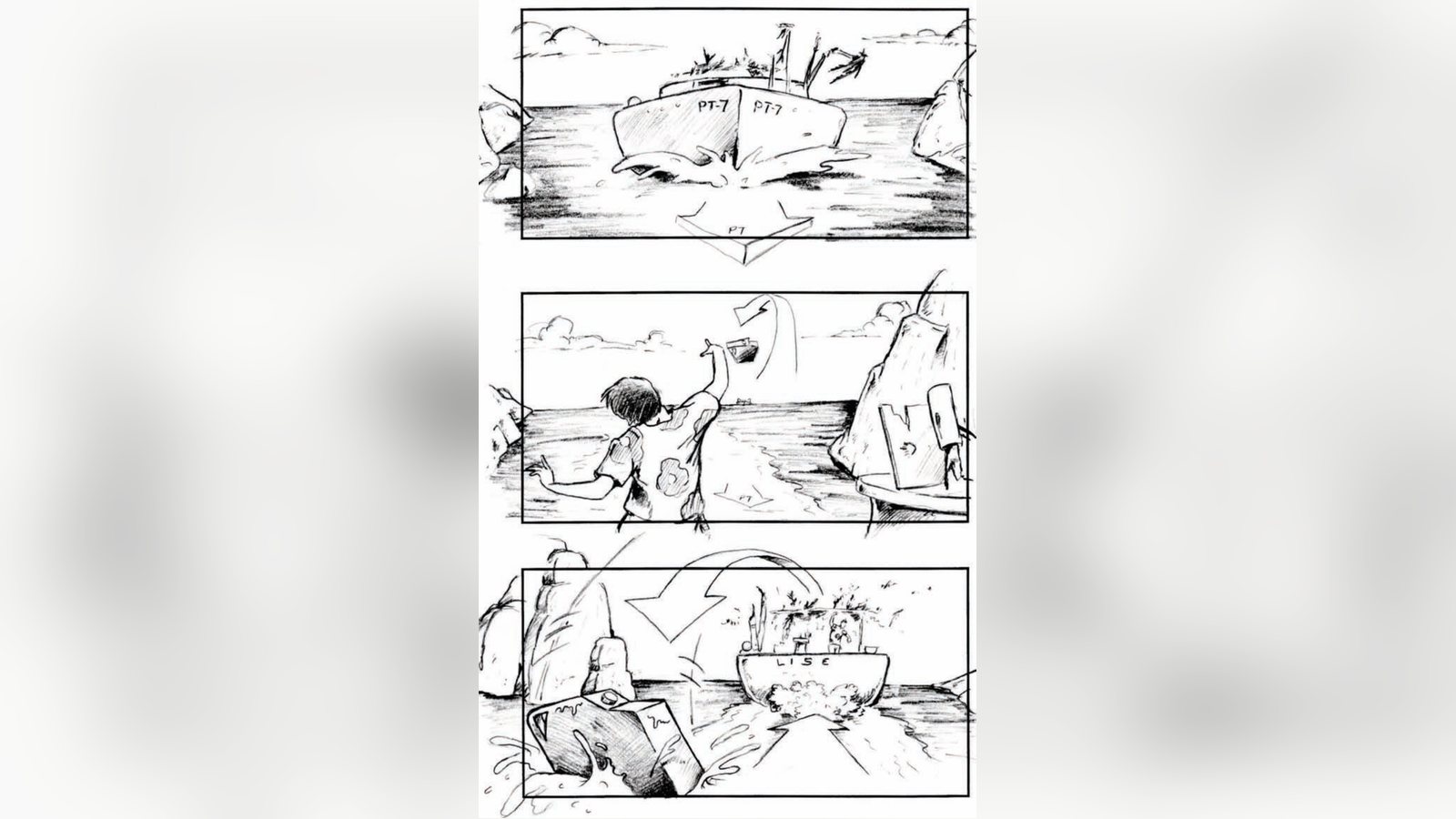
Time. Money. Communication. These are powerful words in the entertainment industry. Far too often a production will opt not to pay for storyboards. This is being penny-wise and pound-foolish. Developing and using storyboards solves production problems, saves time and money, and can be used for testing an idea early on.
In animation, the benefits are not only plentiful, they’re unavoidable. Nina Elias Bamberger, executive producer for Sesame Workshop animation, has said:
“Storyboards are the blueprint for the series. They convey the emotions; they convey the creative direction of the series. Since oftentimes, like in Dragon Tales, we ship to several studios in order to get the work done on time. The storyboards are what will guarantee uniformity throughout the series and its quality control. And it also gives the producers the opportunity to fine-tune what they want the series to look like before it’s out of their hands for a while.”
Storyboards also help break down the language barrier between countries. When a production is shooting in a country which speaks a different language than the main crew, the storyboards help direct their actions. A picture is truly worth a thousand words, in any language.
In live-action productions, the first scenes to be storyboarded are those with effects, stunts, and special camera moves. Effects and stunts can’t be properly budgeted or scheduled without boards, so productions need them boarded as early into the process as possible.
Production story. On the movie McHale’s Navy, there was a chase sequence between McHale and Vladikov that consisted of only three lines in the script. The second-unit director, Glenn Wilder, designed a huge sequence, far beyond what was written in the script. The sequence ended up needing over 100 panels. Production could not have accurately scheduled or budgeted the second-unit shoot without the boards, since the script would have led them to believe the sequence was much shorter than it ended up being.
If production has enough time scheduled, the storyboard artist will board other scenes to develop the visual flow of the story and develop shot lists after the effects and stunt boards are complete.
One major benefactor of live-action storyboards is the director. Developing storyboards with an artist forces the director to fully visualize the script. When the artist is doing breakdowns, lists of needed camera shots, this also presents directors with options that they may not have considered. The storyboards become a visual shot list. Directors often mark off each drawing as the shooting proceeds to make sure they get every shot.
Storyboards also help with continuity. Screen direction, the direction in which a character or object is moving across the screen, is very important in all scenes, but it is the hardest to control in action and special effects scenes. Successive cuts may be shot on different days or even different weeks. It’s hard to keep track of screen direction when different elements and shots of the same scene are shot so far apart. Boards act as a blueprint for each shot and limit potential problems with screen direction.
This is supported by director James Cameron in a November 24, 1986, Hollywood Reporter interview as he spoke about his hit movie, Aliens:
“The scene where she [lead character Ripley] takes over the control of the APC and drives it through the whole structure, that was heavily storyboarded because we were intercutting the full-size action I was shooting with miniatures — they had to get the screen direction, the size of the frame, all of that.”
In animation, the storyboards help the animators retain proper continuity. They tell animators working on different scenes what leg the character was standing on, what hand was holding the flashlight, or what direction a character should be running. Continuity mistakes take the viewer out of the story, and the magic of the moment will be lost.
The director may also use the storyboards to explain his direction to an actor and the cameraman. It is always easier to show someone what you want rather than just explain it.
A tremendous amount of work needs to be done on a set at any given time, and there are never enough hours in the day to accomplish it. With a full set of storyboards, the production manager will be better able to schedule the shoot. There will be less chance of cost overruns when the shoot is scheduled properly.
When a scene is boarded and the crew heads have those boards, there are fewer needless questions asked and less time wasted. When the crew can see the director’s vision prior to shooting, they are better able to anticipate what is needed — and the shooting will proceed faster and more smoothly because of it. The faster the crew works, the less the production will cost. Time is money.
Film is money too. When each shot is planned in advance with boards, the director and the director of photography are able to shoot less coverage. In other words, they are able to shoot only the exact shots needed to cover the scene, and they don’t necessarily have to shoot the entire scene from multiple angles. The boards will also help them plan complex camera moves.
When a designer reads a script and imagines a new set, he feels the need to build the entire four walls of the set in case the director wants to shoot in different directions. When a scene is fully boarded, the designer may find out that only one section of a set is needed, thus saving time and money in construction and set dressing. Of course, the designer may also use the storyboard artist to do a conceptual rendering of a set for approval by production before construction starts.
Production story. When I was art directing and designing sets at Nickelodeon, I had a scripted scene that needed a girl’s bedroom. I was designing a large four-wall set with lots of dressing. I then storyboarded the scene with the director, only to find out that he wanted the entire scene shot with one angle of the girl sitting in the corner of her room. I was then able to save money from my set and dressing budgets by providing production with only what was needed instead of a full, elaborate set.
Projects with lots of effects and stunts constantly have production problems coming up as different elements of each shot raise their heads. With storyboards, these problems may be fleshed out early while there is still time to deal with them and design properly. Often, different elements in a single special effects shot may be shot months apart. These shots need to be planned completely so that the shot will work correctly and will fit in with the flow of the story and the final edit. The storyboards can break down these shots into their different elements so that all crews — first unit (the director and lead actors), second unit (often a separate director shooting stunts and cutaways without the main actors), and special effects — are working in conjunction with one another.
Every time stunt coordinators or special effects people budget for a stunt or effect, they pad their bid (make the bid more expensive) in preparation for the unexpected. Without storyboards, stunts or effects could be designed differently from what the director is looking for. With storyboards, the look can match the director’s vision, each element may be designed down to its minute details, and a more exact budget can be worked out. Stunt and effects people often hire storyboard artists on their own so that they can use the boards as part of the contract specifying exactly what elements are included in their bid.
All crew heads benefit from studying the storyboards of their project. Delays are costly to production. Any element of theirs that is affected by the action in a storyboard is important for them to know about.
When advertising agencies are pitching an idea for a commercial to a client, they usually use storyboards to carry the visuals of the presentation. These generally are done in color and do not include every shot, just enough information to get the idea across.
Large corporations also use storyboards to present marketing ideas to the decision makers. These may be simple sketches or vibrant color illustrations.
Storyboards may also be used to test the viability of a finished commercial product without the great expense of shooting it. These drawings are shot on video and edited together just like a live shoot. This footage is then dubbed with music and voices. This is called an animatic. The animatic may then be shown to test groups around the country.
Productions benefit from boards in many ways. They may cost money in preproduction, but that cost is much less than the hidden expenses caused by a lack of proper planning or any miscommunication.
Mark Simon is the owner of the storyboard company located in the Southern U.S., Animatics & Storyboards, Inc. He’s an award-winning animation producer, storyboard artist and lecturer, and author of books including, “Facial Expressions: A Visual Reference for Artists,” “Producing Independent 2D Character Animation,” “Storyboards: Motion In Art, 3rd Edition,” and “Your Resume Sucks!” Mark’s websites are www.storyboards-east. com and www.YourResumeSucks.biz.
Related filmmaking guides
Keep learning filmmaking
Want more lessons like this? Join StudentFilmmakers free for live webinars with working pros, and stream on-demand filmmaking classes in cinematography, directing, screenwriting, sound and post.