Reference: StudentFilmmakers Magazine, March 2007. Anthony Hopkins Traverses Indie Filmmaking Frontiers: Veteran Actor’s Debut as Writer/Director: Slipstream Premieres at Sundance. Pages 24 – 26, 28 – 29.
Slipstream takes the viewer on a surreal rollercoaster journey through time, dreams and reality into the workings of the creative mind, shaping a dreamlike narrative from momentous events in the life of Felix Bonhoeffer (Hopkins), a screenwriter, mystified when characters from his screenplay show up in his everyday world. As writer, director, composer and star, Academy Award-winning actor, Sir Anthony Hopkins, is the creative mind behind the groundbreaking independent film, which premiered in the Frontier section of the 2007 Sundance Film Festival.
Hopkins was inspired by his wife, Slipstream’s producer, Stella Arroyave, who suggested he write a screenplay. In discussing this first screenwriting foray and the philosophy behind it, Hopkins twists and turns as much as the nonlinear structure of his story. “I didn’t know what I was writing, but I wanted to break all the rules of writing cinema. The whole thing is a pastiche. I wanted to say, tongue-in-cheek, what I believe – that life is not a Hollywood ending. It is brutal and tough and rough, and death greets us all at the end. And that is my statement!” Even in the youth orientated culture of Hollywood, Hopkins believes that we’re all followed around by the “angle of death”, but he admits he does not know if there is meaning in life and that the film was not meant to convey a message. “We’re living in a tough place,” repeats Hopkins, then he turns it around, “But it is also a glorious place. I’m not that nihilistic.”
Hopkins also wanted to take a shot at the film industry and his own profession of acting with all the ego and eccentricities that seem to go along with the job. He literally wrote the film as a stream of consciousness, starting at scene one. When he got to page one-twenty he thought, “I guess I’m on my way there.” He wondered if his characters had motives for what they did, “And do they need a motive? None of us have motives in our lives.” So he started to turn the script upside down, which is what he wanted to do with the whole film – turn it upside down and change course. “And at the end of course…death,” Hopkins says again with his tongue-in-cheek.
Most of the production was shot in the 120-degree summer heat of the California desert, although some scenes were shot in the early spring when the company cast veteran actor, Kevin McCarthy, best known for his role in Invasion of the Body Snatchers, who was 92 at the time. “I wanted to get him desperately in the movie because he was symbolic,” Hopkins shares. “We had to get him on camera as fast as we could because you know…[that death thing again]. We didn’t want to expose him to terrible conditions. He was as sharp as a tack, a great professional, a wonderful man.”
The company filmed at a Mojave location dubbed “Club Ed”. The 1940’s-50’s set, which was originally built over twenty-five years ago for the Dennis Hopper film Eye of the Beholder, included a classic American diner, an old gas station, polished aluminum Airstream trailers and a motel with pool. Hopkins chose to film in the brutal conditions of the desert because that environment fit his take on the brutality of life. The location was a metaphor for the main character’s arc in the film. “Felix goes on this journey into the desert, and he is confronted by the demons of his own life and the meaninglessness of it all,” explains Hopkins. “I guess it really is an existentialist movie. I did have a Hollywood ending, which I actually filmed. Then I cut it because it was so horrible. The acting was good, but the writing was pretty awful. I take full responsibility for that.”
Arroyave decided to produce the film independently, which afforded Hopkins with the creative control to pursue his vision without outside interference. They even decided to go without a bond company because they did not want to compromise. Arroyave also realized early on that she needed to surround herself with people who understood the nonlinear storyline of the film. When she met producer Robert Katz, she instantly knew he got it. His involvement with the film freed her to fulfill her other commitment to the film, the role of Gina, which Hopkins had written for her.
Hopkins credits Arroyave and Katz along with his internationally acclaimed cast and crew for getting the film made. His stature in the industry worked as a magnet attracting a stellar ensemble cast including Christian Slater, John Turturro, Michael Clarke Duncan, Camryn Manheim, S. Epatha Merkerson and Kevin McCarthy. Hopkins paid everyone in the cast – newcomers and veterans – the same amount of money. “That is a good basis for an ensemble. We all had the same accommodations. That brings people together.” On working with the actors, Hopkins follows the philosophy of “know your lines and show up.” He also knows when to let the actors take the lead.
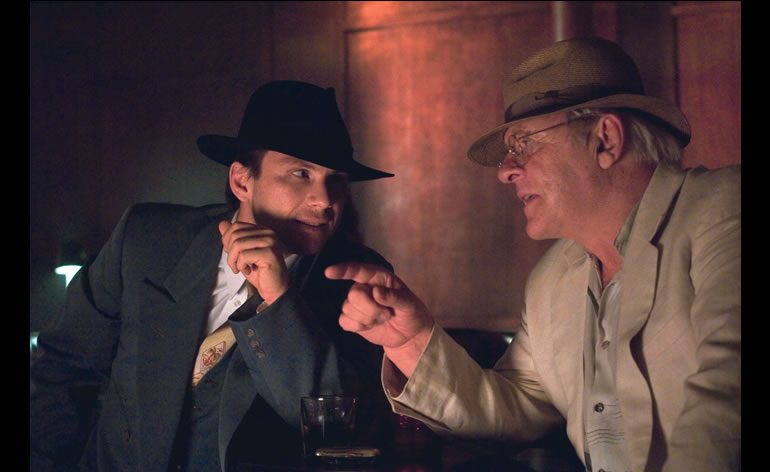
One particular scene – the confrontation in the diner – was particularly long and posed a problem for Hopkins on his tight schedule. He acknowledges that the quality of the cast made his job easier. “I trusted the actors. Christian [Slater] came in that morning to do the scene with Jeffrey [Tambor] and they just whipped the ass off it. They knocked two days off my schedule. He is so focused. I didn’t direct him. I just blocked the camera and gave him some suggestions as to where to move.” Hopkins shares his favorite anecdote from the shoot, “In fact, he took over my precious moment in the scene that I was going to put in the kitchen. His instinct was, ‘We can’t act in this tiny little space. Why not take it into the main diner?’ I had no idea that this was going to happen. He made the film for me. I felt this guy had the chops, so I just sat back and watched.”
Slater had worked with Hopkins on Emilio Estevez’s Bobby. When Hopkins approached him, the actor jumped at the opportunity to be part of the film. “I have always been a great admirer of his work. I read the script and it was very different, bizarre, outrageous, twisted. It took at lot of different turns,” shares Slater. “With the role of Ray I had a lot of free license to go completely crazy. I was grateful for that. I remember rehearsing with Jeffrey because this was a movie with Anthony Hopkins. I wanted to be as prepared as I could possibly be. I was looking for some kind of meaning in it. I knew that Tony had written it, and I tried to keep in mind that it was a very personal project to him. I almost felt that the character of Ray was a bit of Tony’s subconscious, and this was an opportunity to communicate it back to him as he watched the monitor. That’s what was going on in my head. It sounds a little deep and ridiculous, but I had to find something to latch onto and make it personal for myself. ”
Hopkins’ creative team included cinematographer Dante Spinotti, Oscar-nominated for his lensing of The Insider and L.A.Confidental; Julie Weiss, Oscar-nominated for her costume designs on Frida and Twelve Monkeys; production designer Ismael Cardenas, who brings extensive experience from the art world; and Michael Miller, the editor of independent classics such as Raising Arizona, Stigmata and Swing Kids.
Spinotti was the first director of photography that Hopkins offered the film to. The director was a bit tentative at first about approaching the famed cinematographer because he thought, “He’s too big,” but then thought “Why not?” Spinotti responded enthusiastically to the script and assured Hopkins that the “indie money” was not a problem. Although they shot the early footage with Kevin McCarthy on 35 mm, Spinotti proposed working digitally. He shot the bulk of the production in high definition using the Sony Genesis Camera. The added benefit to shooting in the hi-def format was the ability to shoot for 55 minutes without changing stock, which in essence saved the company time on set.
The format also saved time in the editing room and was more efficient in the process of creating the numerous visual effects, which could be more easily previewed when working digitally. Hopkins was very hands-on in the editing room. He worked with Miller for 16 weeks and found the film that he had shot. When Hopkins saw the result he thought, “This works. It’s odd. It’s weird. It’s unconventional, but I wanted to see the peculiar structure of memory.” The editing succeeded in creating visually the sense of what thought and images are.
Hopkins was not finished with his creative contributions to the film once it was “in the can”. He loves to write music and had already used some of his original compositions as guide tracks on set to get the actors in the proper mood. Katz encouraged him to score the film. After receiving additional positive feedback, ultimately Hopkins wrote 64 minutes of score over the course of seven days. “The only way I could do that had nothing to do with ego,” says Hopkins. “I believe that in breaking all the rules, by being free and fearless, you can do anything you want in this world.” Slipstream proves his point.
Mary Ann Skweres is an award-winning independent writer/director with over a dozen produced short films under her belt. A member of the Editor’s Guild, she has edited feature films, documentaries and shorts. She writes about the art and craft of filmmaking for magazines including Below the Line, Film and Video, VFX World and Animation World Network. She can be reached at [email protected].