By Carl Filoreto
NBC’s Mara Schiavocampo and other backpack journalists explain how one person can shoot, report and edit news video, and the gear that makes it possible.
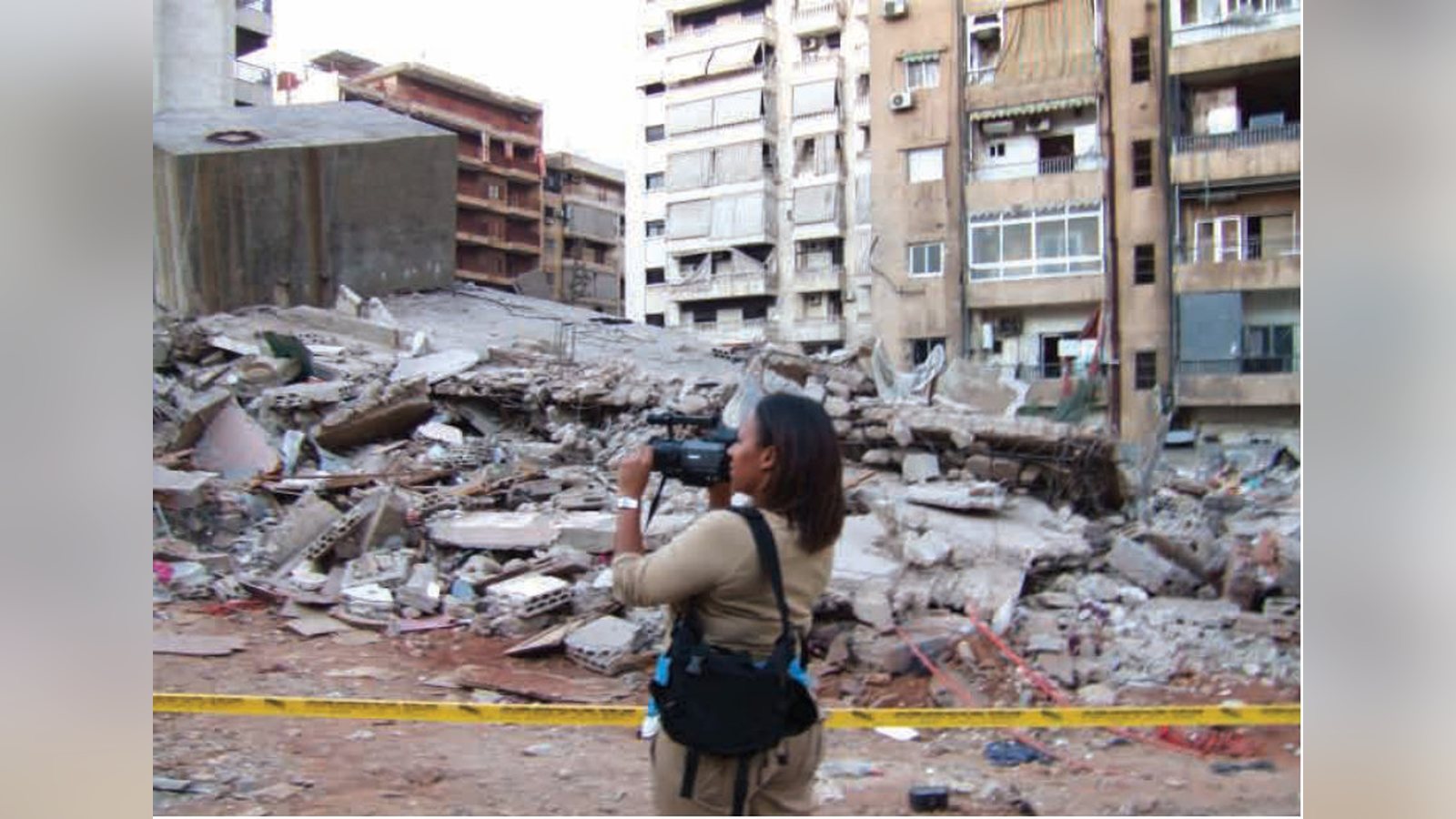
Against a backdrop of newsroom downsizing, budget cuts and rapidly evolving technology, the concept of backpack journalism is being sculpted into a reality. The idea of one person producing, shooting and writing a news story is not new, but it’s quickly becoming an integral part of television newsrooms across the country.
The one man band (sorry for the gender bias) is not a new idea or practice. However, it’s being reinvented on a daily basis. “I’m not sure it’s the future of journalism,” relates Poynter Institute faculty member Al Tompkins, “but it’s part of it for awhile.” The high quality of palm size camcorders and the ability to edit on a laptop computer has created a highly mobile platform for video journalism. The barriers created by the sheer size, weight and bulkiness of video gear have been removed, and new possibilities emerge on the journalistic landscape due to this transformation.
Video journalists. Solo journalists. Digital correspondents.
Backpack journalism. There isn’t much consensus on what to call the practitioners of the craft, but they’re working in greater numbers in more markets. And they emerge from a variety of backgrounds.
“I really wanted to do some international work, so I quit my job, bought some gear and started making reporting trips abroad,” explains Mara Schiavocampo, currently the Digital Correspondent at NBC News, the first reporter of her kind in network television. “For me, I thought ‘these’ are the stories I want to cover, and the only option for getting them done is for me to do everything. The identity of a backpack journalist came much later.”
“I didn’t look for the job,” Jennie Castor, a video journalist/reporter at KMGH-TV in Denver, Colorado told me. “I got the option of trying something different, and thought, okay, I’ll try it.” Jennie emerged from a solid career behind the camera to try out the new role. And many people in the business are facing the same choice, whether they like it or not. Traditional reporters face learning the skills of shooting and editing, and photojournalists need to ask themselves if they’ve got the writing chops and flexibility to move up to a larger role in the newsroom.
This wholesale change in the daily routines of newsrooms has sparked a lot of controversy. Just because one person can do the job of two or three or four, is that necessarily a good thing? KMGH-TV in Denver, Colorado.
“In my experience, there aren’t a lot of people out there who can really do it all, and do a good job,” claims Steve Sweitzer, news operations manager at WISH-TV in Indianapolis.
“The concerns over quality are legitimate,”
Poynter Institute’s Al Tompkins adds. “I worry about the loss of voices in a story. I can’t tell you how many times a photog’s thinking saved me from going off the deep end on a story.”
While these are legitimate concerns, the role of the video journalist in the newsroom is probably here for the foreseeable future. The cost savings alone will probably insure not only their survival, but their probable growth in the industry. So what does it take to do a good job in this role, and how do you obtain the skill sets required for success?
“Everything I learned about journalism I got in graduate school at the University of Maryland, College Park,” Schiavocampo explains. “I learned how to shoot and edit, how to write a script, how to tell a story, everything. It was invaluable to what I’m doing now,” she adds. For Jennie Castor, some new skills needed to be learned on the job, but she feels she had an advantage. “I think it’s easier to go from a photog to an all-in-one journalist, than the other way around,” she noted. “To me, it seems it’d be tougher to learn the technical skills. A good photojournalist is a de facto reporter anyway, and knows the elements that make up a good story.”
So while a small camera and a laptop editor are nice tools, the vital skills are the same for any good journalist. “Ultimately, no matter what your workflow, what we do is all about stories, so identifying really compelling stories is key,” Mara relates. “I always think, would I want to watch this? Writing and editing are integral to the storytelling process. And editing is where you really get to polish your work by accentuating the wonderful and burying the awful.” And Mara has traveled the world incorporating these fundamental skills into her work. On the local level, Jennie Castor concurs, “What’s most important is being able to recognize a good story, and can you personally tell the story well. Although without the technical skills and the ability to write, you’re dead in the water.”
Like any cog in a machine, the role of the video journalist has inherent advantages and disadvantages. One of the primary advantages lies on the bottom line: it simply costs less to have one person do the job of several. And potentially, it can provide a way to put more resources into the field. But on the local level, turning a same day story can be fraught with high pressure challenges. “It’s stressful to turn a same day story by yourself,” Castor relates. “You have to be totally organized and you’re constantly playing beat the clock.” And even when the challenge is met, and the story successfully airs, the day isn’t over. There’s a need to write content for the station’s website, and possibly a blog as well. “Some days I do well, sometimes it’s a bit too much. That’s ok, but it can be a long day,” Castor concludes. F Panasonic P-2 Digital Camera, AG-HVX200P (2 P-2 cards) F MacBook Pro Laptop with Final Cut Pro F Sennheiser EW100 G2 Wireless Lav and Stick Microphone F Shotgun Microphone with Extra Mic Cable F Miller Tripod Lightkit with Rifa Box Light, Omni Light, Tota Light, 3 Light Stands, etc.
F Skullcandy Pink Headphones F Travel wheel cart!
F Computrekker Rolling Trekker plus Camera Bag F Sony V1U F Libec THM20 Tripod F Lectrosonics UCR-100 Wireless Mics (2) F Lite Panel Camera Mounted Light F Power Strip F Universal Charger F Firewire & USB Cables F MacBook Pro Laptop with Final Cut Pro F 200 GB External Hard Drive And some stories are better suited to a backpack journalist. “I’m not out there doing legislative stories,” Castor states. “I’m better suited to environmental, entertainment, or tug at your heart stories.” She does work on a number of consumer and investigative reports, though. Globe trekking Mara Schiavocampo has her own set of difficult situations. “Big media events are a real challenge for me and quite frankly, not all that fun. Breaking news has its challenges as well. I don’t think this is necessarily the best model for those situations.” Usually, though, the story creation process and the workflow are comfortable situations for her. “I’ve integrated the workflow so much that it doesn’t feel like multiple tasks. I think that’s the key, mush all your roles together. When I’m researching I’m thinking about shooting, and when I’m shooting I’m thinking about writing, and so on. They’re all links in a long chain,” she says.
Both journalists agree the best part of the job is the total creative control they possess over a story. There aren’t any intermediaries to change or alter their vision. But there can be a lot of long days on the road and in the field chasing a story. “It’s lonely,” Castor relates. “I’ve lost so many friends because I don’t work with them anymore. And I don’t have anyone to bounce ideas off. I used to have a human sitting next to me in the car, now it’s just a bunch of stuff.” Mara Schiavocampo agrees. “Day to day, I’m used to it. But on long trips, yes. After eight nights of eating dinner alone I definitely start to wish I had a travel buddy.”
While talking to each journalist, I found it interesting that there wasn’t an emphasis on the “techie” aspect of the job. For Jennie Castor, the camera is now smaller than the cameras she’s used in the past, and for Mara Before joining NBC News, Mara worked as an international contributor and commentator for numerous news outlets and websites, including ABC News, Current TV, Yahoo!, NPR, “Ebony” Magazine, “UPTOWN” Magazine and more.
In 2008, Mara received an astounding seven Telly Awards, including a Silver Telly (highest honor).
Mara Schiavocampo is a member of the National Association of Black Journalists and serves the organization as the Deputy Director for the Northeast. Schiavocampo, the highly portable and mobile gear has always served as a tool, a means to an end. Certainly a separate discussion could be had concerning the overwhelming use of small format cameras in an HD world, but that’s for another day. As new technologies develop though, including the use of Skype for live broadcasts, one must heed the warning of Steve Sweitzer that “I don’t want to watch You Tube quality video on my 52 inch television screen.”
For those aspiring to the role of a backpack journalist, there are lessons to learn on the road to becoming adept at a multi-skilled job. “Play to your strengths,” advises Schiavocampo. “Maybe you’re a super shooter but average editor, or an amazing writer and so-so shooter. Accentuate the good and minimize the bad.” And Jennie Castor has a word of caution for new graduates, “My concern about young people coming out of school is can they tackle the big issues, make the contacts, and handle the journalistic side. We as an industry have to be careful in that respect.”
With the television news industry rapidly changing, morphing, and at the moment, contracting, it’s safe to say the backpack journalist will be a fixture for awhile. For those who make it into the business, Schiavocampo offers this advice, “Be forgiving, especially at first. There’s a lot to remember and a lot to do, so don’t beat yourself up over mistakes. Do what you can to fix them, take note of the lesson and move on.” And that’s sage advice in almost any job. Carl Filoreto is an award-winning DP, and his company is Elk Run Productions, Inc. (www.elkruntv.com), which has a roster of clients that spans corporations, production houses, crewing agencies, and broadcast and cable networks, including Dateline NBC, The Food Network, and The Travel Channel. Prior to starting his business, Carl won seven regional Emmy awards, numerous national and regional National Press Photographers awards, and multiple awards from Colorado Ski Country and the National Snowsports Journalists Association, while working at KMGH-TV in Denver, WTNH in New Haven, and WGGB in Springfield, Massachusetts.
Related filmmaking guides
- Film directing: getting good performances
- Coverage and the master shot
- Camera angles in film: a beginner’s guide
Keep learning filmmaking
Want more lessons like this? Join StudentFilmmakers free for live webinars with working pros, and stream on-demand filmmaking classes in cinematography, directing, screenwriting, sound and post.