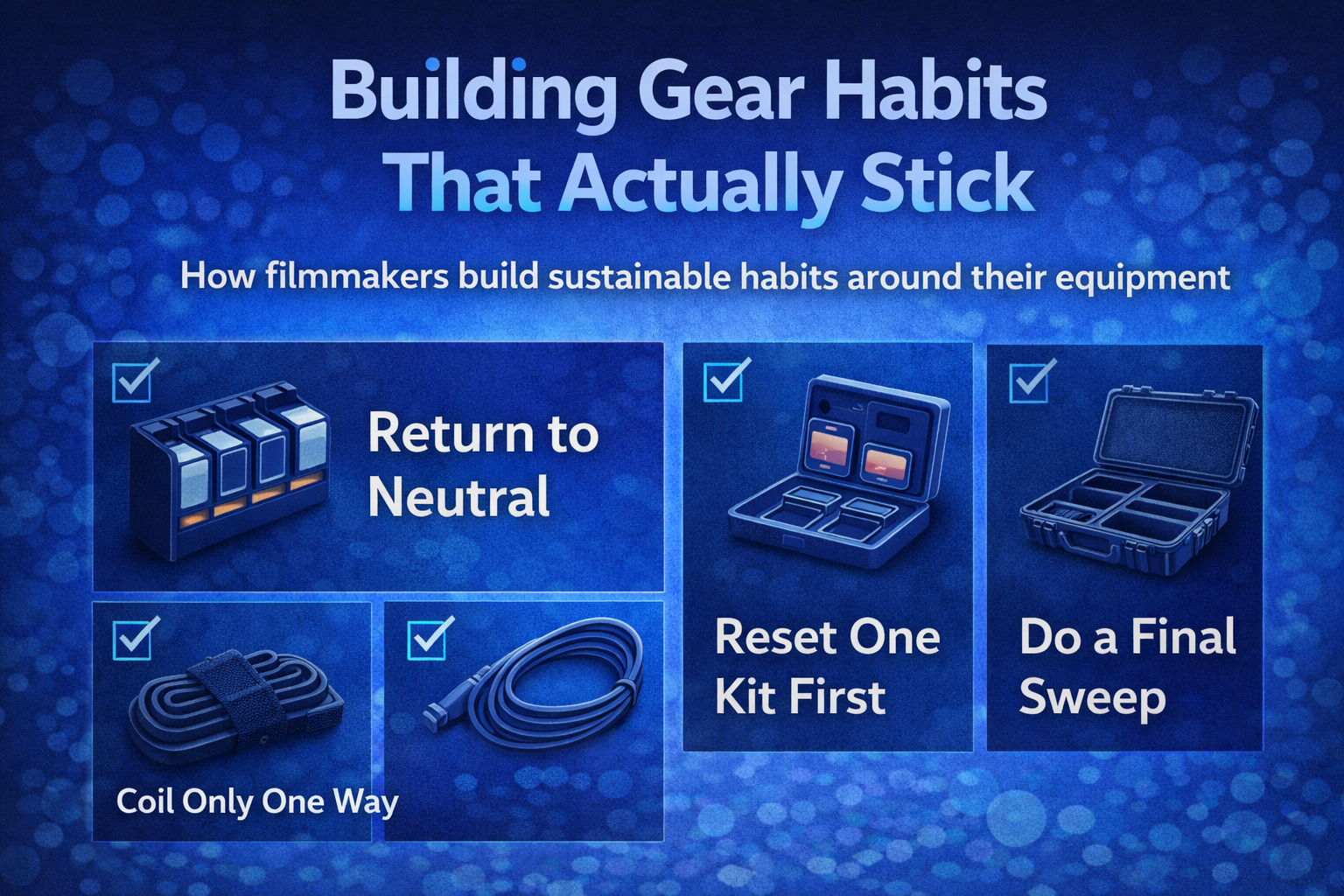
Building Gear Habits That Actually Stick
Why organization only works when it becomes part of how filmmakers move, not just how they clean up
Reorganizing your film gear can feel satisfying.
Cases get reset. Cables are wrapped. Everything has a place again.
And then—weeks later—it quietly unravels.
This isn’t because filmmakers are careless. It’s because organization alone doesn’t change behavior. Systems that don’t account for how people actually work tend to collapse under pressure.
This companion piece isn’t about better labels or smarter cases. It’s about how filmmakers—students, educators, and independents alike—build gear habits that survive real shoots, real schedules, and real fatigue.
Why Organization Fails Without Habits
Most gear systems are designed for ideal conditions.
Calm environments. Plenty of time. Full attention.
But filmmaking rarely happens there.
On real shoots, gear is handled when:
- time is short
- people are waiting
- decisions are stacked
- energy is low
In those moments, habits—not intentions—take over.
If a system requires extra steps, memory, or discipline, it will be bypassed.
Habits Are About Motion, Not Motivation
Many filmmakers assume habits require willpower.
In practice, habits form around movement:
- where gear naturally lands
- what happens immediately after a shoot
- how things are packed under pressure
Strong gear habits reduce the number of decisions required.
Weak habits ask you to “remember” to do the right thing.
Remembering is unreliable. Motion is not.
The Most Durable Gear Habit: Returning to Neutral
Professional crews often share one unspoken rule:
Gear returns to neutral.
Neutral means:
- batteries either charging or clearly dead
- cards either empty or clearly labeled
- cases packed the same way every time
This habit matters more than neatness.
It creates a predictable starting point for the next shoot—even if that shoot is weeks away.
Why Small Habits Beat Big Systems
It’s tempting to design elaborate organizational systems.
But complex systems break down when conditions aren’t perfect.
Small habits survive because they’re repeatable:
- wrap cables the same way every time
- store cards in one orientation only
- reset one kit before touching another
These habits don’t require motivation. They rely on consistency.
Teaching Gear Habits in Educational Settings
In film education, gear organization is often taught once—then assumed.
But habits need reinforcement.
When educators model gear habits intentionally, students learn:
- how to work under pressure
- how to collaborate respectfully
- how systems support creativity
This isn’t about control. It’s about teaching students how to stay oriented when stakes rise.
For Independent Filmmakers: Habits as Self-Support
When you’re working alone or in small teams, habits replace oversight.
No one is there to catch small mistakes.
Good habits do that quietly.
They protect you from:
- forgotten accessories
- dead batteries at the wrong time
- lost setup time
They don’t make work perfect. They make it survivable.
Optional Exercise: The Habit Audit
This can be used in classrooms, shared studios, or solo practice.
Step 1: Observe One Shoot (or Setup)
Don’t fix anything yet.
Just notice:
- where gear naturally piles up
- what gets handled last
- what gets skipped when time runs out
Step 2: Identify One Friction Point
Choose one moment that consistently creates stress or delay.
This is your entry point.
Step 3: Design a Habit, Not a Rule
Ask:
“What is the smallest repeatable action that would help here?”
Examples:
- reset audio before touching camera gear
- charge batteries before packing anything else
- do a final sweep before closing a case
Step 4: Test for Two Weeks
No perfection. Just notice if it holds.
If it fails, simplify it.
Why This Isn’t About Being Organized
This work isn’t about becoming a certain type of filmmaker.
It’s about supporting the filmmaker you already are.
Gear habits don’t make films better on their own.
They make it easier to show up ready to think, listen, and create.
A Closing Perspective
Reorganizing gear sets the stage.
Habits keep the stage standing.
When systems and habits align, filmmaking feels calmer—not because it’s easier, but because fewer small problems are competing for attention.
That quiet support is what sustainable creative work is built on.