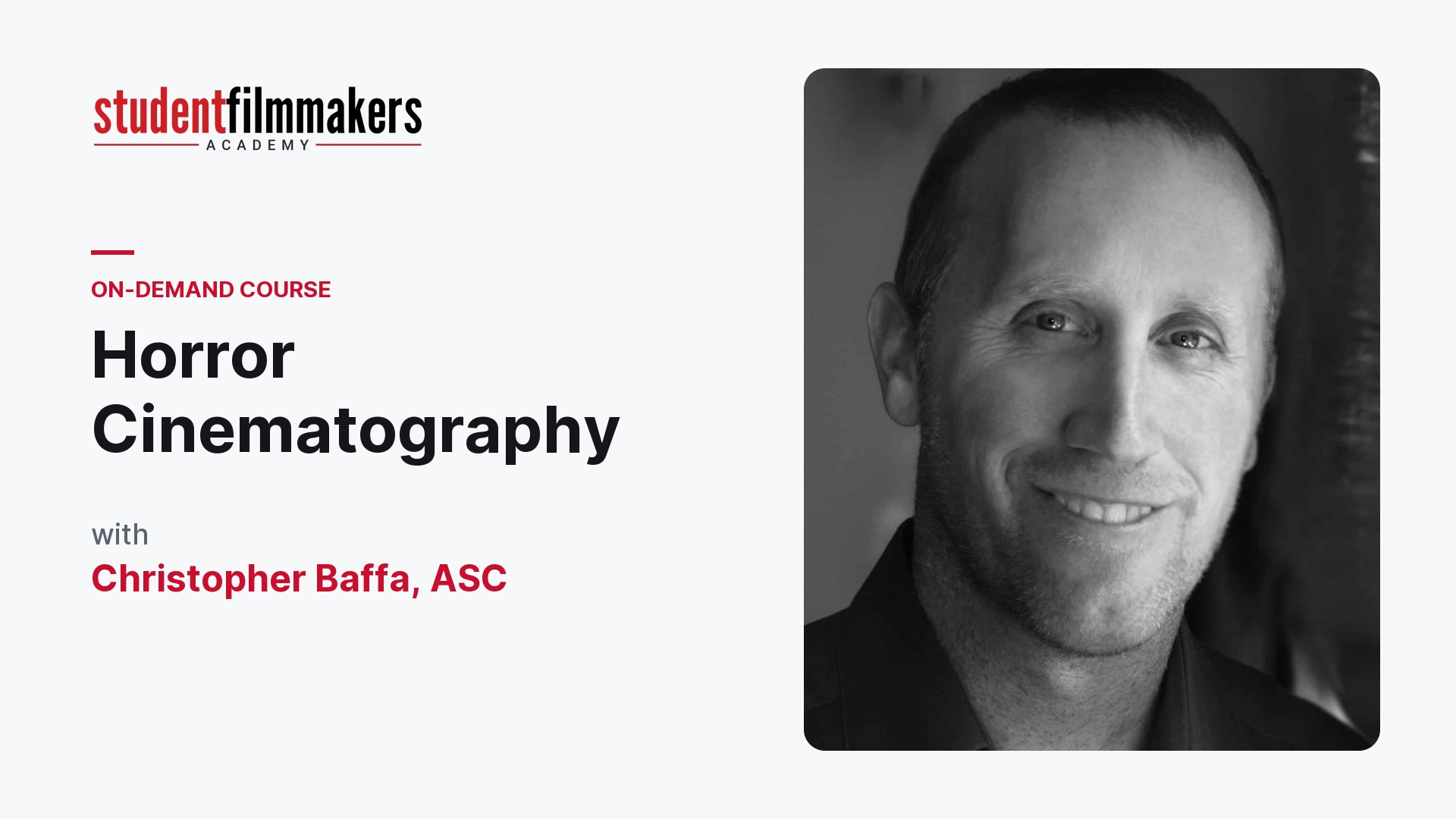
Christopher Baffa, ASC, shot the pilot of American Horror Story for Ryan Murphy, after shooting the pilots of Nip/Tuck and Glee. His lesson for horror cinematography runs against habit: a scary film does not have to hide in the dark, and a natural, believable world often makes the fear land harder. Teaching filmmakers live on Zoom, he traced a line from Nosferatu to his own basement scene and then took questions on shadows, soft light and strobes.
Why can a brightly lit scene be scarier?
Baffa started with the German Expressionist films, where blackness swallows the frame, and then pointed to the films that broke that rule. The shower in Psycho is lit brightly, so nobody is braced for what comes. The chest-burster in Alien happens at a white dinner table under full light, so every drop of blood shows. In Halloween, John Carpenter puts Michael Myers behind a bush in daylight.
His favorite example is The Exorcist, shot by his friend and ASC sponsor Owen Roizman. Hallways look like hallways and bedrooms are lit by their own lamps, and that is the point:
“By creating a naturalistic world the way he did, he allowed us a way in and accessibility to experience these events with the characters.”
Baffa’s word for this is accessibility. He learned it from Ryan Murphy on the Nip/Tuck pilot, where Murphy wanted the show stylized and sexy but real enough that an audience would connect with some very strange people.
How did the American Horror Story pilot find its look?
Only while building this class did Baffa notice how much of that history went into the pilot. He and Murphy agreed on “the Owen Roizman Exorcist route.” There is falloff, cool tones and the odd Dutch angle, but the darkness never goes beyond what a real room would have.
The Rubber Man scene shows how far they took it. The wife believes the figure is her husband, so they lit and covered it like a normal dialogue scene. The situation was eerie enough; the light did not need to announce it.
Michael Goi, ASC, who shot later seasons of the show, joined the class and asked a question. Baffa admitted he sometimes feels he played the pilot “a little too safe,” but Goi argued the naturalism built the audience that let later seasons get wild.
How was the basement flash scene lit?
Down in the basement, the problem was the Infantata, a creature with great makeup and wardrobe that might read as corny on screen. Baffa put it plainly:
“We just weren’t sure if they were corny scary, over-the-top scary, or great scare.”
They talked through silhouettes, glimpses of hands and odd angles. Murphy’s answer was flashes: total darkness broken by bursts of hard light, as if the fluorescent tubes were failing. Baffa admits real fluorescents could never do that, “but we were okay to push it.” Here is how it worked, as he remembers it:
- The lights: most likely a Unilux strobe system, the kind used for music videos and champagne-cork commercials.
- The control: gaffer Andrew Glover had a button. Hold it down and the light stayed on; let go and it went dark, like lightning.
- The placement: most units came from a cross or backlight angle, with one over the camera to wash out a wide shot for an instant.
- The shutter: left at 180 degrees. Baffa wanted as few variables as possible.
- The takes: some very strobing, some longer flashes followed by black, so Murphy could choose.
- The edit: editorial cut in black frames to stretch the dark and trimmed flashes that stayed on too long.
Why not add the strobing in post? It came up. Baffa felt the slight falloff of real light helped the audience believe it was flickering bulbs. He also admitted the nerves: “I didn’t sleep that night.”
What is a “healthy negative,” and why does it matter digitally?
Asked how to get a dark background without noise, Baffa went back to film-lab language. A healthy negative held detail even in the shadows, because you could always darken it later:
“Healthy negative meaning there was detail everywhere because you were always safe to go down. It was difficult to come back up.”
So a very dark movie is often a lit movie. There may be a light barely touching a corner so the colorist can keep a hint of it or crush it to black. Lifting shadows that were never exposed gives you grain on film and noise on digital.
Digital sensors cut the other way too. On his first digital job, the crew asked whether to reroute cables lying in a dark corner. “I said, no, we’ll never see that. And sure enough, next day’s dailies, I was like, oh, there’s my cables.” If you want true black, take the light away on set. Crushing too hard in the grade starts to damage the rest of the image.
For more on this side of the craft, see Daniel Villeneuve, CSC on lighting dark scenes and our piece on chiaroscuro lighting.
Can you control soft light in a dark, moody set?
Goi, a hard-light shooter, asked exactly that. Baffa loves soft light and says it is a real struggle in horror, since hard light can be cut with a flag and soft light spills everywhere. His habits:
- Use a harder source for the wide master, where the back wall matters, then bring softness back for the close-ups.
- Pull actors away from the walls to give the key grip room to flag.
- Pull furniture out, sometimes three feet, so a lamp on a dresser does not throw its own shadow.
- Ask the art department for darker walls before the shoot.
“I usually will go into a set and say, can everything be three shades darker because it’s going to be filled with light?”
For a stylized show he will go further and ask for an area to be painted black so only a lamp remains. He also wants wild walls, so the camera can sit at the end of a hallway with someone walking up it.
Should an actor ask the DP about the shot?
An actor in the class said he had been told to mind his own business when he asked about lighting. Baffa disagreed strongly. He told a story from Martin Landau, who did Tucker with Francis Ford Coppola and Vittorio Storaro, with dramatic light and a push into his face, and realized he had to do almost nothing. Then on Crimes and Misdemeanors, with Woody Allen and Sven Nykvist, the only coverage was a wide shot in a corner, so he had to do everything.
“Some actors like to know, hey, when you’re going to get into this, tell me. I’m going to hold back on the tears until we’re in a shot that you’re going to see the tears. That’s a pro.”
Baffa watches rehearsal closely. If a performance is going very big, he will simplify a big lighting plan so the two are not fighting each other.
Small choices from the Q&A
Eye light: a Kino Flo or similar tube wrapped in full grid, which gives a stripe in the eye rather than a dot. In a very dark close-up that stripe tells you where the eyes are, and losing the eyes means losing the performance.
Lenses: on early Roger Corman films there was one lens package, and everyone knew the chip in the 50mm showed up in the lower left corner. That taught him to make mood with light. Today he picks the sharpest glass and adds diffusion, so he controls how the image is softened.
A hike-in location with a few grips: take light control, not lights. Flags and solids for negative fill and to keep sun off a face, plus white material to clip on as a bounce.
Effects gags: if a monster is seen only by muzzle flash, or the camera must push through a bullet hole on a probe or snorkel lens, the DP needs to hear about it early. That gear is not on the truck.
And he gave sound its due: he has heard that The Exorcist mixed in bees in a jar, low enough that audiences felt uneasy without knowing why. Writers can find the story side of fear in Neal Bell’s horror screenwriting tips.
The full class includes Baffa’s tour of horror images from Nosferatu and Night of the Hunter to The Others, the basement sequence played start to finish, and the rest of the live questions.