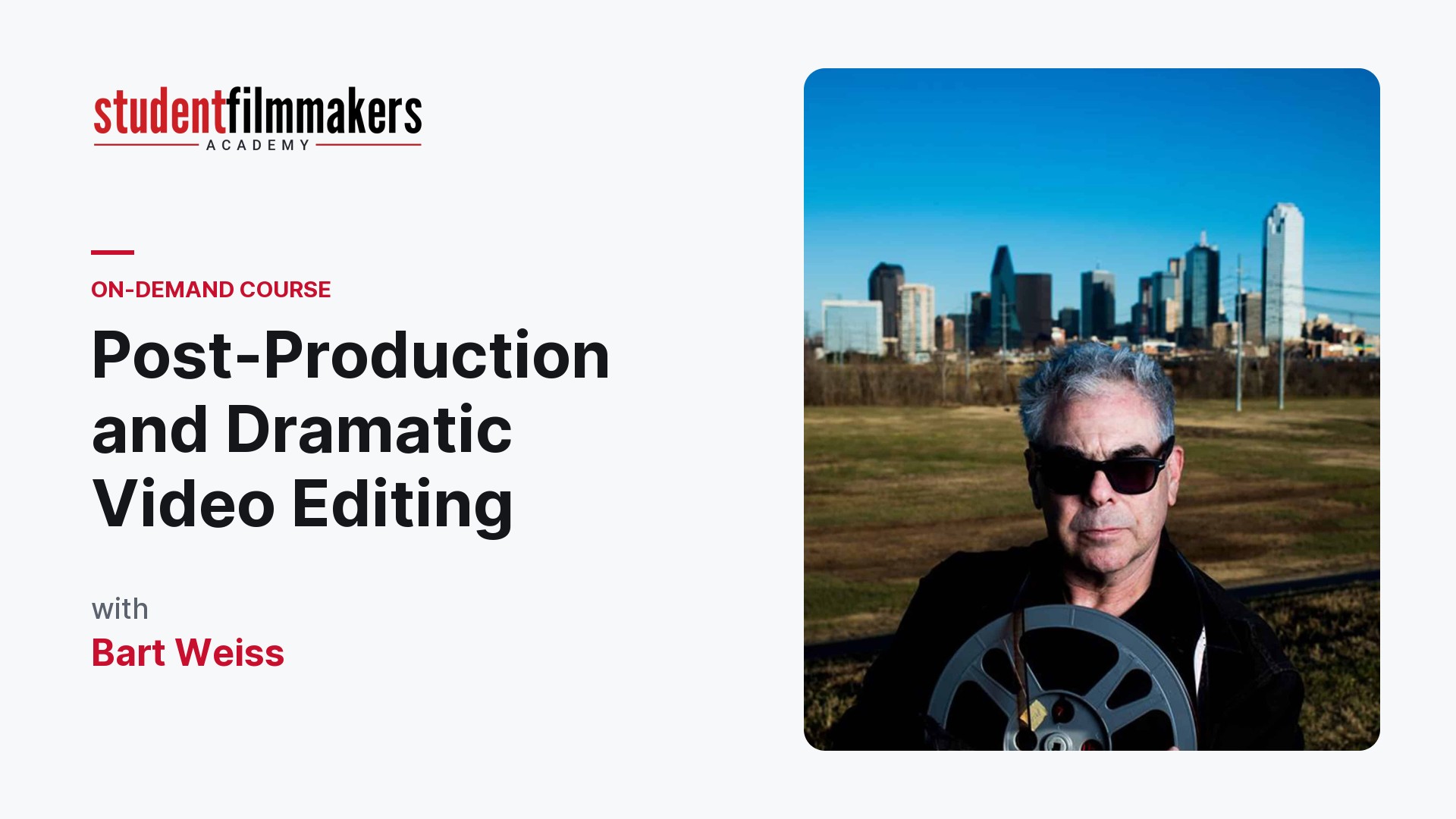
Bart Weiss, the filmmaker and longtime film professor who founded the Dallas VideoFest, edits every dramatic scene around one question: whose story is this, right now? In his class on dramatic editing for StudentFilmmakers, he walked from the first close-up of 1903 to a live recut of a scene from 24, and kept landing on the same point: cut for the feeling first.
Whose story is the scene telling?
Weiss calls this the idea he rarely sees in editing books, and he puts it plainly:
“In each film, in each scene, in each shot, ask yourself whose story is it and how do I show it?”
The answer decides your coverage choices. If the scene belongs to one character, then while the other person talks you may want that first character’s reaction, because their face tells us how they take what was said. If the moment belongs to the speaker, you stay on them, because their words are their view of the world. The answer can change partway through a scene, so he checks it at every point on the timeline.
He showed this on a scene from the TV series 24. Edgar, a loyal, hardworking character, questions a woman named Marianne about why she needs a level three clearance. She answers that she intends to get ahead. Played as Edgar’s scene, you set her up early as trouble and then cut to his face each time she annoys him. Played as Marianne’s moment of rebellion, you give her the close-up for the line. Weiss swapped her line in the two-shot for her close-up, and the whole feel of the exchange shifted. He also pointed to a small eye roll in her close-up that could be used early to show who she is.
What is a ripple overwrite, and why use it for drama?
Most edits are three-point edits: you mark two points on one side and one on the other. For the 24 swap, Weiss marked four: an in and out on the close-up, and an in and out on the timeline section it should replace. A plain overwrite or insert can’t honor all four marks. A ripple overwrite can, replacing the section and adjusting the timeline to the new length. For cutting dramatic dialogue, he called it the best tool for the job.
But he warned against starting with the buttons. Before marking anything, decide what matters in the scene. The marks come after the choice.
How should you watch your dailies?
Not just for which take is best. Weiss looks for moments inside each take: a head tilt in take two, a line reading in take four. “One way to think about editing is to get the best performances from each take to create a performance of the whole scene.”
To keep track of those moments, he adds a marker with a note, or makes a subclip. In most editing systems you mark an in and an out and choose “make subclip” from a menu or a shortcut; in Resolve you can drop the marked section into the browser. Then name the subclip after the great line or gesture, so when you scan scene two later, the moment is waiting for you.
And when an actor praises the finished scene, he says, don’t mention that you built that performance in the edit. You want to keep working.
How do Walter Murch’s six rules rank?
Weiss urged everyone to read Walter Murch’s In the Blink of an Eye, which he described as theory rather than a recipe. Murch ranks what makes a good cut and gives each a weight. Here is how Weiss walked through it:
| Murch’s criterion | Weight | Weiss’s note |
|---|---|---|
| Emotion of the moment | 51% | The best performance of that emotion comes first |
| Advances the story | 23% | A nice moment that doesn’t move the story still goes |
| Rhythm | 10% | Tap the scene out with a pen, or say it as “da da da” |
| Eye trace | 7% | Where the eye leaves one shot and enters the next |
| Two-dimensional screen plane | (lower) | The 180-degree rule; break it only on purpose |
The eye trace number is the one that humbled him. As a student making dance films, he would put a finger on the screen where the energy of one shot ended and slide the next shot until it lined up. He spent about half his attention on that. Most student filmmakers do the same, he said, when the real weight sits with emotion.
A student asked about cutting the dialogue audio first for pacing. His worry is that you end up cutting to the script, placing lines instead of reading the actors’ eyes. His answer was to do both, but to keep emotion at the top of the list.
How do you know a cut is too long?
Weiss calls it the remote question. Picture a viewer at home with the remote. If you hold a shot you love for twenty more seconds than it needs, “that person’s thumb is going to get right next to their remote control and they’re going to watch something else and you’ve lost them.”
The fix is to show the cut to someone whose opinion on film you value, and sit beside them. They don’t need to speak. He feels the problem as anxiety, in the back of his head, and writes the time down. Then comes a tip that surprises people:
“Oftentimes, it’s not that moment when I feel the problem. It’s the moment before that that set that moment off.”
He backs that up with Sergei Eisenstein’s line that editing is the ruthless suppression of the inessential, and says the key word is ruthless. When he asks students why a shot is there and they don’t know, his advice is simple: “If it is not essential, you should cut it out.”
What does a festival short need in its first minute?
A strong open. A festival screener may watch 25 shorts in a sitting, and yours could be number 24. Great first 30 to 50 seconds wake that person up. Music matters most of all in a short: “If I don’t like your music, there was zero chance I’m going to like your film.” If test audiences don’t respond to the track, try another one. He also suggests half an hour on the Art of the Title website before designing a title sequence, and leaning on the rule of three: show something once, twice, and on the third time let something change.
A 25-second vertical recut
For the 25th anniversary of The Sopranos, each 40- or 50-minute episode was cut into a 25-second vertical video. Weiss gave his own students the same task in the middle of a project: stop, and remake it in 25 seconds, vertical. It forces you to find what the piece is about, which audio to keep in sync, and how to reframe a story for a tall screen.
Editing history worth watching
Weiss’s quick tour gives you a viewing list: Edwin S. Porter’s The Great Train Robbery (the first close-up) and Life of an American Fireman, Griffith’s Intolerance, the Kuleshov experiment, Dziga Vertov’s Man with a Movie Camera, the breakfast montage in Citizen Kane, the bone-to-spaceship cut in 2001, the baptism in The Godfather, the chase in The French Connection, and the match-to-desert cut in Lawrence of Arabia. He also recommends the documentary The Cutting Edge before your first project.
On software, he says there is no single winner. Learn Avid if you want Hollywood work, since it handles teams and shared media best. Premiere ties in with After Effects and Audition. He likes Resolve, which is free and keeps its rooms one click away. And he treats every shot that isn’t in sync as elastic: you can stretch it, slow it, reframe it or flip it, as long as no text or hair part gives the flip away. If you’re starting out, see our guide to cutting a first short with free software, and for more on story-first cutting, film editing and the narrative through-line. Weiss also spoke with us in an earlier Zoom Q&A interview.
The full class includes the whole 24 demonstration, the history of editing from the guillotine splicer and Steenbeck to Final Cut Pro X, and questions from filmmakers, including how long one page of dialogue should take to cut (a first rough cut in about 30 minutes).