By Scott Essman
Writer-director Marc Lawrence drew on his own college years to write The Rewrite, starring Hugh Grant. He talks about writing and directing the film.
Based in part on his own college education at the State University of New York at Binghamton, writer-director Marc Lawrence crafted the new film, The Rewrite, in which Hugh Grant’s character, a washed-up screenwriter, takes a teaching job at the same SUNY school. “I’ve had this thought about writing this story of a fallen screenwriter for a while.” Lawrence said from his New York base. “Something that had been percolating. I’m interested in that whole argument of whether you can or can’t teach creativity.”
In the story, for which Lawrence noted “the timing was right,” Grant’s Keith Michaels, a one-time Oscar winner, is so bereft of work, he is forced to take a temporary professorial residence at Binghamton – which The Rewrite’s script notes is the top publicly-funded university in the northeastern United States despite its rustic surroundings.
“Binghamton was a backwater place where his initial reaction was to sort of slowly let the colors seep in, and the romance becomes apparent to him,” Lawrence noted of his film, lead character, and plot.
After Lawrence pitched the story directly to Grant, the actor gave him a verbal commitment, putting in motion their fourth feature collaboration. “Hugh said, ‘Sounds good,’” Lawrence recalled. “It’s always based on how he reacts to the script. Once Hugh said, ‘Yes,’ we were off and running.”
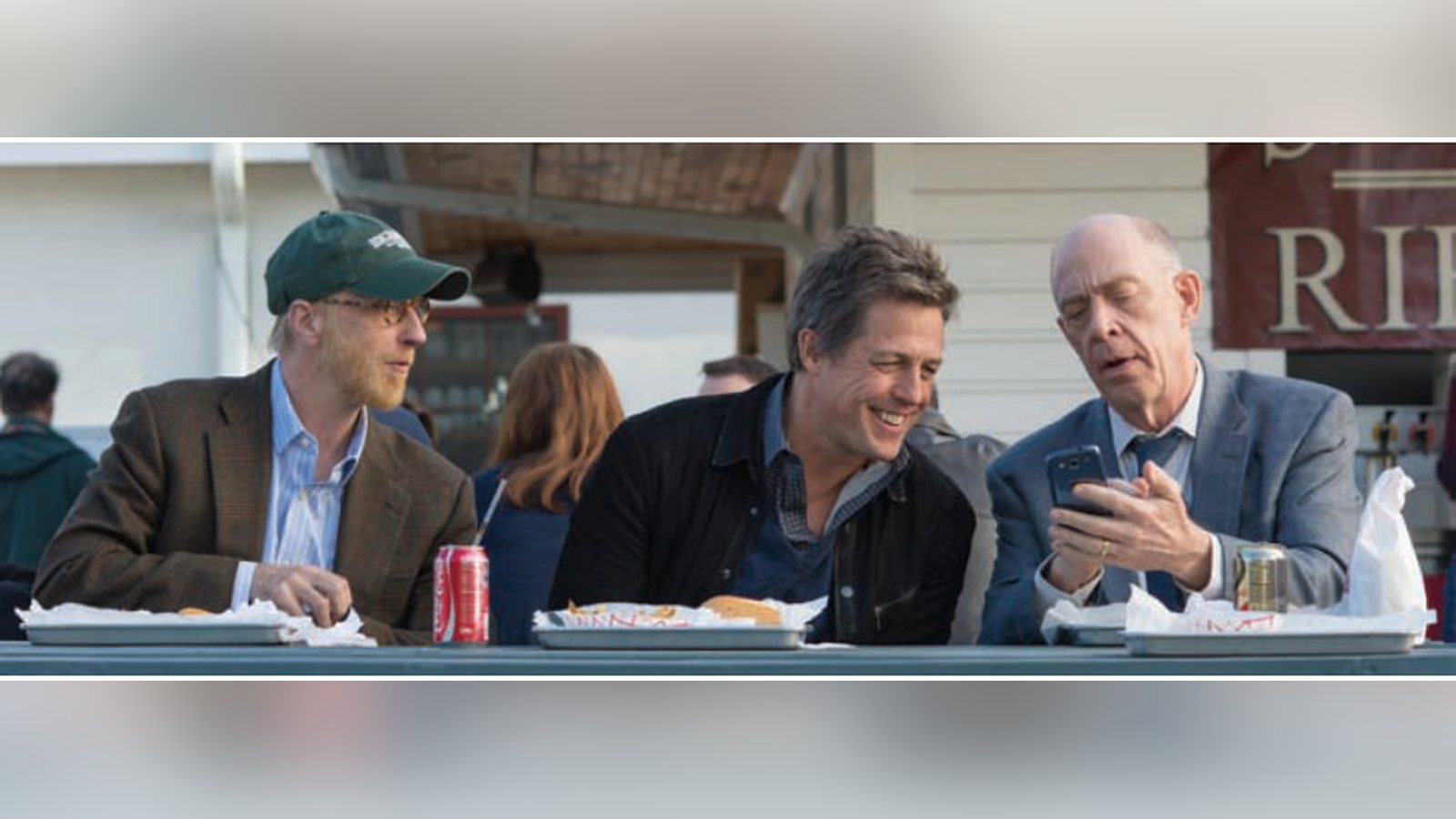
With Grant on board, Lawrence lined up Castle Rock who put a deal together. Lawrence then brought in notable supporting players Marisa Tomei, J.K. Simmons, Allison Janney, Chris Elliot, and many new faces portraying Grant’s disparate group of youthful screenwriting students. “It was not a bigger studio film,” Lawrence reflected. “We didn’t have to go through a lot of layers or echelons. I have been doing films for them since Miss Congeniality [which he co-wrote and executive produced].”
After the Lawrence-Grant creative partnerships on Two Weeks Notice, Music and Lyrics, and Did You Hear About the Morgans?, Lawrence approached The Rewrite as a simpler project. “We wanted to keep it very small compared to the other films we’ve done together,” Lawrence confessed. “It’s a micro-budget. It was relatively easy at that budget — with Hugh committed and Marisa — to get it going. We wanted to keep it small, story-wise.”
As with most smaller films, The Rewrite’s 28-day production schedule mandated several production challenges. “We wound up, because of the bizarre logistics of movie financings, [that] it was prohibitive to shoot it all at Binghamton,” Lawrence related. “It would have blown apart the budget. We shot [there] for only four days, and what we got was exteriors. We shot the rest at the campus of C.W. Post [on Long Island, New York, Lawrence’s childhood home].”
During a screening at SUNY Binghamton with Grant in attendance, Lawrence noted that they were predictably playing to a guaranteed audience of devotees. “Any view of the campus received a standing ovation,” Lawrence recollected. Additional shooting took place in Brooklyn, Queens, and in Manhattan on soundstages at the Javits Center.
Of working on as fast a pace during principal photography as he ever had on a film, Lawrence professed that it energized his cast and crew. “The actual shoot was really terrific,” he detailed. “I like working at that speed. Time can be wasted when you are working at a bigger budget. You’ve got to get three-and-a-half to five pages a day instead of two pages a day. It was the first time I made a movie [at that] budget. It was an enormously pleasant shoot.”
Lawrence noted his being pleased with the final results. “I think the cast is so good, that once we got that group of people together, we were going to be in relatively good shape,” he said of his key players. “Your chances of it being interesting and enjoyable are fairly high. I was excited to go out and do it. I’m pretty pleased with it; it’s hard to ever talk about your own stuff.”
Related filmmaking guides
- 7 advanced screenwriting tips
- 40 basic plot points for a feature film
- How to write a short film script
Keep learning filmmaking
Want more lessons like this? Join StudentFilmmakers free for live webinars with working pros, and stream on-demand filmmaking classes in cinematography, directing, screenwriting, sound and post.