By John Hart
Storyboard artist John Hart shows how one-point perspective makes storyboards and shots more dynamic, and why it is the first perspective skill to learn.
Having taught one and two point perspective for many years at many schools, I know that perspective is the biggest challenge for most students in learning to draw. In this article, I have tried to simplify that challenge.
Here are some visual shortcuts to help you utilize this invaluable tool that will also give added depth to your shots and setups. These examples are adapted from storyboard sketches. The main objective is to convince you to visually utilize one-point perspective – just one-point for now – as two-point perspective is mainly for shooting into corners – rooms or buildings.
Just by simply being aware of the possibilities it will offer, one-point perspective will add dynamism to shots. If you scout hard enough, often selected locales will already have this ‘depth of field’ advantage waiting to be used by the director.
My main emphasis is to convince you to make use of this invaluable visual tool: perspective. For each of the following examples, there will be simple interpretations given, and each will illustrate basic observations that will enhance your own personal ‘visual field’ or director’s vision.
You should then be convinced to incorporate into your shots one-point perspective for increased three dimensionality, and true depth of field within your framed scenes.
In Illustration 1, notice how the foreground/background separation of planes adds to the depth of this shot. The lines on the building to the couples left also give great depth to the shot.
If you followed the line of the overhang about left and the grey railing, they would converge to a point just the other side of the guy’s head, just above the distant shore. That point is called the vanishing point (V.P.), and all the lines coming toward the foreground plane will emanate from that point.
Take a look at Illustration 2. Just by observing how each circle recedes into space, in other words, getting smaller, takes Illustration 1.
Illustration 2 the view deeper into the scenes. It is not a flat scene. Picture two actors in the foreground.
Here in Illustration 3, if your eye follows the lines of the boards, they will all meet at a distant point on the horizon. Here, at vanishing point (V.P.) will be just to the left of the Dad’s head on the far shoreline. Great depth in this shot.
Now, try a close-up of the child reacting to all that space.
In this shot in Illustration 4, the foreground does have a character occupying the frontal plane. The large building in the background recedes into space. The V.P. for the building would be just above the top of the yellow boat in the right background. From that point, all lines on the building with its blue shutters would converge to that one V.P. Note: Reds as in the balloon guy’s jacket also dominate the foreground and give added depth color-wise as the background is in dark browns and blacks. So, what’s wrong with spacial concepts?
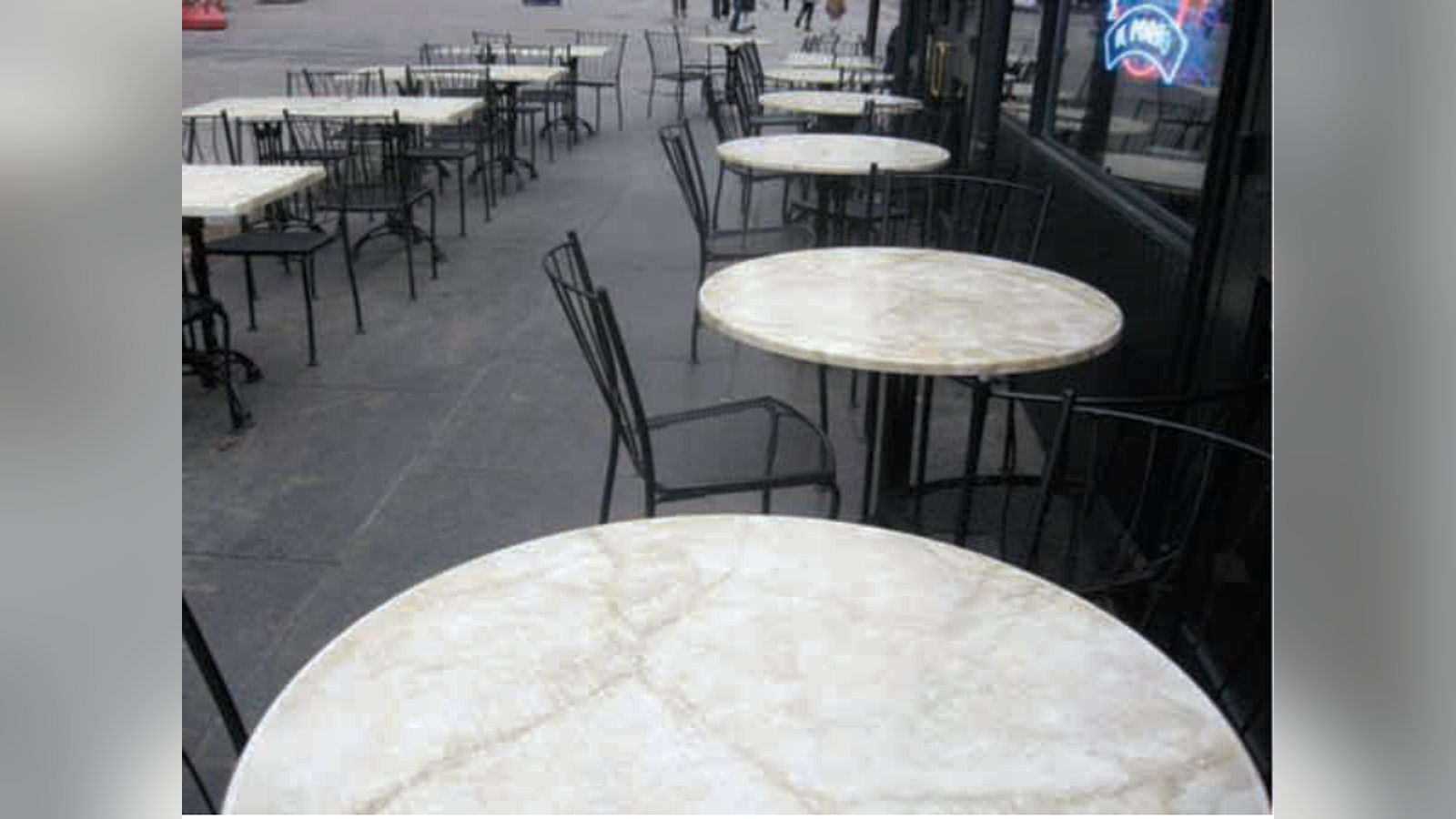
Another obvious reminder of how simple placement of objects in a scene can have added depth – piercing the frame like an arrow shot into the background. See Illustration 5. Place two figures in the foreground at the table. Great visuals and not distracting to the frontal plane action.
This setup / mise-en-scene in Illustration 6 speaks for itself. Can you find the V.P. there in the background? (Right in the center of the red railing.) Again, great recession of space for your shot.
Illustration 3 Illustration 4 Illustration 5 Illustration 6 Here in Illustration 7, the actor will be panned as he moves across the frontal plane, while the buildings in one point perspective add major depth to the shot.
This shot (Illustration 8) is an example of ‘atmospheric’ perspective. No orthogonals (receding lines to V.P.). Just horizontals and mood lighting. Late afternoon. Silhouetted windows in foreground frame push the eye into the background for true depth. Blue, the opposite of red, recedes into the background.
Ladies frame the foreground action in Illustration 9. Background is again simple horizontals, but the greys and pale blues in the water and sky act as receding planes of color, not lines. Note how the red jumps foreward. Main action figure is off-center to the left.
Here in Illustration 10, the railing takes the viewer’s eye directly into the background. The figure on the bike (off-center to the left of frame) will also take us directly into the V.P. – which is easy to find, as the railing points right to it in the out of focus background. A simple shot, but one that illustrates graphically the depth and three dimensionality that one point perspective can add to your shots.
John Hart is an award-winning author, lecturer, storyboard artist, graphic designer and photographer based in New York. His most recent book is called, “The Art of the Storyboard, 2nd Edition: A Filmmaker’s Introduction.”
Illustration 8 Illustration 9 Illustration 10 Illustration 7 If you’re passionate about creating great content, the NAB Show is the ultimate place to fi nd everything necessary to bring your vision to life. Experience a wealth of hands-on educational opportunities presented by the producers, directors and cinematographers infl uencing today’s edgiest content.
Visit the unparalleled exhibit fl oor to see, touch and test all of the technologies enabling HD and 3D. Here you will fi nd virtually every innovation driving production, editing, animation, gaming, widgets, social networking and more.
From big screen to small screen to no screen and beyond, professionals with creative passion come to the NAB Show to exchange solutions and strategies for developing award-winning content for local, national and global audiences. Join the community that shares your passion for creating excellence. For more information, visit www.nabshow.com.
GREAT CONTENT: it’s more than what you do, it’s who you are.
Conferences: April 18–23, 2009 / Exhibits: April 20–23 Las Vegas Convention Center / Las Vegas, Nevada USA
Keep learning filmmaking
Want more lessons like this? Join StudentFilmmakers free for live webinars with working pros, and stream on-demand filmmaking classes in cinematography, directing, screenwriting, sound and post.