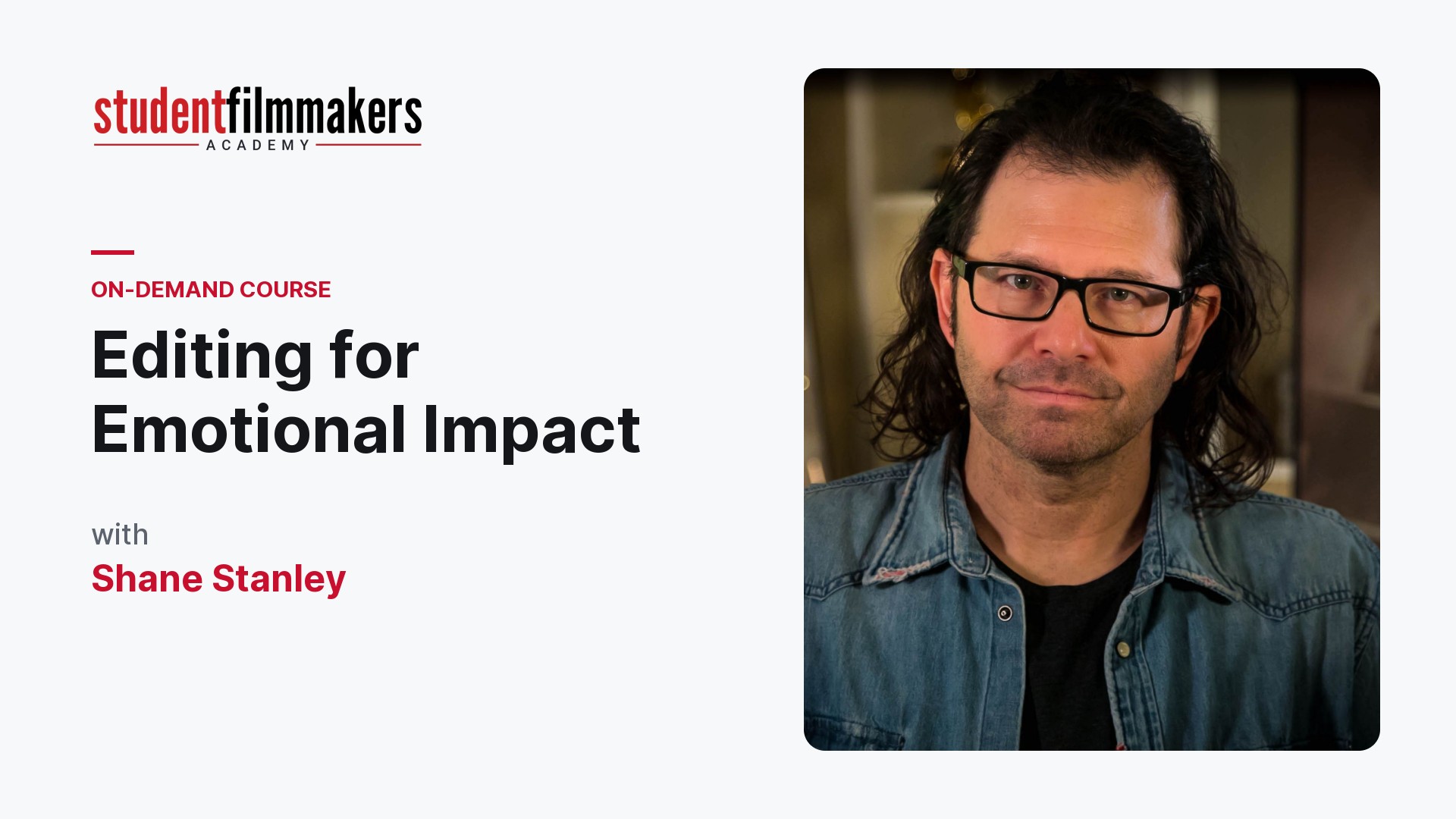
Producer-director Shane Stanley, an Emmy winner whose thriller Night Train topped the Hulu chart, says that of all his jobs, cutting is the one he truly knows. In a StudentFilmmakers class on editing for emotional impact, his core lesson came from a veteran editor who made him defend every cut: know why you leave one shot for the next, and look for the eyes.
Where did Shane Stanley learn to edit?
On his father’s Moviola. Lee Stanley cut his own 16mm documentaries, and by fourth or fifth grade Shane was being picked up from school and handed a clipboard: pull footage, splice for the editors, sync picture to sound. He jokes that he may be a hack writer and a hack director, but cutting became natural to him.
He explained the job with a line he repeats often:
“There’s three scripts. There’s the one that’s written, the one that’s shot, and the one that’s cut.”
His first big lesson in scale came in 1994, on one of his first shows cut on a nonlinear system: a documentary shot on five 35mm cameras, 47 hours of footage to turn into 90 minutes, with no script. He recommends documentary work to anyone who wants to learn to build arcs, because nothing is handed to you.
What does “stop, go back, why” teach an editor?
In the mid-1990s, still in his twenties and new to the editors’ union, Local 700, Stanley was the director’s pick to cut a $13 to $14 million action thriller for Miramax on an Avid. The studio executives watched some scenes and were not impressed. The next morning he was called upstairs, sure he was being fired. Instead he was told his cutting was fast but “something’s missing,” and sent to spend a day with an Academy Award-nominated editor who still worked on a Moviola.
That editor cut faster than anyone Stanley had seen on a computer. Then he came downstairs to watch Stanley’s first 20 minutes. After every cut: stop, go back, why? In an action film with thousands of edits, it was painful, but the point was to make him put his choices into words. With 24 frames in every second, why this frame to that one? Shot size? Eye direction? Ask what each cut does to push the story forward, the same way a writer asks what each scene is for.
“You are basically in the driver’s seat in post-production. You are deciding how fast or how slow a film is going to play.”
Hold on a moment, he said, and the audience has time to connect with it. Leave too soon and you deprive them, which is sometimes the right choice, but it should be a choice.
Why does eye contact matter in a cut?
At the end of that day, the veteran gave Stanley one piece of advice in two words: eye contact. For drama and emotion, he says, the eyes carry the scene. He compares it to cold reading in acting class: look at your scene partner, glance down at the line, find their eyes again, then speak. Cut the same way.
The common student mistake is to cut on every line: one person talks, cut, the other talks, cut. The script is good, so why is there no emotion? Because there is no flow. Overlap dialogue across picture instead of cutting the instant a line ends. For action, the rule changes: cut on the hits, and do not hold a falling body until it stops moving unless that fall ends the scene.
How should a cut sound?
When he finishes a scene, Stanley plays it and walks down the hall. He does not want to see it; he wants to hear it, like a conversation at the next table in a busy restaurant. If it sounds real and organic from the hallway, it is working. Then he comes back, mutes it, and watches. If the scene flows with no sound at all, he has a solid start.
He takes the same view of music:
“If you can make a scene play without music, and it touches the heartstrings, or it gets people excited, or, or, or, you’ve done a remarkable job.”
He assembles with no music. A real composer, he said, will tell you their job is to take what the filmmaker and editors built and give the audience just enough to tip over into the feeling. If you lean on temp tracks too early, you risk “temp-itis”: falling in love with borrowed music so that the composer’s original work disappoints you or gets boxed in. For action scenes, though, he will sometimes blast a playlist in the room while he works.
Is there a rule for pacing?
No formula, he told an editor in the middle of a cut. It is feel and instinct, and your first reaction matters most. But he offered two tools from his own learning:
- A metronome. When he was learning to cut drama, he set one ticking in the edit bay to settle into a rhythm and keep from rushing. He got the idea from his first film, which had a grandfather clock ticking in the background of a scene, so every cut had to keep the tick-tock honest.
- Musical arcs. He pointed to Neil Peart’s long drum solos, which pull an audience in with quiet before building, and to advice from drummer Tommy Lee: always push the chorus. Find the part of a scene that should lift and drive into it.
Even a tiny exposition beat, like someone picking up a letter before walking into the next room, sets tone for the long scene that follows.
What should you cut, and what should you keep?
Asked what to avoid cutting in a short film, Stanley pointed to an old reminder taped up in his edit bay:
“It’s not what you cut, it’s what you don’t cut.”
Let actors begin and finish their movements. He has cut more than 300 music videos and remembers when a network would reject a video with any shot longer than three seconds. That habit lives on in filmmakers raised on fast cutting. His question to them: what are you afraid of? If a moment runs out of gas, cut it. If you are unsure, show the film to people with no stake in it, neither friends nor enemies, and listen for where they get bored.
When a feature has to come down to length, trim dead air inside scenes before you drop whole scenes. As a writer, you learn a lot from watching which scenes go first.
Breaking the rules on purpose
On set, coverage goes from the master in toward close-ups. In the edit, he likes to break that order. Leaving a big sunset farewell scene, he dissolved into an extreme close-up of dollar bills hanging over a bar, making the audience wonder where they had landed. Rather than open a restaurant scene on the wide shot, start on a serving platter as a waiter picks it up, and let the camera follow it to reveal the room. Some rules of continuity and camera movement you cannot break, he said, but the edit room is the place to stretch. Just remember true establishing shots when the audience needs to know where it is, such as a jump from a house to a hospital.
Who should cut your film?
He counts the editor among the five things that make a low-budget film look bigger, with cast, cinematographer, sound and locations. A friend once made a beautiful $1.5 million film with Oscar-winning actors, then hired an editor with almost no credits. Stanley asked what she spent on the wrap party: about $15,000, money that could have paid an experienced cutter. If you are the storyteller and know how to cut, he urges you to cut your own work.
His tools: he prefers Adobe, also uses Avid and DaVinci Resolve, and says the software matters less than the cutting. What matters is calling your post house before you start so your files will translate. He also does his own dialogue editing and builds a timeline of at least 32 audio channels, once spending 45 minutes to find the right sound of a diesel bus pulling away.
Related reading: film editing and the narrative through-line, a beginner’s guide to editing and pacing and composer Joel Diamond on why scoring is not an afterthought. The full class includes his answers on reshoots, featured extras and when to show footage to your cast.